
September 3, 2026 - PBS News Hour full episode
9/3/2026 | 57m 46sVideo has Closed Captions
September 3, 2026 - PBS News Hour full episode
September 3, 2026 - PBS News Hour full episode
Problems playing video? | Closed Captioning Feedback
Problems playing video? | Closed Captioning Feedback
Major corporate funding for the PBS News Hour is provided by BDO, BNSF, Consumer Cellular, American Cruise Lines, and Raymond James. Funding for the PBS NewsHour Weekend is provided by...
September 3, 2026 - PBS News Hour full episode
9/3/2026 | 57m 46sVideo has Closed Captions
September 3, 2026 - PBS News Hour full episode
Problems playing video? | Closed Captioning Feedback
Where to Watch PBS News Hour
PBS News Hour is available to stream on pbs.org and the PBS app.
Providing Support for PBS.org
Learn Moreabout PBS online sponsorshipAMNA NAWAZ: Good evening.
I'm Amna Nawaz.
GEOFF BENNETT: And I'm Geoff Bennett.
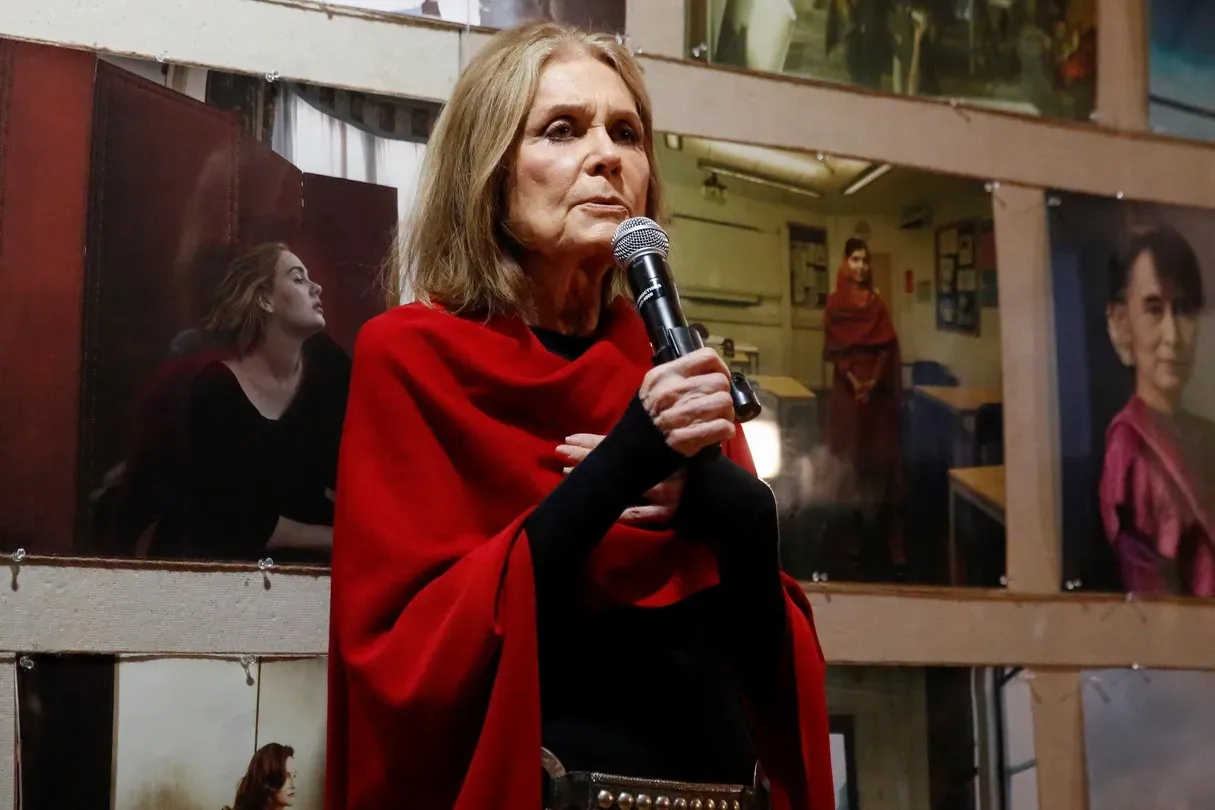
On the "News Hour" tonight: We remember feminist icon Gloria Steinem, a trailblazer who helped transform the fight for women's rights and equality and whose influence spanned generations.
AMNA NAWAZ: Shadow warfare.
NATO countries confront the threat of sabotage from Russia, while, on the front lines in Ukraine, a high death toll means more Russians could soon be forced to fight.
KIRILL MARTYNOV, Editor in Chief, Novaya Gazeta Europe: The goal of this war for now is continuation of the personal power of President Putin.
He needs to have more people on the battlefield.
GEOFF BENNETT: And we speak with Shiyazh Pete about his quest to become the first Navajo player in the NFL.
SHIYAZH PETE, Football Player: To represent my community in the best light possible, it's been a privilege, to say the least.
(BREAK) GEOFF BENNETT: Welcome to the "News Hour."
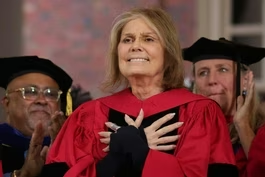
Gloria Steinem, the pioneering journalist and fierce activist who was an icon of the women's liberation movement, has died at the age of 92.
AMNA NAWAZ: For more than half-a-century, Steinem challenged entrenched ideas about gender and power, helping bring the fight for women's equality from the margins of American life into the mainstream.
Jeffrey Brown has this remembrance.
JEFFREY BROWN: For more than five decades, Gloria Steinem was one of the most prominent faces of American feminism.
A trailblazing journalist, political activist, and public intellectual, she helped lead a movement that revolutionized both the professional and personal lives of women across the country.
GLORIA STEINEM, Journalist and Activist: We have marched for every other movement that exists, and we worked for everything else except ourselves.
And now to see women supporting other women and standing up for their own rights is really very, very moving and gratifying.
JEFFREY BROWN: Born in Toledo, Ohio, in 1934, Steinem overcame a tumultuous childhood, which included her parents' divorce and taking care of her mother for many years.
She graduated from Smith College in the late 1950s and soon moved to New York to begin a career as a freelance journalist.
As a young writer, she famously went undercover as a Playboy Bunny for "Show" magazine, exposing exploitation and sexual harassment.
GLORIA STEINEM: You had to have an internal physical exam, which they told us was a requirement of the food servers in New York state.
JEFFREY BROWN: She became a columnist for "New York" magazine and established herself as a leader of so-called second-wave feminism with thoughtful and often pointed commentary.
She also covered the fight for abortion rights, a topic that hit close to home, as she told the "News Hour" in 2019.
GLORIA STEINEM: I would have had a profoundly different life if I had been responsible for rearing a child.
I had had an abortion in England.
It allowed me to live my own life, not to marry someone for whom I would have been the wrong wife and he would have been the wrong husband.
JEFFREY BROWN: She also said the fight for reproductive rights was a catalyst for her own career in activism.
GLORIA STEINEM: And I began to see what, of course, the radical feminists were saying in the first place, which was that it is a caste problem and that women are an oppressed group.
And then, finally, I understood that, even though I was not married living in the suburbs, that it was a problem that affected absolutely every woman.
JEFFREY BROWN: In the early '70s, Steinem co-founded "Ms."
magazine, a radical break from traditional women's publications.
With a masthead made up entirely of women, it tackled topics like sexism, harassment, and equal pay, and became a clearinghouse for some of the biggest names of the women's liberation movement.
GLORIA STEINEM: It started, in desperation, I think, because there were just a great many women writers and editors who didn't feel that they were working on magazines that they read and that they had the opportunity to really be honest about their own experiences in a magazine.
Shirley Chisholm has not got the depth and breadth of the coverage she deserves.
JEFFREY BROWN: As a political activist, she worked to elect women to office and was a co-founder of the National Women's Political Caucus, traveling the country, speaking out against sexism and economic exploitation.
GLORIA STEINEM: It's the kind of blue-collar working woman who needs these reforms the most, I think, and also poor women and welfare women.
But it's -- I think it really is going forward on all on all levels at once, and it's an important bridge between black women and white women.
JEFFREY BROWN: She remained a prolific writer, a bestselling author, and prominent public speaker for much of her long life, advocating for women's rights internationally, opposing apartheid, and campaigning prominently for Democrats, including Hillary Clinton.
Along with others in the movement, she helped solidify gains that many these days may take for granted.
Still, when she spoke with Judy Woodruff in 2020, she said she felt it much remained unfinished.
GLORIA STEINEM: We have the right to vote.
We still don't fully have the right to our own bodies.
Many women are still subject to bodily invasion at a rate far exceeding that of men.
I think we have yet to understand the rights that the female half of the human race need as females.
JEFFREY BROWN: She condemned the Dobbs decision in 2022, which overturned abortion rights.
GLORIA STEINEM: I'm old enough to remember before there were any real abortion rights.
Nonetheless, about one in three American women had had an abortion at some time in her life even when it was maybe not legal.
JEFFREY BROWN: And as she told Amna in 2020, she felt each person could be part of the fight for equality.
GLORIA STEINEM: I just want to say that we should stop asking passive questions.
I mean, it's not what will happen, what should happen, what -- it's, what am I going to -- what are we going to do?
And that means tomorrow morning what are we going to do?
JEFFREY BROWN: Steinem, who in her trademark aviator glasses became nearly synonymous with women's liberation in the media, was not without her critics.
In the late '80s, black feminist Alice Walker resigned as a contributor from "Ms."
Magazine, citing a lack of diversity on staff and in its pages.
And Steinem had a major falling out with Betty Friedan, herself a towering figure in the movement and an erstwhile ally.
They battled over many issues, including Steinem's critiques of men and traditional marriage, which Friedan could be counterproductive.
Through it all, Steinem emphasized she was just one part of a much larger struggle, as she said before receiving the Presidential Medal of Freedom in 2013.
GLORIA STEINEM: I'm grateful to have the opportunity to say here that I would be crazy if I didn't understand that this was a medal for the entire women's movement.
JEFFREY BROWN: Over the years, Steinem dated a number of prominent men, including director Mike Nichols.
She married briefly later in life but had no children.
Today, tributes poured in from across the globe, including from Oprah Winfrey, Jill Biden, and Hillary Clinton, who called her one of the architects of the entire structure of women's equality.
In a 2015 interview for her memoir, I asked what advice she'd give young women today.
GLORIA STEINEM: Here's my advice.
Do not listen to me, really.
(LAUGHTER) JEFFREY BROWN: Do not.
GLORIA STEINEM: No.
I want to support their listening to themselves.
Each of them has things that they love, things that they do that they love so much.
They know their own life and situations.
I'm here to support that and say, you're not -- OK, you're not more important than somebody else, but you're not less important either.
JEFFREY BROWN: Gloria Steinem was 92 years old.
For the "PBS News Hour," I'm Jeffrey Brown.
AMNA NAWAZ: For more now on the life and legacy of Gloria Steinem, we're joined by Julie Taymor.
She's director of the 2020 film "The Glorias," a biopic that spanned eight decades of Steinem's life.
Julie, welcome to the "News Hour."
Thanks for being with us.
JULIE TAYMOR, Director, "The Glorias": Thank you for having me.
AMNA NAWAZ: So I saw you smiling there as you were hearing Gloria's voice and listening to her answers.
I just want to start with your reaction to the news.
What did you think when you heard the news that she had passed?
JULIE TAYMOR: Oh, well we knew she wasn't well, but it's such a terrible passing.
We need her right now.
We need that voice.
And I'm glad we're bringing out the film right now again, because you have to understand this woman was an extraordinary pioneer.
She really was.
And she was humble all the time, wasn't -- she never wanted her face on the cover of a magazine.
People would steal it and put it there.
She really -- she said things like: "Without me, there would still be a woman's movement."
She really was just an extraordinary person, a friend, and an inspiration for men and women.
AMNA NAWAZ: You once said, "I thought I knew her, but I didn't," when you began working on this film.
What do you think people might not have understood about Gloria Steinem?
What did you learn in telling her story?
JULIE TAYMOR: Well, I know the inner fears.
I know what she went through when she had to keep that power face on.
Even her little laugh at the end of things that she says for people when she's critical, she had to navigate that territory that many women do, especially leaders, where they don't want to come on too strong, but they have something strong to say and to do.
I also think the joy and what she and the other women of the time of her period of them working together was such a lesson that people have to see.
Most movies, they're about women who want to get a husband or have to get a divorce or dealing with an affair or clawing at each other.
And here was a woman and other women who really, really had a love affair with each other as they were working to make it better for all women all over the world.
I didn't know things about how she had learned about the talking circles in India.
I mean, there were many things in the book, but one of the things that was so great with her when I was making this movie was her openness to me doing things that were surreal, her inner journey, her inner story.
She was so supportive of me being the film director I am, dealing with real material in a - - sometimes with documentary, but sometimes in a surreal way, instead of saying, oh, I don't think that way.
She was extremely generous, had a great sense of humor, was gorgeous, and that didn't stop her.
You know, people always would say things like that.
But that was what was great about her, that she had a sense of style and knew how to simplify her dress.
And yet people loved her for how she was her.
She stayed true to herself.
AMNA NAWAZ: And she navigated so much, including, as we noted in that report from Jeff Brown, criticism from other women that were in part of that feminist movement.
You saw some of the concerns from people like Alice Walker, bell hooks, prominent Black leaders and thinkers who -- Alice Walker even leaving "Ms."
magazine for the lack of diversity there.
How did Gloria take that criticism and how did she handle it moving forward?
JULIE TAYMOR: Well, it's one of the scenes in the movie when a Black journalist says, how do you respond to the women's move - - the Black women's movement saying that the white women's movement does not listen -- does not include them?
And she said: "I wouldn't say anything.
I'd listen."
Now, the thing is that Gloria Steinem always had a Black partner, whether it was Flo Kennedy or Dorothy Pitman Hughes.
She was always working with women of various locales.
Dorothy, what was it -- Wilma Mankiller, the Cherokee chief, they were best friends.
This is the most important friend that she had who was an extraordinary woman, or Dolores Huerta, who I spoke to when I was doing this film.
But I heard that Alice Walker was a very close friend of Gloria.
So that might have been a period of time right there on "Ms."
She wasn't running "Ms."
by herself.
She was she was always part of a collaborative team.
But I know they were friends.
And Betty Friedan is an interesting thing.
I didn't put her physically in the movie, but I had Bella Abzug played, oh, God, Bette Midler -- perfect -- say you have to basically confront Betty Friedan.
And she says, I'm not going to do that.
If she wants to be the head of the National Women's Caucus, let her do it.
And they said, no.
So she wasn't really ever seeking conflict.
But she had to confront it sometimes.
And there - - obviously, there would be competition, like there's competition among men.
So it's not like every -- that women are going to be pristine and can get away with what's not essentially human.
AMNA NAWAZ: Julie, in the minute or so I have left, I have to ask you because you were with her in a couple of key moments, election night in 2016.
You were there with cameras.
You thought that you would witness her witnessing the first woman president in America, and then you followed her instead on the Women's March that followed that election.
What did you learn from her and take away from her in those more fraught moments?
JULIE TAYMOR: Yes, well, at -- we were at Samantha Power's apartment, the ambassador to the U.N., and there were 40 women from different countries there, and you watched the night go on as each of these women, these ambassadors, knew that it would be difficult for them, for the women in their countries.
The last person in that room that night before she went over to see Hillary was Gloria Steinem.
And these were her words: "We have to look at the upside of the downside."
And if there was any haiku for her spirit, that's how I -- that's what I get from her, which is always looking to, OK, don't be defeated.
Do.
Don't -- you have to act.
And then we did.
We took the documentary crew to Washington, D.C.
It's in my film.
The film has four Glorias, plus the fifth, the real one.
And to listen to her speak at that and say that this is what democracy is about it, it makes you cry right now.
It actually -- I haven't seen it today.
I saw it this summer.
It was being screened.
And I hope it gets screened now so people can really see her in action and understand her full life.
But she was a positive energy, positive force, and not just for women.
This is the thing.
It was about relationships between men and women, how to live in an equal society.
So, yes, yes.
AMNA NAWAZ: Julie, I know it's a tough day for you.
We can't thank you enough for taking the time to join us, Julie Taymor.
JULIE TAYMOR: Thank you very much.
GEOFF BENNETT: In the day's other headlines: The Trump administration is asking the U.S.
Supreme Court to lift a block on a plan to restrict mail-in voting just a day before the first ballots are set to go out for this year's midterms.
Under President Trump's executive order, the Postal Service could refuse to deliver certain ballots and force states to submit lists of eligible voters to an online portal.
A federal judge in Boston had paused the order last week.
Federal prosecutors are reportedly charging a U.S.
immigration enforcement officer with lying to investigators about the shooting of a Venezuelan man earlier this year.
That's according to the Associated Press and other news outlets.
The charges against Christian Castro mark a rare instance of the Trump Justice Department accusing a federal agent of breaking the law while on duty.
Castro was among thousands of officers who were part of an immigration crackdown in Minnesota earlier this year.
He was released from jail last week after Texas Governor Greg Abbott refused to hand him over to Minnesota authorities to face charges there.
Also in Minneapolis, prosecutors say the gunman who carried out a deadly shooting in an apartment building yesterday had been investigated by police in June, but was not charged.
At a briefing today, officials identified the man as 35-year-old Carlton Johnson, saying he had a legal permit to carry the gun.
Court documents say he was facing eviction and had threatened a fellow resident in the months before the shooting, in which two people were killed and five others were injured.
That's according to police officers.
The shooter was later killed by police.
Billionaire investor Leon Black is defying a congressional subpoena to address his ties to the late sex offender Jeffrey Epstein and is instead suing the House panel.
Black is asking a federal court to block two subpoenas, one that calls for him to produce nondisclosure agreements and other documents and another for his appearance itself.
In a statement, his lawyer accused the committee of being on a -- quote -- "fishing expedition" that oversteps its authority.
House Oversight Committee Chairman James Comer, who was named in the suit, accused Black of hiding behind litigation.
REP.
JAMES COMER (R-KY): I would hold him in contempt right now.
Of all the powerful billionaires and political people we brought in for interviews and depositions, this is the first time anyone's filed suit.
GEOFF BENNETT: The top Democrat on the committee, Congressman Robert Garcia, is calling for Black to be held in contempt.
Black denies any wrongdoing.
The jury in Lindsay Clancy's murder trial ended a sixth day of deliberations without a verdict.
Today, her defense attorney called for the removal of a single juror who is said to be holding up a verdict.
The judge refused the request and once again urged the jurors to keep trying to reach a unanimous decision to avoid a mistrial.
The jury is deciding whether to hold Clancy criminally responsible for killing her three children in 2023.
Deliberations are set to resume tomorrow.
Turning now to the Middle East, Iran fired on Kuwait today as part of its retaliation for U.S.
bombings earlier this week.
Kuwait says its air defenses intercepted the missiles and drones.
U.S.
allies Jordan and Bahrain say they also intercepted attacks yesterday.
Meantime, in Southern Iran, hundreds gathered for the funeral today of four of the victims from a reported U.S.
airstrike that hit a wedding.
At a White House press briefing today, Vice President J.D.
Vance said the U.S.
is investigating the incident and said the military never targets civilians.
J.D.
VANCE, Vice President of the United States: We never will do that.
We never have done that.
And, unfortunately, obviously, sometimes things happen.
When our military makes mistakes, they learn from them to try to get better from them.
GEOFF BENNETT: Vance was also asked if the war would be over by the November midterm elections.
He responded by saying that he -- quote -- "wouldn't call it a war" and said it depends on Iran's actions.
In Thailand, sailors and Marines from the USS Lincoln are finally on dry land following their long deployment in the Middle East.
Some 5,000 service members streamed into the beach city of Pattaya by bus after more than nine months at sea.
Multiple media reports had raised concerns about poor living conditions aboard the ship, though military officials and President Trump largely dismissed those reports.
One sailor's mother flew all the way from New Jersey for an emotional reunion with her daughter.
SHAKEIRA FAIRFAX, Mother of USS Abraham Lincoln Soldier: I just can't wait to see her smile.
I can't wait to hear "Mom."
I know that's the first thing she's going to say.
I can't wait to hear her say "Mom."
GEOFF BENNETT: The crew will enjoy several days of R&R in Thailand before their weathered ship is scheduled to resume its journey home to San Diego on Sunday.
In Nepal, thousands of displaced people are struggling to access essential supplies after last week's devastating floods cut off major access routes.
Residents in some of the worst-affected areas are using temporary zip lines to cross a major river after flooding damaged bridges and roads.
Meantime, search-and-rescue efforts are increasingly focused on tunnels at several hydropower projects, where authorities believe some workers may still be alive sheltered by pockets of air.
One worker who managed to escape as the disaster hit described the ordeal.
DHAN BAHADUR TAMANG, Survivor of Tunnel Flooding (through translator): When the flood came, I hung on to floating debris to keep my head above the water.
I felt like I was going to die.
There were so many people who had died there, and we could see bodies everywhere.
GEOFF BENNETT: Specialized rescue teams from India, China and the U.S.
are involved in the rescue efforts.
Officials say the death toll has risen to more than 1,200 people in Nepal and Tibet, with at least 4,700 others still missing.
Well, stocks on Wall Street rallied today as bond yields eased a bit more.
The Dow Jones industrial average jumped more than 600 points.
The Nasdaq rose nearly 1.5 percent.
The S&P 500 also ended sharply higher.
Still to come on the "News Hour": Russia considers calling up more soldiers, given the high death toll in its war against Ukraine; the NBA hits the Los Angeles Clippers with a record fine for circumventing the salary cap; and our "Settle In" podcast discusses the rise in Islamophobic rhetoric among politicians.
AMNA NAWAZ: Today, German police arrested two people suspected of attacking a weapons manufacturer in Munich.
The incident comes after Germany officially blamed the Russian government for another kind of sabotage attack last month, when armed drones came close to downing an aircraft as it landed in Leipzig.
GEOFF BENNETT: European officials say these so-called hybrid attacks are part of a wave of sabotage by Russia targeting members of NATO.
Here's Nick Schifrin.
NICK SCHIFRIN: In the distance, an electricity substation explosion and what German officials fear is another Russian provocation.
A swarm of police descend on the scene.
A phalanx of officers comb fields for evidence and find 10 other bombs.
It's the second such incident in two days, and German officials say it was no accident.
HERBERT REUL, (through translator): Let me be clear.
This was not a faulty switch.
It was deliberate.
It is a criminal offense, sabotage directed by a foreign state or left-wing extremism.
We cannot rule out either possibility.
NICK SCHIFRIN: The apparent Russian sabotage threat became very real early last month, when, in the Leipzig Airport, a bomb squad found drones with military-grade explosives, the suspected target, a Ukrainian cargo plane.
But authorities also said another drone exploded next to a plane as it landed.
This week, Germany cast blame officially.
ALEXANDER DOBRINDT, German Interior Minister (through translator): We assume that Germany is the target of further hybrid attacks by Russia.
Let me make one thing clear.
We are not at war.
But we are a daily target of hybrid warfare.
NICK SCHIFRIN: European officials accuse Russia of years of hybrid warfare, from attempted arson outside the British prime minister's home, to firebombing warehouses in Latvia storing aid for Ukraine, to an assassination plot against a German weapons manufacturer, as well as drones that cross into NATO territory and have destroyed property.
But Russian President Vladimir Putin calls all the accusations fiction.
VLADIMIR PUTIN, Russian President (through translator): It is unclear why all these accusations are being made.
Yet there is one explanation, the need to counter an aggressive Russia.
But where is the evidence?
Well, they have planted the evidence.
NICK SCHIFRIN: Germany is Ukraine's largest European benefactor.
European officials say it's no coincidence Moscow's reported sabotage targets Kyiv supporters.
Germany vows it will close a Russian consulate and seek more sanctions.
But collective European punishment is still under debate.
KAJA KALLAS, High Representative, European Union: It is clear that it has all the hallmarks of state-sponsored terrorism.
The question is, what do we do about this?
NICK SCHIFRIN: Also today, Denmark's National Security and Intelligence Service accused Russia of recruiting Danish citizens for sabotage against Danish defense firms with ties to Ukraine.
For perspective on all this, we turn to David Cattler, a former senior member of the U.S.
intelligence community and former assistant secretary-general for intelligence and security at NATO from 2019 to 2023.
He's now a senior fellow at the Center for European Policy Analysis.
Thanks very much, David.
Welcome back to the "News Hour."
DAVID CATTLER, Former U.S.
Intelligence Official: Well, thanks.
It's great to be here.
NICK SCHIFRIN: It is very rare that Germany actually calls Russia out on one of these sabotage attempts.
How significant is the calling out and what does it say about the seriousness of the Leipzig Airport incident?
DAVID CATTLER: Well, I think it's very significant that the German government has taken this step now to publicly attribute a broader campaign, not just the attack on Leipzig, to Moscow, saying that they are orchestrating and directing these sorts of hybrid attacks.
I think it also matters because a hybrid attack doesn't mean that the attack is harmless.
And just because the attack failed doesn't mean that there aren't and shouldn't be consequences for it.
There's almost certainly a lot of intelligence in the background here.
But the fact that they have taken this step is a -- it's a big deal.
What we need to wait and see now, though, is what consequences come.
And does that actually provide the deterrent effect that Berlin and NATO and other allies wish to have happen?
NICK SCHIFRIN: Before I ask about the consequences, let's talk about the attacks themselves.
Are they increasing in number?
Are they increasing in location?
And does the Leipzig attack especially indicate that Russia is willing to take more risks when it comes to the sabotage?
DAVID CATTLER: So, yes to all of those things.
I think where you end it is exactly the key point for people to understand, that what you're seeing is an increase in the pace.
You're seeing an increase in the scope and in the range of activities.
You have the Leipzig attack.
You have arson, sabotage, murder, attacks on critical infrastructure also.
And Russia has more than one service likely engaged in this campaign.
You have military intelligence in the GRU, and you have the FSB that's sort of a combination of the CIA and the FBI.
And if they're not checked, if they're not deterred, you should expect to see some tests of what the risk tolerance is of the victim also.
NICK SCHIFRIN: Right.
DAVID CATTLER: How far can they push before they provoke a response?
NICK SCHIFRIN: European officials tell me Putin is trying to test what he can get away with.
He's trying to test NATO resilience.
He's trying to undermine support for Ukraine, perhaps all three.
Why do you think Russia is apparently launching these attacks?
DAVID CATTLER: Well, all of those reasons, and I think, at the strategic level, he's really trying to accomplish two things.
One is to break support for Ukraine.
So let's go and try to conduct an arson attack at a weapons depot, or let's try to assassinate the CEO of a major German arms company that's made statements and is investing not just in increased arms production, but direct cooperation with Ukraine.
And, at the same time, that can support an even broader goal, which is to break solidarity within Europe and within NATO, to try to change the security architecture for Europe as a whole.
And if he can accomplish those two things through these activities without a direct conventional attack on NATO, all the better, I think, from Moscow's perspective.
NICK SCHIFRIN: And I should mark, of course, Russian authorities deny any involvement in this, and we heard Vladimir Putin himself saying this is all fiction.
The German response, as you brought up before, to Leipzig was to close the Russian consulate in Bonn, terminate its agreement with the Russian House cultural center in Berlin, and summon Russia's ambassador.
Is that sufficient to create that deterrence that you described before?
DAVID CATTLER: Well, we will see, right?
Because, again, that's -- those are the steps that Germany says publicly they're prepared to take.
They may be taking other steps in private also.
And other nations likely will take actions in solidarity with Berlin.
But I think it's too -- important for people to understand, when you hear things like we're going to close a consulate, we're going to close a cultural center, you think, OK, it's no big deal.
But there have been longstanding allegations about Russian activities conducted from those facilities, signals intelligence, human intelligence collection, influence operations.
NICK SCHIFRIN: But even does - - forgive me for interrupting.
NICK SCHIFRIN: But does kicking out some intelligence agents really deter Russia?
DAVID CATTLER: It might not deter them, but it makes them -- it makes the operations more difficult to conduct.
They have to do them remotely, might have to use the Internet, communications, that sort of thing.
NICK SCHIFRIN: I had the Latvian foreign minister, Baiba Braze, on the show last week, someone you worked with at NATO.
And she said that while European intelligence services are indeed concerned about these sabotage attacks, and the attacks themselves might escalate, there's no immediate military threat to NATO, because Russia is bogged down in Ukraine.
Do you think that's right?
DAVID CATTLER: I think it's right that we don't see signs, I don't see signs of Russian preparation for a conventional attack on a NATO ally.
I think, in that case, the deterrence and the defensive capabilities that NATO has arrayed are sufficient to convince Moscow that the cost of that attack would be too high.
But they're doing this hybrid campaign.
And they are trying through the hybrid campaign to achieve the same results that they might have sought through a conventional attack.
The risk there is too high.
So they have decided to go in a different direction.
NICK SCHIFRIN: David Cattler, thank you very much.
DAVID CATTLER: Yes, thanks, Nick.
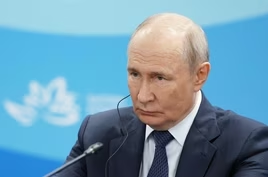
GEOFF BENNETT: Shifting our focus now to how Russia is supplying the soldiers to fight this war, this week, Russian President Vladimir Putin for the first time addressed rumors that the Kremlin is preparing for a full military mobilization to boost its manpower, calling them complete nonsense.
But Putin made much the same promise back in 2022 not to send conscripts to Ukraine before ordering a partial mobilization that remains in effect today.
AMNA NAWAZ: Now, with Russian military losses estimated at some 40,000 a month, there are signs the Kremlin is preparing for the possibility of a much broader call-up, perhaps after parliamentary elections later this month.
Special correspondent Simon Ostrovsky reports from Georgia.
SIMON OSTROVSKY: This is the state of Russia's new recruits being sent to the front lines in Ukraine.
In social media videos from this past winter, men say they were tricked and drunk when signing their enlistment papers.
This man says he's injured and is barely able to lift his flak vest.
"Look at your special forces, Putin," he says.
Russia, it seems, is running out of men who are fit and willing to fight.
Until now, Russia has mainly used financial incentives to get men to join the military, sometimes offering sums equivalent to a year's salary to get them to sign a contract.
But with increasingly high casualty rates on the front lines due to Ukraine's newfound drone dominance, even those high numbers aren't the same draw they once were.
That's putting the Kremlin in a bind.
Either halt the war now without achieving its declared goals, or find new ways to compel men into the army.
One option would be to take the highly unpopular and potentially destabilizing step the Kremlin has avoided until now, instituting a draft, or a general mobilization, as it's known in Russia.
The word mobilizatsiya is all over the Russian airwaves.
MAN (through translator): The question isn't, will a mobilization be announced?
The question is, what will it look like?
SIMON OSTROVSKY: Scenes like this offer a clue.
Men being pulled off the street by the authorities in legally questionable recruitment drives are becoming all too common and illustrate the Kremlin's desperate need for men for the front.
If the decision is made, the mobilization of men from the general population would only take place after parliamentary elections this month.
That's according to Kirill Martynov, the editor in chief of Russia's leading independent newspaper operating in exile, whose groundbreaking reporting about the Russian war effort has resulted in the Kremlin banning the newsroom as a - - quote -- "undesirable organization."
KIRILL MARTYNOV, Editor in Chief, Novaya Gazeta Europe: The mobilization, I believe, is very likely in September or October of this year.
This is a very dangerous moment both for Ukraine and for Europe.
Russian army is losing more than 40,000 people every month for now.
So that means, if Putin wants to put - - to put more pressure on Ukraine, he basically needs more soldiers.
SIMON OSTROVSKY: Over 4.5 years of war, Putin's escalating campaign of pressure on Ukraine has failed on a number of fronts.
Not only has he been unable to capture the capital, Kyiv.
Putin hasn't even taken full control of three Ukrainian regions that already appear on Russian maps as part of Russia.
On top of those failures, the cost of the war in Russian lives has been devastating.
some 1.5 million men.
Seven months after launching his full-scale invasion of Ukraine in 2022, President Putin launched a partial mobilization with recruitment quotas assigned to local draft offices all across the country.
It was Russia's first mass call-up since World War II.
It led to scenes like this along the country's land borders.
Hundreds of thousands of men converged on crossings like this one to try to get out of the country to avoid the draft.
More than 700,000 Russians arrived here in neighboring Georgia in just a matter of weeks.
Augustine (ph) was one of them and now lives full-time in the capital, Tbilisi, in order to avoid military conscription.
AUGUSTINE, Russian Draft Dodger: Second wave of mobilization, I think, is definitely happening after election day, yes.
Situation looks pretty bad for the Russian army, in my opinion.
So, I know how it's working in Russia.
They can take you with no reason.
They will find a reason to bring you in the front.
So I'm pretty scared, but I'm here.
I feel safety here.
SIMON OSTROVSKY: Alexey, who also left because of the war, thinks it's becoming much more difficult to avoid military service in Russia.
Do you feel like going back to Russia now, it's even more risky that you would get drafted into the military.
ALEXEY, Russian Draft Dodger: I think, yes.
They just can start picking people wherever they want.
I really fear myself crossing the border.
SIMON OSTROVSKY: You're afraid of crossing the border?
ALEXEY: Yes, yes.
SIMON OSTROVSKY: Recruitment statistics published by the independent Russian outlet Vyorstka show that, in the spring of this year, the number of new recruits from Moscow fell by a third, with the same trend seen across the rest of the country.
The publication also learned that many of those who did sign on were forced by police.
KIRILL MARTYNOV: I strongly believe that basically the goal of this war for now is continuation of the personal power of President Putin.
He has no clear way out.
He needs to have more people on the battlefield.
Because we don't have tool to stop Putin politically, diplomatically, there is a kind of high risk that war will become even broader, it will affect Europe directly.
SIMON OSTROVSKY: Last month, the Russian military tested how a mass mobilization would look in Kaliningrad, a Russian region situated between NATO members Lithuania and Poland.
The idea, according to The Wall Street Journal's reporting, was to work out any glitches before a possible future mobilization.
KIRILL MARTYNOV: And, for sure, I believe if Putin starts this forced campaign to bring people back to the battlefield, I think a lot of people try to find some way how they can escape.
During September, a lot of young men, they will prefer to spend a few weeks on vacation, maybe on the day of election, before the most risky time, to wait and see what will happen next.
SIMON OSTROVSKY: But for fighting-age Russian men, the path ahead won't be easy.
Since the first wave of mobilization, Russian authorities have upgraded a digital registry of all male citizens eligible for service, making dodging military conscription far more complicated now than it was at the start of the war.
For the "PBS News Hour," I'm Simon Ostrovsky in Tbilisi, Georgia.
GEOFF BENNETT: The NBA handed out one of its harshest penalties in history against the L.A.
Clippers for circumventing the salary cap with its star forward, Kawhi Leonard.
The league suspended the team's owner and fined the Clippers $30 million.
William Brangham has more.
WILLIAM BRANGHAM: The NBA's powerful rebuke followed a yearlong investigation, which detailed how Clippers executives allegedly set up four separate side deals where other companies would pay Leonard.
That boosted the stars' income and thus violated the NBA's salary cap.
In addition to the $30 million fine and suspending team owner Steve Ballmer for a year, several other team executives were barred, the team will lose five consecutive first-round draft picks starting in 2029, and the Clippers will be monitored by the league for five years.
Kawhi Leonard won't be facing suspension, and his contract remains intact.
He has to pay a $700,000 fine, and it's expected that he's going to be traded to the Toronto Raptors.
So for more on this scandal, we are joined by David Aldridge.
He's senior sports columnist for The Athletic.
David, thank you so much for being here.
In a column that you wrote today about this scandal, you noted that NBA commissioner Adam Silver, in bringing this punishment down, -- quote - - "met the moment."
What do you mean by that?
DAVID ALDRIDGE, The Athletic: Well, William, everybody in the league has been following this for the last year, since the initial podcast by Pablo Torre, who's been doing an incredible job on this over the last year, multiple episodes detailing multiple instances of things that just didn't make sense, right, that he was getting information about the Clippers and the deals with Kawhi Leonard that didn't make sense.
So everyone in the league wanted to know, what was Adam Silver going to do if the investigation from Wachtell Lipton said that, yes, the Clippers have circumvented the cap, in our opinion, and here's the reasons why we say that, because Steve Ballmer is not your ordinary NBA owner.
Look, they're all billionaires, and Steve Ballmer is richer than all of them, OK?Forbes has him as the 15th richest person in the world.
We all -- I think your viewers surely know about Steve Ballmer's background and history.
So -- and he's well liked amongst the other owners.
Nonetheless, the other owners are competitors, and their view was, if the Clippers have violated the salary cap, they need to be punished.
And the detail to which Wachtell Lipton showed that alleged behavior, I really think left the league with no option.
A slap on the wrist, a light suspension, a second round draft pick, no suspensions of personnel would have really told the rest of the league, you can do whatever you want, it's OK.
The league said unequivocally with these punishments that the cap is sacrosanct, and you can't do whatever you want to violate it.
WILLIAM BRANGHAM: What do you make of Kawhi Leonard's involvement in this?
We know that his uncle, who apparently was involved in some of these deal negotiations, was barred also by the league.
WILLIAM BRANGHAM: But what do we know about Kawhi's involvement and his future going forward?
DAVID ALDRIDGE: Well, he put out a statement on Wednesday saying that he took responsibility for his company or his people's actions, and he didn't -- he didn't say that, I knew about the circumvention, but he said he took responsibility for the actions, right?
Look, yes, as you mentioned, there was a trade already in place that was held up by this investigation that would have sent Kawhi Leonard to the Toronto Raptors for a couple of players and multiple draft picks.
And I think the NBA looked at this and said, we could suspend Kawhi Leonard.
We could try to void his contract.
It would almost certainly go to arbitration.
The players union has done this before in the past, and successfully, I might add, gotten players' contracts restored, gotten suspensions reduced, and I don't think the NBA wanted to fight that fight.
I think they felt like the Clippers had to be the entity that bore the brunt of the punishment in this case.
But Kawhi's going to go on.
I'm sure - - I don't think anything's going to keep the trade from going through, and he will go back to the Toronto Raptors, the team that he led to an NBA championship in 2018.
WILLIAM BRANGHAM: In the last minute or so we have left, in losing all of those first-round draft picks, this seems to deal pretty serious blow to the Clippers going forward.
DAVID ALDRIDGE: Yes, I think, William, that's what a lot of the people around the league were looking at, because even though the league fined the Clippers $30 million, again, Steve Ballmer is an incredibly rich person.
They can pay it.
That's not as punitive as losing the draft picks.
That was really, in my view, the only thing the NBA could do to really demonstrate the harshness of what it considered the cap violations and what it would do to punish teams that tried to do it.
It's -- they did it many years ago to the Minnesota Timberwolves.
They took five draft picks and ultimately they wound up giving two of them back.
So, the Clippers might well get one or two of their picks back down the road.
But I think this was the best way, the league felt, to send a message that it was going to take cap circumvention very seriously, because draft picks are really the most important way to build rosters and try to great create superstars in the NBA.
WILLIAM BRANGHAM: David Aldridge of The Athletic, thank you so much for sharing your reporting with us.
DAVID ALDRIDGE: Thanks, William.
AMNA NAWAZ: Most professional football players gain fans and win fame from what they do during the game.
In the case of rookie offensive lineman Shiyazh Pete, millions came to know him from what he said after.
After his Dallas Cowboys preseason win over the Arizona Cardinals on August 22, Pete was invited by the coach to address his team in the locker room.
His words went viral.
Take a listen.
SHIYAZH PETE, Professional Football Player: Fate brought us here as strangers, but this game, this star, this team will make us brothers.
(CHEERING) AMNA NAWAZ: Pete already made history as the first Navajo player ever to sign an NFL contract.
But just this week, as teams made their cuts, Dallas announced that Pete had not made the squad.
He's now hoping to continue his football journey with another team.
And Shiyazh Pete joins us now from New Mexico.
Shiyazh, welcome to the show.
It's great to talk to you.
SHIYAZH PETE: Yes, thanks for having me on, Amna.
Good to be here.
AMNA NAWAZ: So I have to start with that moment that we just showed after the Arizona game.
You're in the locker room.
Everyone's celebrating.
Coach Schottenheimer invites you to say a few words.
What do you think in that moment?
What's going through your mind?
SHIYAZH PETE: Well, I mean, it was - - it was awe-inspiring to see such a massive crowd show out for the game, and specifically for me.
It was awesome.
But I will say that couldn't have happened without the Cowboys.
And for that, I thank them for it.
I mean, without their reputation and status as an NFL club, I wouldn't have been able to obtain that kind of platform.
So I'd like to say thanks to that.
What was going through my head was a lot of stuff, but about the game, about my performance, about what's for lunch after or what's for dinner after, but, most importantly, what am I going to say?
I know I'm going to have to say something about that.
And those words that I mentioned, they were my own, but I will say they -- the speech, the structure of it was heavily inspired from a video game series "Halo 2."
So there was some inspiration to it, and I'm not going to say it was, like, all me, but I got it from a really cool video game I used to play as a kid.
AMNA NAWAZ: I mean, it was just 59 words.
That speech inspired headlines and media coverage and your face, like, splashed across TV screens across the country.
Did the reaction to the speech surprise you?
SHIYAZH PETE: From the moment the words left my mouth, I knew I was like, dang, that was some really good stuff.
(LAUGHTER) SHIYAZH PETE: Really good energy, positive energy, the ability to speak from my heart was displayed there.
And it was a really good moment and a really good night.
And it was something I have always wanted to showcase.
And so it was quite special, indeed.
AMNA NAWAZ: You mentioned the crowd.
At that game, there was a very large, very vocal contingent.
Thousands of fans, members of the Navajo Nation who drove to Arizona traveled just to see you.
They were chanting your name.
They were waving Navajo Nation flags.
What was that like for you during the game?
SHIYAZH PETE: I will say I wasn't expecting that large of a turnout, and I got to see firsthand the strength and power of the Navajo Nation people.
It was really special to be appreciated and welcomed and supported and cheered for by the Navajo Nation people, all of Native people in general.
It was quite special.
AMNA NAWAZ: We mentioned you're the first ever Navajo player to even sign an NFL deal, and now you're looking for a new team, I know, hoping to continue your career.
Do you think about what that means for all the other young players out there, members of the Navajo Nation, to watch you, to see you in this position right now?
SHIYAZH PETE: I'm very thankful I got the opportunity with the Cowboys, and I'm excited to see what the future brings.
When it comes to the youth and the fans and people looking from afar to me, I have done -- I have done a great thing.
And to be able to display that and to represent my community in the best light possible has been a privilege, to say the least.
And I have been taking some time outside of football, instead of my career, to pay it back, to pay it forward to the youth.
And I have attended my former high school and have been motivating and giving words of wisdom to the youth and enlightening them about the -- how far the journey can take you if you put in the hard work and dedication, and if you have a vision and you really want to do something and you stick your mind to it, and you put in the work day in and day out.
To be an impact on so many people, again, is a huge responsibility.
And it's a privilege, again.
AMNA NAWAZ: Shiyazh Pete, I know you have a lot of fans out there cheering for you who want to see you join a team.
We wish you all the best of luck on your journey ahead.
Thank you so much for joining us today.
SHIYAZH PETE: Thank you, Amna.
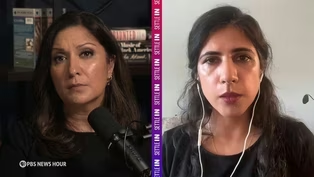
AMNA NAWAZ: In her new book, "Seasons of Fury," journalist Rozina Ali traces the history of Islamophobia in the U.S., from FBI monitoring of Muslim and Arab communities in the 1960s to the sweeping surveillance programs launched after 9/11.
I recently spoke with her for our PBS News podcast "Settle In."
I'm curious how you look at America today contextually on this, because, yes, on the one hand, you have the kind of commonplace anti-Muslim rhetoric that you see from the president of the United States, from some of his closest advisers, from sitting members of Congress.
But then you also have Muslim Americans who've risen to very powerful positions.
They have been elected to Congress, people like Ilhan Omar, Rashida Tlaib.
You have got the first Muslim mayor in New York City.
You have another candidate for the Senate in Michigan.
How do you look at the context of where we are today and what it means for this?
ROZINA ALI, (Author): It is remarkable the rise of Muslim politicians in this country.
But I also think it was inevitable, only because Muslims are a growing population in the country.
That said, they're still about just 1.5 percent of the American population.
But what is different since 9/11 is, a lot more Muslims have protection, in the sense that they were either born here or they were naturalized.
Unlike Muslims who were mostly immigrants after 9/11, a lot of the Muslims we see today who are rising up in political circles do have a sense of security.
But what has also happened after -- in the last 25 years is a cohering of a political Muslim voice that in a sense is a reaction, ironically, to 9/11.
Before 9/11, there were disparate Muslim voices, but mostly people really considered themselves, again, South Asian or immigrant or so forth.
But 9/11 really started cohering a Muslim social political identity.
And so when we see the rise of people like Zohran Mamdani or Abdul El-Sayed or Rashida Tlaib or Ilhan Omar, they do talk about themselves as being Muslim.
That said, there is a level of Islamophobia that we see today that I have not seen in my lifetime.
It is a level of acceptance of Islamophobia.
The ways in which senior officials, policymakers, Laura Loomer, for example, the adviser to the president, speaking about Muslims and Islam as if they are second-class citizens, calling for a complete ban on Muslims, calling for a complete ban on anything that is related to Islam in the United States.
And, to me, what that says is not so much about the Muslim American community.
It says a lot more about the American community as a whole.
AMNA NAWAZ: What do you mean by that?
ROZINA ALI: I think what we have done is, we have reached a point where -- tolerance of religion and freedom of religion was a founding tenet of this country.
And what we see now is a society that is actually OK with dismantling that very pillar of the United States.
We are now openly calling for Islam not to be part of the United States or part of its social and political fabric.
And I think what we're doing is actually changing ourselves as a society in really damning and worrying ways.
This is not a problem just for the Muslim community.
It's actually a problem for American society as a whole, and it's changing the face of what we think of as the values of American society.
AMNA NAWAZ: And you can watch that full conversation and more episodes of "Settle In" on YouTube or wherever you get your podcasts.
And that is the "News Hour" for tonight.
I'm Amna Nawaz.
GEOFF BENNETT: And I'm Geoff Bennett.
For all of us here at the "News Hour," thanks for spending part of your evening with us.

European countries face Russian sabotage and shadow warfare
Video has Closed Captions
European countries confront Russian sabotage and shadow warfare (7m 53s)
Gloria Steinem and her trailblazing fight for women’s rights
Video has Closed Captions
Remembering Gloria Steinem and her trailblazing fight for women’s rights (7m 12s)

NBA hits Clippers with a record fine for evading salary cap
Video has Closed Captions
NBA hits LA Clippers with a record fine for circumventing salary cap (6m)
Rozina Ali joins Amna Nawaz on 'Settle In'
Video has Closed Captions
Rozina Ali and Amna Nawaz discuss Islamophobia in America on 'Settle In' (4m 9s)
Russia may force more men to fight in Ukraine amid losses
Video has Closed Captions
Russia may force more men to fight in Ukraine as military faces heavy losses (7m 59s)
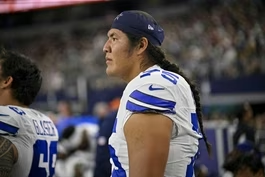
Shiyazh Pete on the speech that made him a viral sensation
Video has Closed Captions
Shiyazh Pete on inspiring Navajo Nation and the speech that made him a viral sensation (5m 5s)
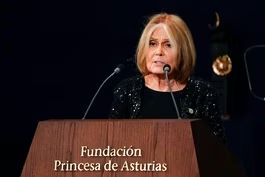
Steinem stayed true to herself despite pressure, Taymor says
Video has Closed Captions
Steinem stayed true to herself despite intense pressure, Julie Taymor says (7m 17s)
Providing Support for PBS.org
Learn Moreabout PBS online sponsorship New Episode
- News and Public Affairs

FRONTLINE is investigative journalism that questions, explains and changes our world.
 New Episode
- News and Public Affairs

Today's top journalists discuss Washington's current political events and public affairs.
 New Episode
 New Episode
 New Episode
 New Episode
 New Episode
 New Episode


 New Episode
Support for PBS provided by:
Major corporate funding for the PBS News Hour is provided by BDO, BNSF, Consumer Cellular, American Cruise Lines, and Raymond James. Funding for the PBS NewsHour Weekend is provided by...