
October 15, 2026 - PBS News Hour full episode
10/15/2026 | 57m 46sVideo has Closed Captions
October 15, 2026 - PBS News Hour full episode
October 15, 2026 - PBS News Hour full episode
Problems playing video? | Closed Captioning Feedback
Problems playing video? | Closed Captioning Feedback
Major corporate funding for the PBS News Hour is provided by BDO, BNSF, Consumer Cellular, American Cruise Lines, and Raymond James. Funding for the PBS NewsHour Weekend is provided by...
October 15, 2026 - PBS News Hour full episode
10/15/2026 | 57m 46sVideo has Closed Captions
October 15, 2026 - PBS News Hour full episode
Problems playing video? | Closed Captioning Feedback
Where to Watch PBS News Hour
PBS News Hour is available to stream on pbs.org and the PBS app.
Providing Support for PBS.org
Learn Moreabout PBS online sponsorshipAMNA NAWAZ: Good evening.
I'm Amna Nawaz.
Geoff Bennett is away.
On the "NewsHour" tonight: Russia bombards Ukraine with hundreds of drones, and Ukraine responds, defying President Trump's claim of an energy cease-fire.
A measles outbreak gripping Pennsylvania claims more lives, despite public officials' calls to get vaccinated.
And we examine the wider effects on students and higher education when small liberal arts colleges shut down.
JIM WALD, Former Hampshire College Professor: Our students were challenged much more than others in a lot of other schools.
The college has a Latin motto, non satis scire, to know is not enough, embodying this idea of wisdom and critical thinking.
(BREAK) AMNA NAWAZ: Welcome to the News Hour The tense alliance between Ukrainian President Zelenskyy and President Trump is nearing a new low point tonight.
After days of bitter back-and-forth between the two leaders, Ukraine has resumed strikes on Russian energy targets following three days of Ukrainian cease-fire.
The president had demanded an energy cease-fire this past Sunday between the two.
Russia never stopped its attacks.
Lisa Desjardins begins our coverage.
LISA DESJARDINS: In Ukraine's capital city today, Russian strikes reverberate in broad daylight, that after Ukrainian officials say Russia launched a large-scale overnight attack, more than 850 drones.
But Russia too is burning.
The Associated Press reports Ukraine hit this oil refinery.
VOLODYMYR ZELENSKYY, Ukrainian President: Three days, we didn't attack any energy, diesel and et cetera systems of Russia, and three days they attack us.
LISA DESJARDINS: Late yesterday, Ukrainian President Volodymyr Zelenskyy told The Financial Times that Russia never abided by the cease-fire announced by Trump.
Zelenskyy criticized the U.S.
for limiting intelligence resources like Starlink.
He was blunt.
His patience is gone.
QUESTION: If they keep doing this, how much longer will you maintain the stoppage of attacks on Russian refineries?
VOLODYMYR ZELENSKYY: That's it.
Block is out.
LISA DESJARDINS: His candor continued when asked about Trump's relationship with Russian President Vladimir Putin and their deal on diesel.
VOLODYMYR ZELENSKYY: He speaks about it, I mean, openly and loudly that he loves such people and he respects such people, because, for him, I don't know, people who can be leaders 20 years, 30 years, 40 years, it's means they're very strong because they -- you can, I mean, hold the power.
How it can be when some people are surviving, fighting, dying, you make some business with the guys with such aggression?
LISA DESJARDINS: For his part, Putin accused Ukraine of violating the truce.
VLADIMIR PUTIN, Russian President (through translator): They made a first step.
We started to respond by striking at energy facilities, which they are now squealing about.
It was them who started it.
They should have thought properly about consequences.
LISA DESJARDINS: And Russia's foreign minister said Zelenskyy's comments point to a deepening rift between Kyiv and Washington.
SERGEY LAVROV, Russian Foreign Minister (through translator): The fact that this is such a direct and indeed crude challenge to President Trump is, in my view, something everyone already understands.
LISA DESJARDINS: Zelenskyy spent his day at an E.U.
summit in Brussels focused on support from his European allies.
KAJA KALLAS, High Representative, European Union: We definitely have different approach to this war.
We see that we have to pressure the aggressor to stop the war, not the victim to surrender.
Squeezing Ukraine is not the right approach.
LISA DESJARDINS: The talks come as the entire region grows more war-weary.
Two cargo ships were set ablaze today in Romanian waters in the Black Sea.
Seven crew members are missing.
NICUSOR DAN, President of Romania (through translator): There are attempts by Russia to destabilize societies and to reduce support for Ukraine.
And our response is, we continue to support Ukraine.
LISA DESJARDINS: European leaders also rejected Trump's push to control and release frozen Russian assets, he said, as a bargaining ship.
FRIEDRICH MERZ, German Chancellor (through translator): These are assets that are frozen in Europe.
And they should remain frozen in Europe.
This is our business.
And we decide on it.
LISA DESJARDINS: And, as world leaders talk, the war grinds on, on the ground.
For the "PBS News Hour," I'm Lisa Desjardins.
AMNA NAWAZ: For perspective now on the tensions between President Trump and President Zelenskyy, we turn to former U.S.
Ambassador to Ukraine William Taylor.
He's now a distinguished fellow at the Atlantic Council.
Ambassador Taylor, let's begin with Ukrainian President Zelenskyy's decision to resume strikes on Russian energy targets after complying with President Trump's demand to stop those for a few days.
Is that the right call for Ukraine right now?
WILLIAM TAYLOR, Former U.S.
Ambassador to Ukraine: Amna, it's absolutely the right call.
As you say, the president held off for three days.
He had agreed to this cease-fire, energy cease-fire, that President Trump suggested or demanded without consultation.
But, nonetheless, President Zelenskyy said, yes, good idea.
He suggested this before.
He made this proposal before.
And the Russians have always said no before, but maybe President Trump had had a conversation with President Putin and was going to get President Putin to agree this time.
So President Zelenskyy stopped firing at the refineries for three days while the Russians continued to batter the Ukrainians, energy, civilian targets, killing civilians.
He couldn't -- he couldn't stop.
President Zelenskyy had to resume the attacks when the Russians had never stopped.
AMNA NAWAZ: Ambassador Taylor, you heard there the remarkable public expression of frustration, of anger from President Zelenskyy.
Is that a risky move for a nation that is still so dependent on support from the U.S.?
WILLIAM TAYLOR: Amna, less support from -- less dependent on support from the U.S.
at this point than it was, say, a year-and-a-half ago, because the United States doesn't provide any weapons.
We don't provide any financial support.
We don't provide any political leadership.
We don't lead the Ramstein process, by which we coordinate the assistance going, the military assistance going.
We don't do any of that.
So we're -- the Ukrainians are not so dependent on us as they were.
Now, it is true that military intelligence is important to the Ukrainians coming from the United States, but they also get that from other places as well.
But in answer to your question, I guess I would not have gone the ad hominem with that.
I wouldn't have made comments about President Trump and why he wants to stay in power.
You know, you don't need any of that.
You just stick to the results that he's after, which is pressure on Putin to stop the war.
And the pressure point on Putin to stop the war is attacks on refineries.
AMNA NAWAZ: You heard Russia's Sergey Lavrov there point to the rift between the U.S.
and Ukraine.
At this moment, does this deterioration in relations between the U.S.
and Ukraine, does that further embolden Putin?
Could we see a ramping up of Russian attacks?
WILLIAM TAYLOR: They're already at the top of the ramping up of Russian attacks.
And, Amna, what Lavrov says, what Putin says, they would love to have this dispute, this rift, as you say.
This is what their goal has been, is to cut off support for Ukraine.
The United States has indicated, the Senate, the House has indicated strong support.
When you ask Americans if they support Ukraine, they do, and they oppose Russia.
The United States will continue to have a strong relationship with Ukraine, and I believe this administration will as well.
AMNA NAWAZ: You have heard President Trump recently strongly criticize President Zelenskyy very directly, saying Ukraine needs a new president.
We should point out Zelenskyy's term did expire back in 2024.
He's operating under a constitutional wartime extension in Ukraine.
What about people on the ground in Ukraine?
Do they want elections?
Do they want a new president?
WILLIAM TAYLOR: They don't, Amna.
They don't.
I have been there many times.
I have been there 15 times since the big war started in 2022.
And I have talked to the people about -- I have talked to opposition parties, who you would think would want to have elections so they can get -- no.
The opposition parties, the people, civil society, the election experts, democracy experts are all united at this point in Ukraine.
They don't think elections are appropriate now.
They can't have elections now.
They don't want it.
They support their president for now.
They're eager to have elections, Amna.
They're really eager to have elections when the cease-fire comes, when the war is over.
They are eager.
They're going to be -- there's going to be real competition, but not now.
Right now, they support their president.
AMNA NAWAZ: In the 30 seconds or so I have left, I have to ask, do you see this as a new all-time low in relations between the U.S.
and Ukraine?
WILLIAM TAYLOR: An all-time low.
Again, the Ukrainians are in better shape now than they have been before because they're less dependent on us.
They have seen that they can't really depend on one thing to the next day, one commitment to the day, a withdrawal of that commitment the next.
So, they're in better shape now.
They have got strong support from the Europeans.
That's going to keep them going, and maybe the Americans will come back as well.
AMNA NAWAZ: That is former U.S.
Ambassador to Ukraine William Taylor joining us tonight.
Ambassador Taylor, always good to speak with you.
Thank you.
WILLIAM TAYLOR: Thank you, Amna.
AMNA NAWAZ: We start the day's other headlines with a late-breaking story out of Bend, Oregon, where police say there are multiple victims following a shooting this afternoon at an elementary school.
Officials say children are among the victims.
Their status is unclear, but at least two people were hospitalized.
Officials also say the shooter was shot and killed at Silver Rail Elementary School possibly by a bystander, though that is not yet confirmed.
Federal law enforcement agencies are investigating a series of letters containing what they're calling suspicious substances that were sent to congressional and state election officials.
In a statement provided to the "News Hour," the FBI says it's investigating each incident and -- quote -- "working with our partners to identify the individual or individuals responsible for the letters."
Elections officials in at least six states have reported receiving such mail, including Ohio, South Dakota, and Maryland.
It comes less than three weeks before the midterm elections.
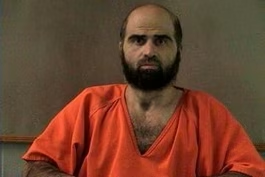
President Trump has canceled plans to livestream the December execution of Fort Hood shooter Nidal Hasan amid growing bipartisan backlash.
The president posted online that he still believes -- quote -- "Streaming the execution for all to see might have been a strong deterrent," but he added -- quote -- "Many very good and well-meaning people would rather not watch him die."
Defense Secretary Pete Hegseth announced the livestream plan last week.
But a growing number of Republicans, including Vice President J.D.
Vance, said they would not watch.
In Texas, voting rights groups are suing the state's Department of Public Safety and the secretary of state over the delay of nearly 600,000 online voter registrations.
Officials say a software glitch in their online portal caused the backlog.
The lawsuit claims that Texas failed to provide a reliable online registration system.
Local election staff are working overtime to process the registrations before early voting starts on Monday.
In Northwest Pakistan, the roof of a private school collapsed during morning classes today, killing at least 34 children and a teacher.
Authorities in the city of Peshawar said rescue workers arrived within minutes, and that rapid response saved dozens of lives.
Crews cleared debris, with officials saying everyone trapped beneath the rubble was eventually pulled out.
Hospital officials say more than 50 other people were injured, some in critical condition.
The local police chief says the school's owner has been arrested.
MIAN SAEED, Peshawar Police Chief (through translator): This is a truly tragic incident, and we will certainly investigate and file a report against the owners.
Holding classes for children in such a fragile building located within such narrow streets, this clearly represents a grave instance of negligence.
AMNA NAWAZ: Thousands of mourners attended a mass funeral later in the day.
The children killed or injured were all between the ages of 6 and 14 and all lived in the same neighborhood as the school.
In Albania, violent clashes erupted in the capital of Tirana today as anti-government protests stretched into a third day.
Alarms sounded as protesters attacked this bank.
Riot police retaliated with water cannons and tear gas.
The nation's Health Ministry says more than 80 people were injured, most of them police officers.
The student-led demonstration started amid anger over a major development project backed by President Trump's son-in-law, Jared Kushner.
They're also demanding better school conditions and for Prime Minister Edi Rama to resign.
He has refused to do so.
In New York City today, ousted Venezuelan President Nicolas Maduro and his wife, Cilia Flores, pleaded not guilty to new charges of torture.
He's accused of overseeing a violent campaign against opponents and others, including three Americans.
The allegations were added to an earlier drug trafficking indictment against the couple.
Maduro told the court today the indictment contains what he called false accusations and false testimony.
The couple were seized from their Caracas home by the U.S.
military in January, and their trial is set for next June.
President Trump's new press secretary, Katie Zacharia, is facing questions about her legal credentials.
Multiple news outlets report she has not passed the bar exam in any state.
Zacharia holds a law degree from Pepperdine's Caruso School of Law.
She's referred to herself online as general counsel in past roles, and Mr.
Trump has called her an attorney.
But legal experts say neither of those titles should be used unless someone has passed the bar.
Zacharia held her first briefing as press secretary this week, taking questions from three outlets in a 15-minute appearance.
On Wall Street today, stocks managed to end higher despite ongoing worries about AI.
The Dow Jones industrial average jumped more than 550 points.
The Nasdaq added just 20 points, so a small gain there.
The S&P 500 rose a third of 1 percent.
And we cover news big and small here at the "News Hour," and in this case, very small.
The London Zoo announced the birth of 15 Afia Birago puddle frogs, one of the world's smallest and rarest amphibians.
The frog is about a fifth of an inch in size, no larger than the tip of a pencil.
These are the first to be born in captivity.
Researchers are racing to save the species, which was only identified in its native Ghana eight years ago.
Now there are a few more.
Still to come on the "News Hour:" the president's multiple promises to give Americans cash raise legal and ethical questions; we report from Georgia on the contentious contest for Senate; and musician David Byrne reflects on creativity and what makes a great idea resonate.
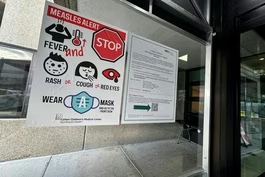
The CDC has now confirmed more than 4,000 cases of measles this year as the country grapples with the largest outbreak of the highly infectious virus in 35 years.
Nearly a fifth of cases comprise children under the age of 5, and more than 90 percent are among people who are unvaccinated.
Pennsylvania is the epicenter of the outbreak with more than 1, 100 cases.
That includes five measles-related deaths and potentially a sixth still being investigated.
For more on what we're seeing and its impact, we're joined now by Dr.
Evan Shirey.
He's a pediatric infectious disease doctor based in Hershey, Pennsylvania.
Dr.
Shirey, welcome and thanks for joining us.
DR.
EVAN SHIREY, Penn State Health: Thank you for having me.
AMNA NAWAZ: So you're in Hershey in Central Pennsylvania, the middle of your state's measles epicenter.
Just tell us what you're seeing at your hospital right now.
DR.
EVAN SHIREY: Yes, unfortunately, I have been seeing a lot of children and a lot of babies who have been admitted to our hospital and have been very sick.
I am seeing the severe consequences that can come from this virus.
AMNA NAWAZ: Tell us about those consequences.
What are the measles like in those young children you're seeing?
How does it present?
DR.
EVAN SHIREY: So there are a number of complications that can come about from measles.
One that we really worry about is encephalitis, and that's when the virus causes infection of the brain.
Children with encephalitis from measles in some cases may be unresponsive.
In other cases, they may be awake and aware, but confused.
They don't know where they are.
They're scared, in some cases, not even able to recognize their own parents.
These cases are really, really tragic to see.
We see infections where the virus infects the lungs or the airways, and we call that a bronchopneumonia.
These children might come in breathing really fast, breathing really heavily, gasping for air, in some cases needing different forms of respiratory support and oxygen, and in some of the extreme cases we have seen have even need to be put on a ventilator.
We have seen babies who have come in who are unable to nurse or unable to take bottles, and just all forms of various different kinds of suffering from the manifestations of these infections.
AMNA NAWAZ: And, Dr.
Shirey, do we know what's driving this outbreak, how it's gotten so severe in Pennsylvania?
DR.
EVAN SHIREY: So we know that, historically, the measles virus caused a lot of infections.
We had three or four million infections every single year in this country, and that also resulted in 50,000 hospitalizations, around 500 deaths every year.
So we know this is really bad virus.
We know the measles virus can spread like wildfire.
It is famous for how infectious it is.
One person with measles can infect up to 18 others.
The reason that we have not been seeing measles cases up until now is because we had a very safe and a very effective vaccine that we had been using for decades that actually resulted in elimination of the virus from this country.
The virus is back because of a failure to vaccinate.
AMNA NAWAZ: Given that we thought measles was eliminated about 25 years ago, is this something you ever thought you would be seeing during your time practicing as a doctor?
DR.
EVAN SHIREY: Absolutely not.
I spent a lot of time learning about measles as a medical student and as a resident and as an infectious diseases fellow going through all of my training.
I always expected that measles was going to stay in the textbooks, and I did not expect that I would live in a world where I was in an ICU taking care of patients in real life.
AMNA NAWAZ: Can I ask you about the rhetoric we're hearing from some of the nation's leaders?
I mean, famously, the HHS secretary, Robert F. Kennedy Jr., has had some anti-vaccine views and vaccine skepticism he's expressed.
How does that complicate your job on the ground?
DR.
EVAN SHIREY: I think it's a real shame.
I think that this outbreak just really highlights how important it is that, when we communicate about these important health issues, that we lead with honesty and the truth.
I think it's -- overall has been a shame that the anti-vaccine movement has gained the power that they have and that they have gained the influence in reaching ordinary Pennsylvanians.
I see in my clinic when I talk to people about vaccines that the types of fears that people have over these last five, 10 years are really just a different dynamic from the way things used to be.
And I think that is largely -- unfortunately, it's related to the success of the anti-vaccine movement as a whole.
AMNA NAWAZ: Whenever we cover these kinds of stories, I should mention to you we hear from people who say, look, if you or your children are vaccinated, you will be fine, so there's not much to worry about.
What do you make of that argument?
DR.
EVAN SHIREY: So, first and foremost, I want to be very clear that the vaccine is extremely safe and extremely effective.
We have been using the MMR vaccine really in the same form since the late 1960s.
So we have decades of experience with this.
Billions of people have received this vaccine.
So I lead with reiterating the truth that the vaccine is very safe and very effective.
For people who are vaccinated, I do want to give reassurance, if you are vaccinated, the vaccine is protective.
The unfortunate thing that I think people need to understand is that not everyone can receive the vaccine.
And so the vulnerable among our communities have been relying for decades on the rest of us to be vaccinated at a high enough rate to achieve herd immunity.
One really important point that I can share personally, infants are an important group that can't be vaccinated.
And I'm a father of a 2-month-old.
He is living in an area where this outbreak is active.
And there's nothing that I can do to protect him, rather than -- other than limit his exposures to public places where he may get the virus.
AMNA NAWAZ: Dr.
Evan Shirey from Penn State Health joining us tonight.
Doctor, thank you so much for your time and your insights.
We appreciate it.
DR.
EVAN SHIREY: Of course.
Thank you.
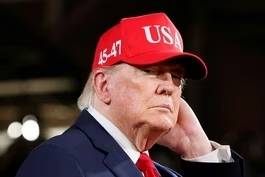
AMNA NAWAZ: President Trump is cutting checks to Americans and promising more with less than three weeks left in a midterm cycle largely focused on affordability.
Trump argues they're refunds for high health care costs and economic dividends that only his party can deliver.
Democrats contend he's trying to bribe citizens to vote for Republicans.
Our White House correspondent, Liz Landers, is here with an accounting of those payouts.
Good to see you, Liz.
LIZ LANDERS: Yes.
Nice to see you.
AMNA NAWAZ: So let's start with those checks some Americans have already started to receive in the last week or so for Affordable Care Act fees.
How much are people getting and what's the president's rationale for those?
LIZ LANDERS: People are starting to get these $500 checks really in the last week or so.
It's gone out to about a million Americans so far across 30 different states.
And this is for people that don't get premium assistance.
With these checks was a personal letter that the president wrote.
And it says in part: "I'm proud to return your money to you, and I will never stop fighting to put the American people first, restore affordability, protect your hard-earned money, and lower the cost of health care."
Now I spoke with Cynthia Cox about this.
She's the director of the Affordable Care Act Program at KFF.
And she said that this move from the administration is unprecedented.
But she also explained how this can help Americans and how these checks will factor into overall rising health care costs.
CYNTHIA COX, Program on the ACA Director, KFF: For people who get ACA coverage, in particular, the people who lost subsidy this year, they're probably paying a couple thousand dollars more in their premiums this year than they were last year.
So the $500 checks are probably going to help.
I mean, $500 is nothing to sneeze at, but they're still having a much higher cost beyond that $500 this year than they were last year.
LIZ LANDERS: Cox says that the timing of this is political.
She said she first heard about this idea floated out there last year, but, of course, now it's being implemented just a few weeks before a midterm election.
The White House fact sheet that they put out claimed that the Biden administration -- quote -- "accumulated a significant surplus of funds that were not used to benefit the Americans who paid these higher premiums."
But I asked Cox about this, and she says that the different administrations between the Biden and Trump administration have collected different user fees, and that the Trump administration inherited this surplus from the Biden administration, and now they're sending it out as checks.
AMNA NAWAZ: Meanwhile, that's not the only check the administration is sending out.
There's more than 20 million Medicare enrollees who could receive a payment as well.
What's the reasoning behind those payouts?
LIZ LANDERS: These are $90 checks, so much less money, only one-time payments.
And this is going to Medicare Part B participants.
But Medicare Advantage enrollees and other people with disabilities and some low-income Medicare recipients are not eligible for this.
Of course, Medicare Part B covers things like ambulance services, doctor visits, lab tests.
So this is helpful, of course; $90 is not nothing.
And this will go out to about 21 million Americans.
This payment is coming through the Medicare Improvement Fund created by Congress in 2008.
And it's not the first time that the fund has been used.
The Obama administration and Congress redirected money to expand coverage, but it's the first time that it's been used for direct payments like this.
AMNA NAWAZ: Liz, meanwhile, there's this other promise the president made you reported on that he first made from the midterm convention stage in Dallas that he would send $5,000 to all American adults.
Let's just start with what that would cost.
LIZ LANDERS: It would cost about a trillion dollars and add that much money to the national debt, which is why you have seen people raise immediate questions about this.
This, of course, made big news when the president announced this from the stage during the midterm convention about a month ago.
And he has been repeating this and promising this over and over to Americans throughout just about every midterm rally that I have watched and covered.
And, yesterday, he talked about this yet again.
DONALD TRUMP, President of the United States: If Republicans can win the House of Representatives and the U.S.
Senate, I am going to give all adult citizens in the United States of America $5,000.
(CHEERING) DONALD TRUMP: Think of it.
LIZ LANDERS: President Trump was asked in September, sort of right after this announcement, why are you doing this if your economic policies are working?
And he said that this is not to turn out voters.
He said instead it is a -- quote -- "reward" for voters having to put up with Biden's economic policies.
There are, of course, lingering questions about congressional approval of this.
Just a reminder, Amna, we're hearing the president make all these promises.
He also promised in November of last year, almost a year ago now, that a $2,000 dividend check would be going out to every American for a tariff revenue refund.
That has yet to materialize.
AMNA NAWAZ: So we just heard some of the president speaking in Montana this week.
We know he's been out on the road.
Where is he heading next?
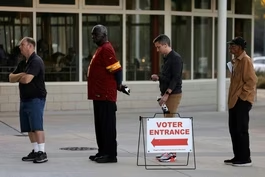
LIZ LANDERS: Yes, Amna, he is traveling to Dalton, Georgia, tomorrow to stump for the Senate candidate there, Mike Collins.
I was in Georgia recently for a closer look at that race, where Collins is in an uphill battle against the incumbent Democratic Senator Jon Ossoff.
On his vineyard in Southern Georgia, Gary Paulk feels the impacts of many of President Trump's policies firsthand.
GARY PAULK, Paulk Vineyards: The fuel today is twice as high as it would have been this time last year.
LIZ LANDERS: Polk is a fifth-generation muscadine grape farmer in rural Ray, Georgia.
GARY PAULK: Pick them up and eat them, yes.
LIZ LANDERS: Mmm.
GARY PAULK: Sweet.
LIZ LANDERS: Really sweet.
He says fuel prices, tariffs that have raised his costs, and an immigration crackdown that has made it harder to find workers have all taken a toll.
The president says all the time that he is doing these mass deportations because noncitizens, people who are here illegally in some cases are taking jobs from Americans.
Is that the case?
GARY PAULK: That's just -- that's not true.
They're not taking -- they're not taking jobs from Americans, and, actually, a lot of times that they are filling jobs that Americans don't want, more ag jobs and more remedial -- you know, labor-intensive jobs, construction jobs.
LIZ LANDERS: Paulk also worries about access to health care in rural areas after his 36-year-old daughter, Amy, suffered serious strokes that nearly took her life.
GARY PAULK: Amy has come a long way.
She still can't speak very well.
She's just now starting to eat some soft foods, but she's a fighter.
LIZ LANDERS: After weighing all these factors, Paulk has decided for the first time in his life to cast a ballot for a Democrat, incumbent Senator Jon Ossoff.
He doesn't agree with the Democrat on all issues, notably abortion, but it is Ossoff's help in getting federal aid after Hurricane Helene wreaked havoc on Paulk's grape crop that won his vote.
GARY PAULK: He's done a lot of things and proposed a lot of things.
And he's crossed party lines to do it, especially with the hurricane disaster.
They got $531 million appropriated for the hurricane disaster for farmers in this area.
SEN.
JON OSSOFF (D-GA): The country needs us to work.
LIZ LANDERS: At 39, Ossoff is the youngest sitting U.S.
senator and the only Democrat running for reelection in a state Trump won in 2024.
A hotly contested swing state in recent elections, Georgia was expected to be a tight contest again.
But Ossoff has built a comfortable lead, in part by relentlessly focusing on affordability.
SEN.
JON OSSOFF: Millions are just one medical bill, short paycheck, or bad alternator from disaster.
You work harder and harder, but the treadmill gets faster and steeper and the bills get higher and higher.
LIZ LANDERS: Ossoff's opponent is Congressman Mike Collins, whose campaign has been plagued with troubles from the beginning, from a campaign kickoff ad that misspelled Georgia to lackluster fund-raising and a series of scandalous headlines that two former aides and even Collins' son-in-law have promoted antisemitism and white nationalist views.
SEN.
JON OSSOFF: If John Lewis were marching today from Selma to Montgomery, Mike Collins would be grabbing a billy club.
His office has been in cahoots with some of the most notorious white supremacists around the country.
LIZ LANDERS: Collins strongly denies the allegations.
REP.
MIKE COLLINS (R-GA), Senatorial Candidate: I have condemned racism, antisemitism, hate.
I don't care where the source is.
And I tell him that too.
It's wrong.
We have no place in this world for that.
LIZ LANDERS: A lifelong Georgian whose father was a congressman for 12 years, Collins attacks Ossoff as left-leaning and out of touch with Georgia values.
REP.
MIKE COLLINS: I am unapologetically pro-God, pro-Trump, pro-Second Amendment.
I believe in a strong military.
Peace through strength works.
If it's not good for Georgia and it's not good for this country, I will never support it.
LIZ LANDERS: Collins has made crime and illegal immigration his major campaign issues, touting his bill, the Laken Riley Act, that requires federal authorities to detain undocumented immigrants who commit theft or violent crimes.
REP.
MIKE COLLINS: Every life taken by an illegal immigrant is preventable.
But it can only be stopped when we have leaders that will prioritize American lives.
LIZ LANDERS: Collins supporters like his message.
WOMAN: Absolutely, I'm supporting Mike Collins.
MAN: He gets results, and that's what I want from any candidate that I vote for.
LIZ LANDERS: They also worry the national conversation is hurting him.
MAN: There is the worry with what's going on nationally and internationally with the president that I think is really hurting Mike Collins.
And so I don't know if it's necessarily his fault.
LIZ LANDERS: President Trump has endorsed Collins.
For his part, Ossoff has kept President Trump front and center in his attacks, making viral headlines with this aside: SEN.
JON OSSOFF: So, he doesn't want to do the job.
He wants to build his ballroom and travel with Natalie on their apparently defenseless flying palace gifted by the emir of Qatar.
(CHEERING) LIZ LANDERS: That brief mention of Trump aide Natalie Harp ricocheted around the Internet for days and prompted this response: QUESTION: What is your response?
DONALD TRUMP: Who said that?
QUESTION: Jon Ossoff.
DONALD TRUMP: You mean Pee-wee Herman?
Pee-wee Herman look-alike.
LIZ LANDERS: Ossoff's campaign style has made him a social media star and even sparked talk of a future presidential run.
But it's Ossoff's attention to local issues, helping constituents solve problems, and steering federal money to Georgia, that has won over even some Republican elected officials.
Scott James Matheson is the mayor of Valdosta, Georgia, in one of the reddest parts of the state.
President Trump has visited Valdosta, Georgia, three times in the last decade.
He won this county that we're in here by 18 points in the 2024 presidential race.
This is Trump country.
SCOTT JAMES MATHESON, Mayor of Valdosta, Georgia: I'm very conservative by nature.
I stick strictly to Republican beliefs, core beliefs.
LIZ LANDERS: Why are you going to vote for Senator Ossoff?
SCOTT JAMES MATHESON: It's a relationship.
I don't know how it took root, but, boy, it's been beneficial to myself as a mayor and to the city of Valdosta.
LIZ LANDERS: Their relationship started in 2022, when Ossoff helped win federal money for a transit system in Valdosta.
And two years ago, when Hurricane Helene devastated the city, Ossoff was the first national politician to visit the scene.
Congressman Mike Collins represents a district not that far from here.
Why not endorse him?
SCOTT JAMES MATHESON: I don't know him.
I didn't have that relationship.
You develop a friendship.
I think people expected me to turn my back on him.
I think people thought that I'd turn away from Jon Ossoff, and I'm just not built that way.
There's no way I'm going to turn my back on that, politics aside.
LIZ LANDERS: He says affordability is the issue he hears most from residents these days.
SCOTT JAMES MATHESON: It's everything that I hear.
It's a very expensive walk through life right now.
I never thought that a power bill at my house would be more than my first two mortgages.
It's just a different world.
That's exactly what I hear.
LIZ LANDERS: About an hour away back at the vineyard, Gary Paulk says he plans to support Republican Rick Jackson for governor, but he's sticking with Ossoff for the Senate.
GARY PAULK: I have church members that probably will chastise me for the... LIZ LANDERS: For the sign?
GARY PAULK: For the sign, but I got some thick skin, you know?
I just say, I want to be on the winning inside.
LIZ LANDERS: For the "PBS News Hour," I'm Liz Landers.
AMNA NAWAZ: Across the nation, scores of small private colleges and universities are either closing or under threat.
With each shuttering, students, faculty, and the surrounding community struggle to find a way forward.
Tonight, Paul Solman reports on one such school.
This story was reported in collaboration with The Hechinger Report and is part of our higher education series Rethinking College.
TOMMY LEE JONES, Actor: The answer you're looking for lies right here.
PAUL SOLMAN: Box office sensations.
LUPITA NYONG'O, Actress: I would make a great queen because I am so stubborn.
PAUL SOLMAN: Award-winning actors.
NARRATOR: We have shared the incommunicable experience of war.
PAUL SOLMAN: PBS' most celebrated documentarian.
The common thread, all grads of a little liberal arts school in Massachusetts, Hampshire College, founded in 1965 as an experiment, no grades, no required classes, students designing their own curriculum.
KEN BURNS, Documentary Filmmaker: I don't recognize the person who entered Hampshire College in the fall of 1971 and the person who graduated in the spring of 1975.
PAUL SOLMAN: Filmmaker Ken Burns.
KEN BURNS: It just rearranged all my molecules.
I don't think I would be talking to you as a documentary filmmaker and so many other things if Hampshire hadn't provided the kind of preparation that it had.
JIM WALD, Former Hampshire College Professor: We would teach people to be thinkers about profound issues of knowledge and society, and that way they would be adaptive learners who could carry on this process of individual thinking as they pursued careers and so forth.
PAUL SOLMAN: History professor Jim Wald taught at Hampshire for nearly 40 years.
JIM WALD: When it opened, it was the hot place, I'm told, more selective than Harvard or equally selective as Harvard.
Hampshire was always way up there in really making students do a lot of work, because the idea was to show people how to be scholars.
This is what it means to be a historian or a biologist.
PAUL SOLMAN: Or become a filmmaker like Barry Sonnenfeld or writer like Jon Krakauer.
JIM WALD: Our students were challenged much more than others in a lot of other schools.
The college has a Latin motto, non satis scire, to know is not enough, embodying this idea of wisdom and critical thinking.
PAUL SOLMAN: An ethos that persisted for actors like Lupita Nyong'o of the "Black Panther" and "The Odyssey" and Liev Schreiber.
LIEV SCHREIBER, Actor: Hampshire was interested in radical questions.
The faculty and the other kids were interested in things that were different.
Challenging the world in which you live in, in a positive and constructive way was certainly the ethos.
PAUL SOLMAN: And students like Chloe De Lisle today, finishing her thesis in ethnomusicology.
CHLOE DE LISLE, Hampshire College Student: I'm looking at the process of when sound in film becomes part of the music and how that represents a protagonist's trauma.
PAUL SOLMAN: What would be an example?
CHLOE DE LISLE: "Apocalypse Now" and how the signature helicopter sound that really permeates the film is part of the protagonist's experience and trauma, and then a collective cultural trauma.
PAUL SOLMAN: Ken Burns' final thesis 51 years ago?
KEN BURNS: My half-an-hour film called "Working in Rural New England" for Old Sturbridge Village, which is a living history museum.
PAUL SOLMAN: So you mean you literally began your career doing what you have been doing ever since at Hampshire?
KEN BURNS: It's even worse than that, Paul, which is the last shot of the film for Old Sturbridge Village was a pan across a painting from an agrarian to a kind of industrial or preindustrial sequence.
PAUL SOLMAN: Just like so many pans in his PBS films, and thus Hampshire's hallmark from then to now, focused exploration.
CHLOE DE LISLE: Here has allowed me to really do whatever I want and really create my own major, and that's meant everything.
And I have just gotten to pull all my interests together and create something really cool.
PAUL SOLMAN: A result of deep connection with the school.
MARS RICHMAN, Former Hampshire College Student: With the class structure, without those prerequisites, able to do what you want, chart your own course, I feel that I was able to be focused faster than most people would at a traditional college.
PAUL SOLMAN: First year student Jupiter Brady-McCullough feels the same.
JUPITER BRADY-MCCULLOUGH, Former Hampshire College Student: I made some great friends.
I had some really amazing classes with some really amazing professors, and I learned a lot about myself.
So I think I'm not alone in feeling kind of hopeless, in that we see a lot of these small schools closing right now.
PAUL SOLMAN: And this barren scene on Hampshire's campus could become a reality for scores of schools across the country.
One analysis finds that, in the next decade, of the nation's 1700 nonprofit private colleges and universities, more than 400 are on the brink, meaning the nearly 700,000 students projected to go to them are at risk.
In fact, when Hampshire announced last April that it would be closing at the end of this year... MARS RICHMAN: I cried all day.
Everyone cried all day.
We were... PAUL SOLMAN: Really?
Everybody?
MARS RICHMAN: Everybody cried all day long.
PAUL SOLMAN: But you knew that school had been in trouble?
MARS RICHMAN: We all -- I mean, we all knew, but it kept not dying.
Logically, we all knew someday it would, but it kept kind of escaping death.
MADELINE KEATING, Hampshire College Student: Hampshire means everything to me.
PAUL SOLMAN: Madeline Keating is finishing up her study in fiber arts.
MADELINE KEATING: I was pretty devastated like everybody else, but I also had an understanding that this was kind of coming.
PAUL SOLMAN: That's because the writing had been on the wall for years.
Hampshire almost went under in 2019, a young school, a meager endowment, reliant on student tuition in the era of the great college squeeze, says Hampshire President Jennifer Chrisler.
JENNIFER CHRISLER, President, Hampshire College: Hampshire, like many institutions of a higher education today, faced a real firestorm between enrollment, cost of college, the changing demographics across this country, the pressure on the value of a liberal arts degree.
PAUL SOLMAN: Fewer high school seniors, fewer going to college, dizzying costs, and a scary job market.
No wonder Hampshire teetered.
Finally, last April: JENNIFER CHRISLER: When it became clear that we couldn't deliver the kind of education that we knew was the most consequential for our students, we decided to do the responsible thing and teach out in a way that allowed those students who wanted to graduate with us to be able to do so, and those who needed to pursue transferring to another college or university the time to be able to do so.
PAUL SOLMAN: Down from a height of more than 1,200, 170 mostly seniors are sticking it out until graduation.
But on the 820-acre campus, that's almost five acres per student.
What's happened to those who've left?
Some have transferred.
MARS RICHMAN: I didn't plan on going to college after high school.
PAUL SOLMAN: But Mars Richman did.
MARS RICHMAN: I heard about Hampshire, and I thought that it sounded like the school of my dreams.
I felt really lucky to be somewhere it felt like I was actually getting the support I needed to be able to learn.
PAUL SOLMAN: He finished two years at Hampshire in April.
After the school announced it would close, he'd become confident enough to transfer to the nearby University of Massachusetts at Amherst, student body 30,000.
You wouldn't have gone to UMass Amherst out of high school, right?
MARS RICHMAN: Absolutely not, no.
PAUL SOLMAN: But did Hampshire prepare you for this?
MARS RICHMAN: As far as being in a higher education institution, yes, absolutely.
PAUL SOLMAN: But when colleges like Hampshire close, many students leave higher ed altogether.
PETER STOKES, Huron Consulting Group: Research suggests that, when a student is at a college that closes, only about 50 percent of those students actually reenroll at another college.
PAUL SOLMAN: Peter Stokes is a higher education researcher.
PETER STOKES: And, of those, only about 50 percent complete.
So a college closure is exceptionally disruptive to the lives of students.
PAUL SOLMAN: Is Hampshire then the cliched canary in the coal mine?
JUPITER BRADY-MCCULLOUGH: I applied to three schools, Sterling College, Hampshire College, and College of the Atlantic, and two of them are now closed.
PAUL SOLMAN: As just this year are both Hampshire and Sterling, a fate now threatening to befall hundreds of colleges across higher ed, 500 of which have closed in just the last 10 years.
For the "PBS News Hour," Paul Solman in Amherst, Massachusetts.
AMNA NAWAZ: Why are some great ideas and works of art forgotten, and why are others revived?
These are among the questions explored by musician, writer, and visual artist David Byrne.
Senior arts correspondent Jeffrey Brown joined him recently in Brooklyn for our arts and culture series, Canvas.
(MUSIC) JEFFREY BROWN: Questions and more questions.
David Byrne is a man with a curious and quirky mind, including when it comes to writing songs.
DAVID BYRNE, Musician and Author, "Sleeping Beauties: Why Good Ideas Go Dormant and How They Wake Up": Sometimes, I will start with the title of a song.
I did a song called "I Met the Buddha at a Downtown."
And I go, all right, what happens?
What's he like?
What's he doing?
JEFFREY BROWN: What's this Buddha guy doing at the party?
DAVID BYRNE: What does he say to you?
What do you say to him?
What does he say to you?
JEFFREY BROWN: He's a man of many turns, front man for the rock band Talking Heads, musical experimenter and collaborator with artists around the globe, Oscar winner for co-writing the score for "The Last Emperor," Broadway star in "American Utopia," and a lot more, including cycling man about town, a regular sight on New York streets, and the subject of his 2009 book, "Bicycle Diaries."
Now he's asking new questions stemming from the fairy tale of Sleeping Beauty, the princess cursed to sleep 100 years, who can be awakened only by the kiss of a prince.
Byrne came across an article in a science journal that applied the term to studies that for various reasons have been ignored or forgotten, only to be later recognized and given renewed prominence.
DAVID BYRNE: I immediately thought, I know this phenomena.
I know it from musicians that I might like, but I feel like didn't get their deserved appreciation.
I know of we're always reading about this or that or the other, and they're suddenly rediscovered, and it's like now we understand it.
Now what they did makes perfect sense.
JEFFREY BROWN: Something's lost and then found.
DAVID BYRNE: Found again, yes.
And it's -- I just love these stories, the stories of kind of a resurrection or that kind of thing, of somebody -- somebody or some work kind of coming back to life and being re-appreciated.
JEFFREY BROWN: The result is the book "Sleeping Beauties: Why Good Ideas Go Dormant and How They Wake Up."
DAVID BYRNE: This kind of clocklike device will kind of keep the telescope always pointed at the object you're observing.
JEFFREY BROWN: It's a mix of art, science, and technology that reflects his own interests.
He asked to meet us at Pioneer Works, an artist- and scientist-led cultural center in Brooklyn that he loves for its focus on creativity in its many forms.
His book offers many examples of world-famous artists lost to history for a time, sometimes centuries, thankfully rescued.
Perhaps you know this image by Italian early renaissance painter Sandro Botticelli.
DAVID BYRNE: Botticelli is really well-known.
JEFFREY BROWN: Very well-known today.
DAVID BYRNE: Very well-known.
He's on tea towels.
You can get a watch with Venus on it.
You can get you name it, and those images that are on there, Birth of Venus and all that stuff.
DAVID BYRNE: So when you tell people, no, this guy went way out of favor for hundreds of years... JEFFREY BROWN: Byrne tells the story of Botticelli's artistic death at the hands of the crusading religious zealot Savonarola and his much later rebirth in the late 19th century.
DAVID BYRNE: Gradually, he gets re-appreciated, until, by the beginning of the 20th century, there were more books written about Botticelli than any other artist.
JEFFREY BROWN: There are as many or more examples in the fields of science and technology, such as Gregor Mendel, today known as the father of genetics, whose initial paper in 1866 went largely unrecognized.
DAVID BYRNE: For various reasons, it didn't click until, later on, two scientists were doing a very similar kind of research, and they thought, before we publish this, let's take a look and see if maybe someone else has done something similar before we take all the credit.
Yes, they found Mendel's paper.
And they go, oh, my God, he kind of did it all.
JEFFREY BROWN: And then there's something you might not expect in a book like this, concrete.
DAVID BYRNE: This is one of my favorite ones.
When people ask me, what's your book about, and I go, concrete.
JEFFREY BROWN: Concrete.
DAVID BYRNE: Yes, concrete.
And they go, what?
What?
Concrete's everywhere, yes, highways, buildings, everything.
DAVID BYRNE: And I go, yes.
The Roman concrete, the Pantheon, for example, the dome of that is unreinforced, and it's lasted 2,000 years and doesn't have a crack in it.
The companies that make concrete now rate their concrete as guaranteed to last 50 years.
JEFFREY BROWN: Fifty years.
DAVID BYRNE: Five-zero.
JEFFREY BROWN: Yes.
DAVID BYRNE: That's a little bit of a difference.
So you go, what happened?
Who lost the recipe?
JEFFREY BROWN: Not so much lost, Byrne shows, as not understanding or ignoring Roman materials and building practices, a bias thinking we know better than people of the past.
The key for Byrne, the rediscovery to benefit us today.
DAVID BYRNE: Let's focus on how these things got rediscovered, because that's really what we want to know.
We want to know if there's other ones out there and how can we find them?
The question is, what are we suppressing, or what have we forgotten that's out there?
Because we do the same things.
JEFFREY BROWN: Byrne himself is still very much producing his own art.
He just finished a long tour for his most recent album titled "Who Is the Sky?"
And he's busy in other ways, including his online magazine titled "Reasons to be Cheerful."
WOMAN: This is just one student group.
JEFFREY BROWN: Offering positive stories by people around the country for how to overcome problems.
He calls it a tonic for tumultuous times.
DAVID BYRNE: It's so easy now to fall into despair or anger, frustration, and feel like, oh, everything's going to hell, yes, and there's nothing I can do about it.
JEFFREY BROWN: Do you feel, as you're getting older, that this is more important to you?
This is -- I don't know if you would call it a kind of service.
DAVID BYRNE: Well, there's plenty of musicians and entertainers or whatever who let people know their political beliefs and things like this.
And I thought, oh, I think what I could do is kind of not push my own particular beliefs, but kind of give a voice to these people in communities or whatever who are doing things and that that -- to me, that gives me hope and it's very encouraging.
JEFFREY BROWN: Do you think about these, about your own lasting contribution or how you will be remembered, I mean, especially in context of "Sleeping Beauties."
DAVID BYRNE: Evidence from this book, you can see that, well, you don't know right away.
Popularity or sales are not the way to judge a lot of things.
That's a very temporary measure.
You don't know the rest until time passes.
JEFFREY BROWN: You don't know whether David Byrne will one day be a sleeping beauty?
DAVID BYRNE: Yes, we don't know that yet.
(LAUGHTER) DAVID BYRNE: I'm imagining yes.
There's some fairy tale prince going in the door and going, whoa, whoa, whoa, who are you?
Yes.
(LAUGHTER) JEFFREY BROWN: Our time together ended not with a prince, but with the Statue of Liberty.
And then it was time for David Byrne to unlock his bike, put on his helmet, and ride off.
For the "PBS News Hour," I'm Jeffrey Brown in Brooklyn.
AMNA NAWAZ: Before we go, an update now to a story we reported earlier.
At least four people have reportedly died, including three children, following a shooting this afternoon at Silver Rail Elementary School in Bend, Oregon.
The "News Hour" has not independently confirmed those numbers.
Officials say the shooter is dead.
We will continue to update the latest on this story on our Web site.
That's PBS.org/NewsHour.
And that is the "News Hour" for tonight.
I'm Amna Nawaz.
On behalf of the entire "News Hour" team, thank you for joining us.
 New
NewAn accounting of Trump's promised payouts
Video has Closed Captions
An accounting of Trump's promised payouts and questions they raise (4m 38s)
 New
NewDavid Byrne explores the art of rediscovery in new book
Video has Closed Captions
David Byrne explores the art of rediscovery in 'Sleeping Beauties' (8m 31s)
 New
NewInside Georgia’s Senate race between Ossoff and Collins
Video has Closed Captions
Inside Georgia’s Senate race and Collins's uphill battle against Ossoff (7m 48s)
 New
NewNews Wrap: Trump says execution will not be livestreamed
Video has Closed Captions
News Wrap: Trump says Fort Hood shooter's execution will not be livestreamed (6m 12s)
 New
NewPennsylvania doctor urges vaccination amid measles outbreak
Video has Closed Captions
Pennsylvania doctor urges vaccination as measles outbreak grows (6m 11s)
 New
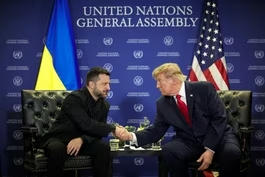
NewUkraine less reliant on U.S. amid rift, ex-ambassador says
Video has Closed Captions
Ukraine less reliant on U.S. as Trump-Zelenskyy rift deepens, former ambassador says (5m 10s)
 New
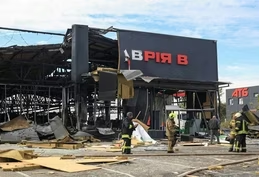
NewUkraine resumes energy strikes, saying Russia never stopped
Video has Closed Captions
Ukraine resumes strikes on energy targets, saying Russia never stopped its attacks (3m 46s)
 New
NewWhy small colleges are closing and the toll on communities
Video has Closed Captions
Why small colleges are closing and the toll on students and communities (8m 39s)
Providing Support for PBS.org
Learn Moreabout PBS online sponsorship New Episode
- News and Public Affairs

FRONTLINE is investigative journalism that questions, explains and changes our world.

- News and Public Affairs

Today's top journalists discuss Washington's current political events and public affairs.
 New Episode

 New Episode

 New Episode



 New Episode
Support for PBS provided by:
Major corporate funding for the PBS News Hour is provided by BDO, BNSF, Consumer Cellular, American Cruise Lines, and Raymond James. Funding for the PBS NewsHour Weekend is provided by...