
Oakland University art exhibition reflects on atomic bombings in Japan
Clip: Season 10 Episode 39 | 6m 39sVideo has Closed Captions
The exhibition features the experiences of survivors of the Hiroshima and Nagasaki atomic bombings.
In partnership with the Peace Resource Center, an exhibition marking the 80th anniversary of the atomic bombings in Japan is on display at Oakland University’s art gallery. “Memorializing the Hibakusha Experience” features photographs, poems and art focusing on the survivors in Hiroshima and Nagasaki. It was curated by Professor Claude Baillargeon and is on display through April 5. One Detroit co
Problems playing video? | Closed Captioning Feedback
Problems playing video? | Closed Captioning Feedback
One Detroit is a local public television program presented by Detroit PBS
Oakland University art exhibition reflects on atomic bombings in Japan
Clip: Season 10 Episode 39 | 6m 39sVideo has Closed Captions
In partnership with the Peace Resource Center, an exhibition marking the 80th anniversary of the atomic bombings in Japan is on display at Oakland University’s art gallery. “Memorializing the Hibakusha Experience” features photographs, poems and art focusing on the survivors in Hiroshima and Nagasaki. It was curated by Professor Claude Baillargeon and is on display through April 5. One Detroit co
Problems playing video? | Closed Captioning Feedback
How to Watch One Detroit
One Detroit is available to stream on pbs.org and the free PBS App, available on iPhone, Apple TV, Android TV, Android smartphones, Amazon Fire TV, Amazon Fire Tablet, Roku, Samsung Smart TV, and Vizio.
Providing Support for PBS.org
Learn Moreabout PBS online sponsorship(upbeat music) - [Toko] Ground zero, Hiroshima, Japan, filmed by the US military in 1946, only months after the first atomic bomb was dropped.
- There are survivors who wanted the world to know what happened to them and others like them, even though many people did not wanna be recognized.
They said, "Please take our pictures, show the world.
"So we do not repeat the evil."
- [Toko] Oakland University's Art Gallery in Rochester.
Claude Baillargeon is a professor of art history.
He's giving a walkthrough of an exhibition called "Memorializing the Hibakusha Experience."
Hibakusha refers to the survivors of the atomic bombings in Hiroshima and Nagasaki in 1945.
- [Reporter] Just 50 seconds later, 15 miles from ground zero, the Enola Gay is rocked by the black.
(tense music) - The significance of "Memorializing the Hibakusha Experience," I think it has a lot to do with our current geopolitics.
I do believe that a lot of people think that the threat of nuclear war is a thing of the past.
People think that since the end of the Cold War, maybe this is no longer relevant, but I think it is even more relevant today than it has been in recent past.
So that is one of the reasons why this exhibition, I think is very significant today.
I do wanna bring your attention to these two magazines that are here.
Very, very significant.
- [Toko] Published accounts of actual atomic bomb survivors' experiences.
In the US, the "New Yorker" published a story in August, 1946, a year after the bombings.
Up until then, coverage of the bombs didn't focus on the human cost.
The Radiation Effects Research Foundation estimates up to 246,000 died from the blast and the radiation poisoning that followed.
- This truly was the first time that the American people read about the people who were on the ground.
Up until that point, it's all been about the mushroom cloud and the physical destruction of the city, right?
But in this case, it begins a noiseless flash.
- [Toko] The article tells the stories of six survivors.
Then the world began to learn more.
In Japan, a press code prohibited reporting about the survivors' experiences.
It was lifted in 1952.
- There was no poetry, no art could be made, no literature.
You cannot talk about it.
This magazine on this site called "Asahigraph" is published on August 6th, 1952.
- [Toko] Seven years after the bombings.
- This is the first time that the Japanese people actually saw images of what happened on the ground.
These are probably some of the most difficult picture to look at in the exhibition because at the time of these three photographs, these people were alive, but they died within hours or a day.
- [Toko] The exhibition is in partnership with the Peace Resource Center established in 1975 at Wilmington College in Ohio.
It preserves a collection amassed by an American anti-nuclear activist devoted to the cause of the Hibakusha.
- You've got photographs by famous people.
You've got photographs by anonymous, amateur photographer.
You've got books that do not exist United States, or some of them, you can find two copies or something.
Then they've got all this archival material.
They have relics, they have example of Hibakusha handicraft.
- [Toko] And Baillargeon had some other artists add their work to the exhibition.
- And I ended up adding five contemporary artists whose work is also inspired by the nuclear experience.
We're also concerned with the state of affairs on a global stage and wanna make art that speak about the memory.
I do hope that this exhibition will travel further.
Looking back at the island of Bikini, so here's another one of these photograph.
- [Toko] Professor Baillargeon's class visual representations and the nuclear experience.
This session's about Bikini Atoll and the Pacific.
After the war, this was a nuclear weapons test site for the US Government.
- If you look at the file name of this, it gives you the date, and at the end it says secret, right?
These images were all completely unavailable until several years, decades, in fact, after the bombing.
- The things that we talk about in here that the things that I learned about that I just, I would have never known.
And it's disturbing really to know that maybe if I had not taken this class, that I would just walk around without any of that knowledge.
- My courses are about visual culture.
In the course, visual representation, nuclear experience.
We have photographs that come from victims, that comes from survivors, that come from the military, that come from artists.
And the list goes on.
I'm interested in the totality.
How can we look at all forms of imagery that actually look at the nuclear era?
- We were told very little about the actual bomb, but we were told like right after that it was for the good to end the war.
So we were kind of told like this was, it was okay.
All of the information that I have and the knowledge I gain, it doesn't just stay with me in this class.
It makes me wanna talk about it.
- You know, with how depressing and how dark and how ugly everything is, I think it's even more important to leave with hope and to leave having faith that we can come out of this and we can be better.
We need to take what we've learned and we need to be more loving.
We need to be more empathetic.
Don't let this hold you down, but let this kind of carry you forward.
I think that's important preference to feel.
- We are there to look with compassion and empathy about what happened, so that hopefully they will contribute to a better world going forward and not repeat the evil.
- Knowledge is power and it's very important to know.
- Knowledge is power.
Yeah, thank you for that.
 New
NewDisney’s “The Lion King” is back at the Detroit Opera House
Video has Closed Captions
Clip: S10 Ep39 | 7m 7s | A conversation with Zama Magudulela, who plays Rafiki, and Thembelihle Cele, who plays Nala. (7m 7s)
 New
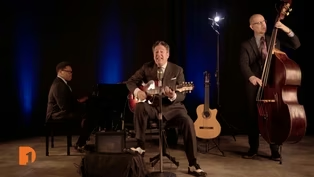
NewWorld-renowned guitarist and vocalist John Pizzarelli returns to Detroit
Video has Closed Captions
Clip: S10 Ep39 | 6m 50s | A conversation with guitarist and singer John Pizzarelli about his music and upcoming show. (6m 50s)
Providing Support for PBS.org
Learn Moreabout PBS online sponsorship
- News and Public Affairs

Top journalists deliver compelling original analysis of the hour's headlines.

- News and Public Affairs

FRONTLINE is investigative journalism that questions, explains and changes our world.












Support for PBS provided by:
One Detroit is a local public television program presented by Detroit PBS