
“Memorializing the Hibakusha Experience,” John Pizzarelli, “The Lion King,” Caregiving Conversations
Season 10 Episode 39 | 26m 46sVideo has Closed Captions
Exhibition reflects on atomic bombings, a conversation with jazz artist John Pizzarelli and more.
A new exhibition at Oakland University reflects on the people affected by the atomic bombings in Japan. Jazz guitarist and vocalist John Pizzarelli talks about his concert in Detroit. Also, we’ll sit down with two South African performers from “The Lion King” at the Detroit Opera House. And, as part of our caregiving initiative, we’ll hear from a metro Detroit man who provided care for two people.
Problems playing video? | Closed Captioning Feedback
Problems playing video? | Closed Captioning Feedback
One Detroit is a local public television program presented by Detroit PBS
“Memorializing the Hibakusha Experience,” John Pizzarelli, “The Lion King,” Caregiving Conversations
Season 10 Episode 39 | 26m 46sVideo has Closed Captions
A new exhibition at Oakland University reflects on the people affected by the atomic bombings in Japan. Jazz guitarist and vocalist John Pizzarelli talks about his concert in Detroit. Also, we’ll sit down with two South African performers from “The Lion King” at the Detroit Opera House. And, as part of our caregiving initiative, we’ll hear from a metro Detroit man who provided care for two people.
Problems playing video? | Closed Captioning Feedback
How to Watch One Detroit
One Detroit is available to stream on pbs.org and the free PBS App, available on iPhone, Apple TV, Android TV, Android smartphones, Amazon Fire TV, Amazon Fire Tablet, Roku, Samsung Smart TV, and Vizio.
Providing Support for PBS.org
Learn Moreabout PBS online sponsorship- Coming up on "One Detroit," we'll visit an exhibition at Oakland University reflecting on the people affected by the atomic bombings in Japan over 80 years ago.
Plus jazz guitarist and vocalist, John Pizzarelli talks about his upcoming concert in Detroit.
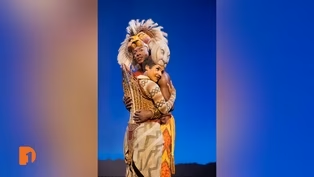
Also ahead, we'll talk with two South African performers appearing in the "Lion King" at the Detroit Opera House.
And as part of our caregiving initiative, we'll hear from a Metro Detroit man who provided care and companionship for two people.
It's all coming up next on "One Detroit."
- [Narrator] Across our Masco family of companies, our goal is to deliver better living possibilities and make positive changes in the neighborhoods where we live, work, and do business.
Masco, a Michigan company since 1929.
Support also provided by the Cynthia & Edsel Ford Fund for Journalism at Detroit PBS.
- [Announcer] The DTE Foundation is a proud sponsor of Detroit PBS.
Through our giving, we are committed to meeting the needs of the communities we serve statewide to help ensure a bright and thriving future for all.
Learn more at dtefoundation.com.
- [Narrator] Nissan Foundation and viewers like you.
(upbeat music) - Just ahead on "One Detroit," we'll hear from acclaimed jazz guitarist and singer, John Pazzarelli, about following in his famous father's footsteps.
Plus the "Lion King" is back at the Detroit Opera House.
We'll hear from two of the cast members and we'll continue our series of conversations with Metro Detroit caregivers about their experiences caring for others.
But first up, an exhibition reflecting on the atomic bombings in Japan is on display at Oakland University through Sunday, April 5th.
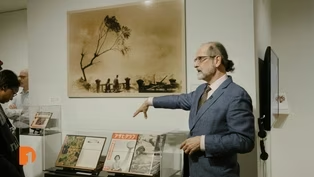
The display features photographs, poems, and art focusing on the survivors of Hiroshima and Nagasaki.
It's titled, "Memorializing the Hibakusha Experience."
Contributor Toko Shiiki produced this story.
(upbeat music) - [Toko] Ground zero, Hiroshima, Japan, filmed by the US military in 1946, only months after the first atomic bomb was dropped.
- There are survivors who wanted the world to know what happened to them and others like them, even though many people did not wanna be recognized.
They said, "Please take our pictures, show the world.
"So we do not repeat the evil."
- [Toko] Oakland University's Art Gallery in Rochester.
Claude Baillargeon is a professor of art history.
He's giving a walkthrough of an exhibition called "Memorializing the Hibakusha Experience."
Hibakusha refers to the survivors of the atomic bombings in Hiroshima and Nagasaki in 1945.
- [Reporter] Just 50 seconds later, 15 miles from ground zero, the Enola Gay is rocked by the black.
(tense music) - The significance of "Memorializing the Hibakusha Experience," I think it has a lot to do with our current geopolitics.
I do believe that a lot of people think that the threat of nuclear war is a thing of the past.
People think that since the end of the Cold War, maybe this is no longer relevant, but I think it is even more relevant today than it has been in recent past.
So that is one of the reasons why this exhibition, I think is very significant today.
I do wanna bring your attention to these two magazines that are here.
Very, very significant.
- [Toko] Published accounts of actual atomic bomb survivors' experiences.
In the US, the "New Yorker" published a story in August, 1946, a year after the bombings.
Up until then, coverage of the bombs didn't focus on the human cost.
The Radiation Effects Research Foundation estimates up to 246,000 died from the blast and the radiation poisoning that followed.
- This truly was the first time that the American people read about the people who were on the ground.
Up until that point, it's all been about the mushroom cloud and the physical destruction of the city, right?
But in this case, it begins a noiseless flash.
- [Toko] The article tells the stories of six survivors.
Then the world began to learn more.
In Japan, a press code prohibited reporting about the survivors' experiences.
It was lifted in 1952.
- There was no poetry, no art could be made, no literature.
You cannot talk about it.
This magazine on this site called "Asahigraph" is published on August 6th, 1952.
- [Toko] Seven years after the bombings.
- This is the first time that the Japanese people actually saw images of what happened on the ground.
These are probably some of the most difficult picture to look at in the exhibition because at the time of these three photographs, these people were alive, but they died within hours or a day.
- [Toko] The exhibition is in partnership with the Peace Resource Center established in 1975 at Wilmington College in Ohio.
It preserves a collection amassed by an American anti-nuclear activist devoted to the cause of the Hibakusha.
- You've got photographs by famous people.
You've got photographs by anonymous, amateur photographer.
You've got books that do not exist United States, or some of them, you can find two copies or something.
Then they've got all this archival material.
They have relics, they have example of Hibakusha handicraft.
- [Toko] And Baillargeon had some other artists add their work to the exhibition.
- And I ended up adding five contemporary artists whose work is also inspired by the nuclear experience.
We're also concerned with the state of affairs on a global stage and wanna make art that speak about the memory.
I do hope that this exhibition will travel further.
Looking back at the island of Bikini, so here's another one of these photograph.
- [Toko] Professor Baillargeon's class visual representations and the nuclear experience.
This session's about Bikini Atoll and the Pacific.
After the war, this was a nuclear weapons test site for the US Government.
- If you look at the file name of this, it gives you the date, and at the end it says secret, right?
These images were all completely unavailable until several years, decades, in fact, after the bombing.
- The things that we talk about in here that the things that I learned about that I just, I would have never known.
And it's disturbing really to know that maybe if I had not taken this class, that I would just walk around without any of that knowledge.
- My courses are about visual culture.
In the course, visual representation, nuclear experience.
We have photographs that come from victims, that comes from survivors, that come from the military, that come from artists.
And the list goes on.
I'm interested in the totality.
How can we look at all forms of imagery that actually look at the nuclear era?
- We were told very little about the actual bomb, but we were told like right after that it was for the good to end the war.
So we were kind of told like this was, it was okay.
All of the information that I have and the knowledge I gain, it doesn't just stay with me in this class.
It makes me wanna talk about it.
- You know, with how depressing and how dark and how ugly everything is, I think it's even more important to leave with hope and to leave having faith that we can come out of this and we can be better.
We need to take what we've learned and we need to be more loving.
We need to be more empathetic.
Don't let this hold you down, but let this kind of carry you forward.
I think that's important preference to feel.
- We are there to look with compassion and empathy about what happened, so that hopefully they will contribute to a better world going forward and not repeat the evil.
- Knowledge is power and it's very important to know.
- Knowledge is power.
Yeah, thank you for that.
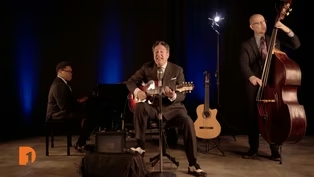
- Internationally acclaimed jazz guitarist and vocalist, John Pizzarelli is bringing his signature style to Detroit's Cabaret 313.
On April 11th.
The concert will celebrate the "Great American Songbook."
Contributor Linda Yohn from 90.9 WRCJ had a wide ranging conversation with Pizzarelli about following in his father's musical footsteps, his new album and his upcoming concert.
(upbeat guitar music) ♪ I call her Firely ♪ ♪ 'Cause, oh my, she radiates moonglow ♪ - We're so excited that you're coming to Detroit again, this time, not as part of the big festival, but as part of a very intimate and elegant, yet swinging and soulful evening for Cabaret 313.
And we'll talk more about how Cabaret 313 sets it up for you.
It's really cool.
But first, "Doe Ray Me" is the very good place to start.
- Basically, it begins in Patterson, New Jersey, where I was born April 6th, 1960.
I was the son of Bucky and Ruth Pizzarelli.
Bucky Pizzarelli being one of the great jazz guitarists and studio figures in New York City for 60 years.
And his uncles taught him how to play guitar, taught me how to play tenor banjo.
And then in my teen years, I, along with learning a lot of rock and roll music, I listened to a lot of the music my father was part of.
And we became a team somewhere in the early '80s, I guess around 1980.
We made a record, a couple of records in the '80s.
And then I started to listen to the music of The King Cole Trio and started to learn some of the repertoire.
"Route 66," "Frim Fram Sauce," "Straighten Up and Fly," right?
And at that point, when I would work with my father, I would sing a little, I made a record in '83, in '84 and '87 singing.
And I think the real big record was called "My Blue Heaven" in 1990, which I made singing with Dave McKenna, Clark Terry, Connie Kay, Milt Hinton, and Bucky Pizzarelli.
I've been very lucky.
I got to do what I want to do.
I can play, "I Got Rhythm" for a living, and I got to work with some of the great musicians on the planet, and it's been quite a wonderful ride.
♪ But when I get her there, set her there ♪ ♪ Do I get to pet her there ♪ ♪ And grab me some glow ♪ ♪ No, she's a gad about, mad about ♪ ♪ Luring every lad about ♪ ♪ While leaving me moaning low ♪ - Another great thing about you, John Pizzarelli, is that you're willing to take a few seconds and tell the story if that particular song really has a neat backstory and tell it.
- Yeah.
I mean, it's part of the presentation, you know, to make sure people who, I always say, there's two groups of people.
There's the John Pizzarelli fan and the person who came with them.
And that's the person that you wanna introduce constantly.
Remember that there's somebody out there who will say, "You know, I don't like jazz, but I like what you do."
- Part of that good category is a chemistry that you develop with the other members of the trio inspired by Art Tatum and Nat King Cole.
So let's talk about those guys 'cause they are on the new CD.
- Yes, they are.
And they've been... Mike Karn, who plays bass with me, has been with me for 10 years.
And Isaiah joined in 2019, December of 2019, and immediately got a year-and-a-half off for good behavior in 2020 into 2021.
But we have a nice chemistry and we figured out our strengths and the things that we can do together.
And we present all of them on "Dear Mr.
Bennett," as we did on stage and screen the record before that.
There's just the idea of the rhythm section, à la Nat King Cole.
But then there's sort of the ideas of the Oscar Peterson Trio in there and then just the great rhythm sections of the '60s with, you know, Bucky on rhythm guitar and Milt Hinton and those guys - When you were at the Detroit Jazz Festival and looked out on the audience, I thought, "Oh, look at those guitarists out there.
"They wanna see the seven string in action."
- Yeah.
- Yeah.
And, of course, hear you.
So what can we expect when you and Isaiah and Mike come and play for us in Detroit at Cabaret 313?
- We'll do a crisscross of the "Great American Songbook."
We'll play some Duke Ellington.
We'll play some things from our Tony Bennett record and from stage and screen and some bossanova.
We just do a good crisscross of the trio's greatest hits over the, well, the 10 years that Mike's been in the band, and then the five years of Isaiah.
So it really is, it's a terrific evening and we have some great sections of those things planned out to make it informative and fun.
And it goes perfectly with that little taste.
♪ Latch on to you ♪ ♪ Know how, oh how ♪ ♪ I love you, but gee ♪ ♪ While you set the night on firefly ♪ ♪ Shine a little light on me ♪ - Thank you.
And the management team and whatever for hooking up with Cabaret 313 to come and honor Tony Bennett for us.
Just a little bit about the recording.
How can people who are listening, viewing pick one up?
- Oh, you can download them wherever you stream your music.
We'll have records on hand when we're playing in Detroit, and I guess wherever you buy your records, they'll be out there.
You can get them, have them delivered to your house.
And there's even vinyl.
So it's on Green Hill is the name of the company that put the record out, and we're just thrilled with it.
We had a little picture that Tony Bennett drew of me on the cover there, which is so sweet and very proud of the record.
And it's out there.
You can find it.
Go to johnpizzarelli.com for your every John Pizzarelli need.
♪ While you set the night on, firefly ♪ ♪ Shine a little light on ♪ ♪ Shine a little light on ♪ ♪ Shine a little light on me ♪ - Disney's the "Lion King" wraps up at the Detroit Opera House on Sunday, April 5th.
The Tony Award-winning musical has been touring North America for more than 20 years.
It's a coming of age story about a young lion in Africa named Simba.
"One Detroit" contributor, Stephen Henderson of American Black Journal spoke with two South African cast members about performing in a show that celebrates their home, culture and languages.
(gentle music) - I am playing the character called Rafiki.
She is a baboon, I know.
There's a variety of questions related to the character, but she plays a shaman in the show.
And she is the only character that really doesn't really interact with all those animals.
However, she's like the glue, you know, she keeps everybody together.
So yeah, my specific joy in playing the character is the fact that I get to speak my language in the show.
And it doesn't matter which country.
I get a chance to speak my language and sing in my language.
So basically I feel like I'm really, really out there representing my country altogether.
You know, not just any country, Africa altogether.
So, yeah.
- And what language is that?
- I speak Zulu.
- Okay.
- Yes.
- And this character, does that character speak Zulu no matter who's playing the part?
Or is it just because you're able to do that?
- No, I speak Zulu 'cause it's my language.
However, in the script, there's like three languages being used from South Africa, which is Zulu, Xhosa, Sotho, those are one of the three of our native languages from South Africa.
So, but me specifically, I speak Zulu.
I mix all of all three, but mostly it is Zulu.
You know, there's a part where in the show where I get to speak, like, tell a story in my language, it's called the click story.
Yes, you would have to come and see it for you to hear it.
Yeah, but basically for me representing my country through my language, through my music, it makes it feel very, very special.
- Yeah.
Let's talk about your character.
- I play the role of Nala.
She is the princess of the pride.
And she becomes, she is forced to grow up quickly, but she also becomes the catalyst for the change that, you know, that takes place when Simba comes back to, you know, take his rightful place as the King of the Pride Lands.
And she has a lot to do with that because she goes out to find help.
So how that translates to me is, you know, it's one of those things where you, especially as a woman, you know, as young girls are being raised all over to believe, you know, certain things about themselves.
And then you step into a role like this and you get to be strong and to show up bravely and courageously and Nala is exactly that.
You know, I came in thinking, you know, having all of these grand ideas about what I would infuse into the role, but Nala really gives me the permission to be all of those things.
To get to also be in a show that values the authenticity of, you know, the culture that it represents.
I also double as the show's dialect coach as well.
So to know that they've invested the energy and the effort into bringing that to the stage as authentically and as truthfully as possible, is something that I also take great pride in.
It makes me so happy to be part of something so big and a legacy so rich, but also represent my culture and my country in such a big way.
Because like she said, these are our home languages that are spoken in, you know, a very small corner of, in the southernmost tip of the continent, but is being represented and has been seen by millions across the globe.
- Yeah.
- Yeah.
- I'm not sure that I know, I knew, or that most people I know knew that it is a South African story.
That it is set in that culture.
Obviously it's African, everyone can tell that, but I didn't know that it was specifically South African.
And that changes, I think, for me, the way I think about it.
I wonder for you guys, whether you think people identify enough with it being South African?
- Basically, I would say on that one, as much as they've taken the South African, of course, even if they could, they could have used the whole African languages, but it's not, was not possible.
So at this point, using the South African, I feel, despite of different countries, we have common grounds.
We relate culturally, we might speak different languages, but we are very much connected.
- I mean, the staging of this is of course, you know, a huge part of what makes it special and so distinct really from the movie.
I wonder as actors what that experience is like to be a part of something that is as kind of richly staged as this is.
- So, because theater is a living, breathing thing, we get to, in real time, at all times, pour in very real aspects of our lives into the show and into the roles that we play.
Because on any given day, you could be experiencing what the story is telling because we've all been within close proximity to loss, or we've lost something or someone, or have felt lost ourselves in the world.
So whether you're on a journey of self-discovery or figuring something out or a very real life event, you are bringing that into the story that on that given day, and it can touch somebody in the audience differently.
On some days, you're joyful about something and you're bringing that joy.
And that's the beauty of it.
Like, we're a cast of 50-plus international people from very different walks of life.
And so we all get to come into that space and bring in whatever life experience we're having.
It's very much alive at every given moment.
And not only is it multisensory in that, you know, our orchestra and our percussionists who are in the house with us are very much a part of this story.
You know, we have the procession coming in and bringing the story to life.
So the audience gets to participate in that as well.
And we get to see that and also feed off of that and react to that.
So at any given moment, the story, it is alive.
As soon as that curtain comes up and you hear the call, you know, the story just comes to life.
- As part of our ongoing caregiving coverage, "One Detroit" launched a series of conversations with local caregivers.
Today we hear from Clinton Township resident, Tom Zaglaniczny about caring for two people in his life.
(bright music) - About 10 years ago or so, I made friends with a person from church and stuff, and we started to hang out, men's Bible study and stuff like that.
And he came down with Parkinson's disease and we used to golf and everything.
So I'd pick him up, or his wife would drop him off at the golf course and, you know, would play.
And over time as he got worse, you know, he couldn't golf any longer, but I just kind of made sure that, I would pick him up and he would chip and putt.
Now a friend of mine has an uncle that I pick up twice a week and he has Alzheimer's.
And we come here, we do different things.
There's a lot of people that have these conditions as they age.
Right?
And is it like, "Is that gonna be part "of my healthcare journey down the road," right?
"And who's gonna take care of me?
How's that?
You know, it's like, is there gonna be somebody there to help me or just to pick me up and take me out someplace?
There's a lot of people here that are caregivers, you know, and we compare notes, you know, with different things on how things are going with their person that they're caregiving for and what my person is going through and stuff.
And we just kind of compare notes and see where they're at.
You know, and we just, we're there for each other.
Some of the advice I've received is just, you know, don't take it personal.
You know, you can get involved really deeply with some people, right?
And then it just kind of wears out on you, right?
So it's like, you know, just keep it safe.
Listen to what the people are saying, right?
I mean, 'cause we all have a conversation within us.
That's the biggest thing.
And, you know, and don't, you know, discount what they're saying or their feelings.
(bright music) - You can see more caregiving conversations and special reports at onedetroitpbs.org.
That'll do it for this week's show.
Thank you for watching.
Head to the "One Detroit" website for all the stories we're working on.
Follow us on social media and sign up for our newsletter.
(bright music) - [Narrator] Brought to you in part by Impart Alliance, Ralph C. Wilson Jr.
Foundation and by... Across our Masco family of companies, our goal is to deliver better living possibilities and make positive changes in the neighborhoods where we live, work, and do business.
Masco, Michigan company since 1929.
Support also provided by the Cynthia & Edsel Ford Fund for Journalism at Detroit PBS.
- [Announcer] The DTE Foundation is a proud sponsor of Detroit PBS.
Through our giving, we are committed to meeting the needs of the communities we serve statewide to help ensure a bright and thriving future for all.
Learn more at dtefoundation.com.
- [Narrator] Nissan Foundation and viewers like you.
(bright music)
 New
NewDisney’s “The Lion King” is back at the Detroit Opera House
Video has Closed Captions
Clip: S10 Ep39 | 7m 7s | A conversation with Zama Magudulela, who plays Rafiki, and Thembelihle Cele, who plays Nala. (7m 7s)
 New
NewOakland University art exhibition reflects on atomic bombings in Japan
Video has Closed Captions
Clip: S10 Ep39 | 6m 39s | The exhibition features the experiences of survivors of the Hiroshima and Nagasaki atomic bombings. (6m 39s)
 New
NewWorld-renowned guitarist and vocalist John Pizzarelli returns to Detroit
Video has Closed Captions
Clip: S10 Ep39 | 6m 50s | A conversation with guitarist and singer John Pizzarelli about his music and upcoming show. (6m 50s)
Providing Support for PBS.org
Learn Moreabout PBS online sponsorship
- News and Public Affairs

Top journalists deliver compelling original analysis of the hour's headlines.

- News and Public Affairs

FRONTLINE is investigative journalism that questions, explains and changes our world.












Support for PBS provided by:
One Detroit is a local public television program presented by Detroit PBS