
Disney’s “The Lion King” is back at the Detroit Opera House
Clip: Season 10 Episode 39 | 7m 7sVideo has Closed Captions
A conversation with Zama Magudulela, who plays Rafiki, and Thembelihle Cele, who plays Nala.
Disney’s “The Lion King” has returned to the Detroit Opera House for its sixth residency. One Detroit contributor Stephen Henderson of American Black Journal sits down with Zama Magudulela, who plays Rafiki, and Thembelihle Cele, who plays Nala. The two South African actors talk about being a part of a show that celebrates their home country’s culture and its impact on audiences around the world.
Problems playing video? | Closed Captioning Feedback
Problems playing video? | Closed Captioning Feedback
One Detroit is a local public television program presented by Detroit PBS
Disney’s “The Lion King” is back at the Detroit Opera House
Clip: Season 10 Episode 39 | 7m 7sVideo has Closed Captions
Disney’s “The Lion King” has returned to the Detroit Opera House for its sixth residency. One Detroit contributor Stephen Henderson of American Black Journal sits down with Zama Magudulela, who plays Rafiki, and Thembelihle Cele, who plays Nala. The two South African actors talk about being a part of a show that celebrates their home country’s culture and its impact on audiences around the world.
Problems playing video? | Closed Captioning Feedback
How to Watch One Detroit
One Detroit is available to stream on pbs.org and the free PBS App, available on iPhone, Apple TV, Android TV, Android smartphones, Amazon Fire TV, Amazon Fire Tablet, Roku, Samsung Smart TV, and Vizio.
Providing Support for PBS.org
Learn Moreabout PBS online sponsorship- Disney's the "Lion King" wraps up at the Detroit Opera House on Sunday, April 5th.
The Tony Award-winning musical has been touring North America for more than 20 years.
It's a coming of age story about a young lion in Africa named Simba.
"One Detroit" contributor, Stephen Henderson of American Black Journal spoke with two South African cast members about performing in a show that celebrates their home, culture and languages.
(gentle music) - I am playing the character called Rafiki.
She is a baboon, I know.
There's a variety of questions related to the character, but she plays a shaman in the show.
And she is the only character that really doesn't really interact with all those animals.
However, she's like the glue, you know, she keeps everybody together.
So yeah, my specific joy in playing the character is the fact that I get to speak my language in the show.
And it doesn't matter which country.
I get a chance to speak my language and sing in my language.
So basically I feel like I'm really, really out there representing my country altogether.
You know, not just any country, Africa altogether.
So, yeah.
- And what language is that?
- I speak Zulu.
- Okay.
- Yes.
- And this character, does that character speak Zulu no matter who's playing the part?
Or is it just because you're able to do that?
- No, I speak Zulu 'cause it's my language.
However, in the script, there's like three languages being used from South Africa, which is Zulu, Xhosa, Sotho, those are one of the three of our native languages from South Africa.
So, but me specifically, I speak Zulu.
I mix all of all three, but mostly it is Zulu.
You know, there's a part where in the show where I get to speak, like, tell a story in my language, it's called the click story.
Yes, you would have to come and see it for you to hear it.
Yeah, but basically for me representing my country through my language, through my music, it makes it feel very, very special.
- Yeah.
Let's talk about your character.
- I play the role of Nala.
She is the princess of the pride.
And she becomes, she is forced to grow up quickly, but she also becomes the catalyst for the change that, you know, that takes place when Simba comes back to, you know, take his rightful place as the King of the Pride Lands.
And she has a lot to do with that because she goes out to find help.
So how that translates to me is, you know, it's one of those things where you, especially as a woman, you know, as young girls are being raised all over to believe, you know, certain things about themselves.
And then you step into a role like this and you get to be strong and to show up bravely and courageously and Nala is exactly that.
You know, I came in thinking, you know, having all of these grand ideas about what I would infuse into the role, but Nala really gives me the permission to be all of those things.
To get to also be in a show that values the authenticity of, you know, the culture that it represents.
I also double as the show's dialect coach as well.
So to know that they've invested the energy and the effort into bringing that to the stage as authentically and as truthfully as possible, is something that I also take great pride in.
It makes me so happy to be part of something so big and a legacy so rich, but also represent my culture and my country in such a big way.
Because like she said, these are our home languages that are spoken in, you know, a very small corner of, in the southernmost tip of the continent, but is being represented and has been seen by millions across the globe.
- Yeah.
- Yeah.
- I'm not sure that I know, I knew, or that most people I know knew that it is a South African story.
That it is set in that culture.
Obviously it's African, everyone can tell that, but I didn't know that it was specifically South African.
And that changes, I think, for me, the way I think about it.
I wonder for you guys, whether you think people identify enough with it being South African?
- Basically, I would say on that one, as much as they've taken the South African, of course, even if they could, they could have used the whole African languages, but it's not, was not possible.
So at this point, using the South African, I feel, despite of different countries, we have common grounds.
We relate culturally, we might speak different languages, but we are very much connected.
- I mean, the staging of this is of course, you know, a huge part of what makes it special and so distinct really from the movie.
I wonder as actors what that experience is like to be a part of something that is as kind of richly staged as this is.
- So, because theater is a living, breathing thing, we get to, in real time, at all times, pour in very real aspects of our lives into the show and into the roles that we play.
Because on any given day, you could be experiencing what the story is telling because we've all been within close proximity to loss, or we've lost something or someone, or have felt lost ourselves in the world.
So whether you're on a journey of self-discovery or figuring something out or a very real life event, you are bringing that into the story that on that given day, and it can touch somebody in the audience differently.
On some days, you're joyful about something and you're bringing that joy.
And that's the beauty of it.
Like, we're a cast of 50-plus international people from very different walks of life.
And so we all get to come into that space and bring in whatever life experience we're having.
It's very much alive at every given moment.
And not only is it multisensory in that, you know, our orchestra and our percussionists who are in the house with us are very much a part of this story.
You know, we have the procession coming in and bringing the story to life.
So the audience gets to participate in that as well.
And we get to see that and also feed off of that and react to that.
So at any given moment, the story, it is alive.
As soon as that curtain comes up and you hear the call, you know, the story just comes to life.
 New
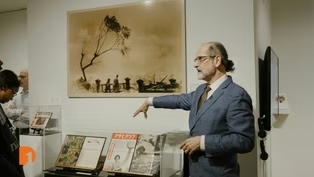
NewOakland University art exhibition reflects on atomic bombings in Japan
Video has Closed Captions
Clip: S10 Ep39 | 6m 39s | The exhibition features the experiences of survivors of the Hiroshima and Nagasaki atomic bombings. (6m 39s)
 New
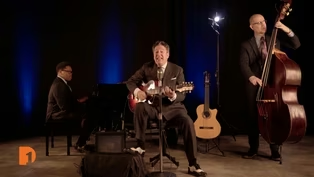
NewWorld-renowned guitarist and vocalist John Pizzarelli returns to Detroit
Video has Closed Captions
Clip: S10 Ep39 | 6m 50s | A conversation with guitarist and singer John Pizzarelli about his music and upcoming show. (6m 50s)
Providing Support for PBS.org
Learn Moreabout PBS online sponsorship
- News and Public Affairs

Top journalists deliver compelling original analysis of the hour's headlines.

- News and Public Affairs

FRONTLINE is investigative journalism that questions, explains and changes our world.











Support for PBS provided by:
One Detroit is a local public television program presented by Detroit PBS