
Brooks and Capehart on Trump's 'forever trade war'
Clip: 8/28/2026 | 11m 54sVideo has Closed Captions
Brooks and Capehart on Trump's 'forever trade war'
David Brooks of The Atlantic and Jonathan Capehart of MS NOW join Geoff Bennett to discuss the week in politics, including President Trump's trade war and dispute with Canada, the legal fight over mail-in ballots, the public backlash to AI and data centers and the loss of Dolly Parton.
Problems playing video? | Closed Captioning Feedback
Problems playing video? | Closed Captioning Feedback
Major corporate funding for the PBS News Hour is provided by BDO, BNSF, Consumer Cellular, American Cruise Lines, and Raymond James. Funding for the PBS NewsHour Weekend is provided by...
Brooks and Capehart on Trump's 'forever trade war'
Clip: 8/28/2026 | 11m 54sVideo has Closed Captions
David Brooks of The Atlantic and Jonathan Capehart of MS NOW join Geoff Bennett to discuss the week in politics, including President Trump's trade war and dispute with Canada, the legal fight over mail-in ballots, the public backlash to AI and data centers and the loss of Dolly Parton.
Problems playing video? | Closed Captioning Feedback
Where to Watch PBS News Hour
PBS News Hour is available to stream on pbs.org and the PBS app.
Providing Support for PBS.org
Learn Moreabout PBS online sponsorshipGEOFF BENNETT: Well, for more on President Trump's trade war moves and the legal fight over mail-in ballots, we turn now to the analysis of Brooks and Capehart.
That's "The Atlantic"'s David Brooks and Jonathan Capehart of MS NOW.
Good evening.
gentlemen.
JONATHAN CAPEHART: Hey, Geoff.
GEOFF BENNETT: So, the U.S.-Canada trade talks have collapsed.
President Trump is imposing 50 percent tariffs on roughly $28 billion worth of Canadian goods.
Canada is now matching them dollar for dollar.
This is set to start in a few weeks.
Jonathan, we are now in this escalating trade war with one of the country's closest allies and trading partners.
What stands out to you about all of this?
JONATHAN CAPEHART: Well, the major thing that stands out to me is that the president is even engaging in this fight that clearly is of no advantage, certainly not to Canadians, but to the American people.
How about those folks on states that border Canada, where basically there shouldn't even be a border?
There's so much cooperation, so much going back and forth.
The other thing that stands out to me is that - - Canada's willing to willingness to fight.
And this is sort of an outgrowth of Prime Minister Carney and his speech at the World Economic Forum where he laid down the marker, and that was, we can't be bullied anymore, and we're not going to be bullied, and we're going to protect our own interests.
And I think the prime minister is doing - - he's putting action behind the words.
GEOFF BENNETT: What about that?
Has President Trump finally found a trading partner willing to call his bluff?
DAVID BROOKS: Yes, we're -- it's another of his forever wars.
This one's a trade war.
My friends at The Wall Street Journal editorial page called this the dumbest trade war in the history of trade wars, and I think that's about right.
Economically, it makes no sense.
Aluminum prices are up 40 percent.
Steel prices are up 22 percent.
Politically, it makes no sense.
Who's getting hammered here?
General Motors.
General Motors has lost $2.5 billion because of the tariffs.
Ford.
Ford has a truck plant in Ontario.
This is Michigan.
Michigan is a swing state.
It's insane to be attacking... JONATHAN CAPEHART: How about Maine?
DAVID BROOKS: Maine too.
I mean, you're going after all your swing states.
And then, to me, even most reprehensibly, it's just morally shameful.
Like, friends don't humiliate and try to intimidate their friends.
It's like we're a big bully, and we think we're just going to render someone undignified and humiliated.
It's like the economic spirit of Abu Ghraib.
And the Canadians have no choice but to stand up.
They couldn't have self-respect as a country if they didn't stand up.
Every time there's some progress towards some deal, Trump says something about the Lake of America, and then the Canadian politicians have to say no.
And so, on every single front, this is like as dumb as dumb can be.
GEOFF BENNETT: To what degree is this trade dispute and to what degree are is this the beginning of another country's realignment away from the U.S.?
JONATHAN CAPEHART: The beginning?
I think it is under way.
Again, going back to Carney's speech at the World Economic Forum, he signaled that these actions were going to happen.
And, to David's point, at a certain point, the Canadians have to call President Trump's bluff, and they're doing it.
And now -- I guess, right now, it's just renaming Lake Ontario for whatever reason.
But we will see how far this trade war goes.
But it doesn't serve -- it serves no one.
GEOFF BENNETT: Well, this week, the U.S.
Supreme Court, as you both well know, they cleared a path for President Trump's executive order restricting mail voting without deciding whether the order itself is legal.
And then you had this federal judge lift another block.
And then the Postal Service, they have rules that are already in effect with ballots set to go out as soon as September 4.
And, David, the key question here is this.
The Constitution gives the power to the states to administer elections with Congress empowered to override them in certain circumstances.
It does not give that authority to the president.
So what is the conservative argument?
Is there a conservative argument for President Trump trying to assert all of this through executive action?
DAVID BROOKS: Wow.
I have got to come up with a creative, like -- wow, this is like the toughest question you have ever asked me in my life.
(LAUGHTER) DAVID BROOKS: Yes, there is no conservative argument.
The conservatives are supposed to believe in federalism, that, with the 10th Amendment or whatever it is, the states have the power to do this, and the federal government does not get to control everything.
And so the things that I find startling, let's put it that way, is first, if -- the Postal Service threatening to not deliver mail in states that don't comply, like, when does the Postal Service get to decide whose mail to deliver?
This is a public good.
And, second, if power does get vested in the federal government, no one should think that Donald Trump won't use this authority.
He will absolutely use this authority.
And so it really is an attempted federal takeover of a job the states have been doing pretty well.
GEOFF BENNETT: And the question for Democrats always seems to be, what are Democrats going to do about it?
Because Republicans don't see it in their own personal interests, elected Republicans on the Hill, to do anything at the moment.
JONATHAN CAPEHART: Well, that's why you have seen Democratic governors and Democratic secretaries of state, the moment the president does anything, related to anything, but particularly when it comes to voting, they are in court immediately.
And so they're still in court over this.
And if the conservatives on the Supreme Court are truly conservative, when the ultimate question of the legality gets to them, it should not take them but two minutes, if that, to come back with a unanimous decision, all six conservatives joining the three liberals on the bench,saying, this is not legal, Mr.
President.
But hope springs eternal.
GEOFF BENNETT: As we focus on the midterms, there is this issue that has become this election year flash point, and it's data centers.
You have candidates in both parties, they're tapping into concerns over higher electricity bills, water use, development.
Look at this national poll.
So, opposition to data centers has gone up to 61 percent.
This is more than 10 points, more than a 10-point jump in just a few months.
Is this A.I.
boom creating a new political fault line that really doesn't fit neatly into left or right?
DAVID BROOKS: I'm in favor of national unity and Republicans and Democrats coming together.
I happen to think this is kind of a dumb issue.
GEOFF BENNETT: Really?
Why?
DAVID BROOKS: Yes.
Well, first, on electricity use, they do use electricity, and there have been some local rate hikes and shortages.
But data centers use far less electricity than your air conditioners, and nobody's threatening to ban air conditioners.
They use water.
They use far, far, far, far, far less than agriculture or golf courses.
Most importantly, what's happened over the last four months in the world of A.I.?
The A.I.
units have gotten so much smarter, so much better.
They're beginning to work together.
We have just seen all these jailbreaks over the last several months, where they're breaking out of what they're supposed to be doing, they're hacking into other companies' databases, they're doing stuff we don't know about.
And so what you're seeing within the -- even within the industry, not that they admit it as much publicly, is, holy cow, have we crossed the point of no return?
I'm a relative A.I.
optimist, but I have been startled by some of the things the A.I.
bots have been doing over the last four months.
So that's where you should focus.
We need to regulate an international moratorium on the growth of A.I., the unrestricted growth.
The data centers will not do anything or almost nothing about that problem.
GEOFF BENNETT: Jonathan, how do you see it?
JONATHAN CAPEHART: I mean, after that, wow.
(LAUGHTER) JONATHAN CAPEHART: But I do think -- I mean, you pointed out energy use, water use development.
And I also think that one of the reasons why -- another reason why this is sort of a kumbaya issue is the fear of A.I.
and the fear of displacement and what this will mean for all sorts of -- all sectors of the economy and what this will do to people.
I also think that it's another issue where Congress is just way, way behind.
I'm still waiting for Congress to do something about the Internet.
That's 25 -- I have been waiting for that for 25 years.
DAVID BROOKS: For modems, dial-up modems.
DAVID BROOKS: When are they going to regulate modem?
JONATHAN CAPEHART: So now A.I.
and these jail breaks, like, Congress will never get anything done with this.
GEOFF BENNETT: Yes.
Well, as we wrap up our conversation here, I want to have you both reflect on Dolly Parton.
The world lost Dolly Parton this past week, a singular talent.
And there was something so generous and joyful about her spirit that she felt like she belonged to all of us.
And perhaps that's why the outpouring after her death has crossed so many of the divides that usually define American life.
David, what can we learn from her example?
DAVID BROOKS: I mean, I'm obviously sad to see her go, but I was very cheered by the reaction to it, the overwhelming reaction.
One thing I have noticed over the last five or seven years is, American audiences have a hunger for the following story.
Somebody is earnest and good and remains earnest and good and virtuous even in cynical circumstances.
So if you remember there were two "Ted Lasso" -- or two Mister Rogers' movies, a documentary and a film with Tom Hanks.
He was a good man, and audiences like me were weeping just to see that goodness.
Then you get "Ted Lasso," now in its fourth season, the same story.
If you saw "The Devil Wears Prada," the Anne Hathaway character is a good person who remains good person in cynical circumstances.
Dolly Parton was a transparently wonderful human being.
And people in the climate of moral shame, wow, I'd love to see that.
I'd love to see her, people like her, and that's the reaction.
GEOFF BENNETT: Jonathan?
JONATHAN CAPEHART: So, Dolly Parton was an enormous talent.
Let's just put it right out there, as a songwriter, a singer.
You said a singular -- I can't remember which one of you said singular talent.
I think you said she was a singular talent.
Enormous talent.
But on top of that, and the reason why I think she's so -- she was so beloved is that she lived her Christian values.
She did not shy away from people because they were different.
She actually moved toward people who were being victimized simply because of who they are.
And so, yes, there's a wide outpouring of grief in all quarters over the death of Dolly Parton, but particularly in the LGBTQ community, huge, huge loss.
Because, at a time when the nation was turning its back on us and what we were going through and the push for equal rights and just equal dignity, Dolly Parton was there saying, I see you and I'm with you, African Americans, same thing.
And so when I was reading the obituaries again on the plane coming back today, I teared up.
And it's -- she's one of those people who, when you see the news, either you hear it on the television or radio or you see it, your heart sinks, because, to David's point, she's one of those people who just she lived her values.
And she was an exemplar for who we all hope we would be, could be, and certainly the kind of person we would want to see someone of that stature.
And, sadly, we don't see very many people like Dolly Parton at that level.
GEOFF BENNETT: Indeed.
One of a kind.
Jonathan Capehart, David Brooks, thank you both.
Have a great weekend.
JONATHAN CAPEHART: Thanks, Geoff.

Devastating scale of Himalayan floods comes into focus
Video has Closed Captions
Devastating scale of Himalayan floods comes into focus as rescuers arrive (5m 12s)
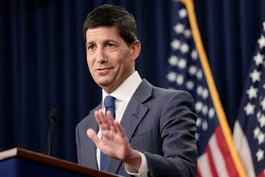
Fed's Warsh not ruling out rate hike amid inflation concerns
Video has Closed Captions
Fed Chair Warsh not ruling out interest rate hike amid inflation concerns (6m 11s)

Groundbreaking treatments offer hope in fight against cancer
Video has Closed Captions
Groundbreaking treatments and vaccines offer hope in fight against cancer (5m 53s)

NPS strained by Trump's construction, political pressure
Video has Closed Captions
National parks under strain from Trump's construction projects and political pressure (6m 59s)

Riley Downing finds poetry in overlooked corners of America
Video has Closed Captions
Riley Downing sings about the overlooked corners of American life in 'Landfill Poetry' (5m 27s)
Providing Support for PBS.org
Learn Moreabout PBS online sponsorship
- News and Public Affairs

Today's top journalists discuss Washington's current political events and public affairs.
 New Episode
- News and Public Affairs

FRONTLINE is investigative journalism that questions, explains and changes our world.
 New Episode

 New Episode


 New Episode


 New Episode
Support for PBS provided by:
Major corporate funding for the PBS News Hour is provided by BDO, BNSF, Consumer Cellular, American Cruise Lines, and Raymond James. Funding for the PBS NewsHour Weekend is provided by...