
Trump faces backlash from ranchers over plan to import beef
Clip: 8/26/2026 | 6m 55sVideo has Closed Captions
Trump faces backlash from ranchers over plan to import beef
Backlash is mounting over President Trump's plan to pause tariffs on imported ground beef. The announcement has drawn sharp criticism from both ranchers and Republican politicians, who say the cheap imports will undercut struggling American producers and weaken the industry in the long term. Geoff Bennett discussed more with Walter Schweitzer of the Montana Farmers Union.
Problems playing video? | Closed Captioning Feedback
Problems playing video? | Closed Captioning Feedback
Major corporate funding for the PBS News Hour is provided by BDO, BNSF, Consumer Cellular, American Cruise Lines, and Raymond James. Funding for the PBS NewsHour Weekend is provided by...
Trump faces backlash from ranchers over plan to import beef
Clip: 8/26/2026 | 6m 55sVideo has Closed Captions
Backlash is mounting over President Trump's plan to pause tariffs on imported ground beef. The announcement has drawn sharp criticism from both ranchers and Republican politicians, who say the cheap imports will undercut struggling American producers and weaken the industry in the long term. Geoff Bennett discussed more with Walter Schweitzer of the Montana Farmers Union.
Problems playing video? | Closed Captioning Feedback
Where to Watch PBS News Hour
PBS News Hour is available to stream on pbs.org and the PBS app.
Providing Support for PBS.org
Learn Moreabout PBS online sponsorshipGEOFF BENNETT: Backlash is mounting over President Trump's plan to temporarily pause tariffs on at least 300,000 metric tons of imported ground beef.
The announcement ahead of the midterm elections has drawn sharp criticism from both ranchers and Republican politicians, who say that cheap imports will undercut struggling American producers and weaken the industry in the long term.
The president says the move is aimed at providing relief to Americans struggling with higher grocery prices.
DONALD TRUMP, President of the United States: We want to get the beef prices down, so we will get them down a little bit.
And that's what people want.
That's what the voters want, and that's what I want.
GEOFF BENNETT: For a perspective from inside the industry, we're joined now by Walter Schweitzer.
He is the president of the Montana Farmers Union and raises black Angus cattle near Geyser, Montana.
Thanks for being with us.
WALTER SCHWEITZER, President, Montana Farmers Union: Yes, thank you for inviting me.
GEOFF BENNETT: Of course.
So, President Trump announced this plan saying he has a commitment to sell imported beef at 25 percent below current market prices.
The details so far have been scarce.
What do you know about how this plan would work and where this beef is coming from?
WALTER SCHWEITZER: I know nothing more than anyone, because we haven't seen the plan.
We haven't seen anything in writing.
All we can do is guess.
And what I do know is, 300,000 ton of additional beef into our marketplace is really only an increase by 2 to 3 percent over the total beef supply that we have.
And without mandatory country of origin labeling, the price of burger won't change.
What will happen is that these multinational packers will import this beef from their packing plants in Mexico, Brazil, other countries, and they will send it straight to the burger plants here in the United States, mix it in, put a USDA-inspected label, and sell it at U.S.
beef prices.
GEOFF BENNETT: So, looking at the numbers, ground beef prices have risen nearly 75 percent since 2021, while the U.S.
cattle herd is now the smallest it's been in 75 years.
So what's driving both sides of that equation?
You have got higher prices and fewer cattle.
WALTER SCHWEITZER: Well, first off, demand.
The consumers want to eat beef.
They know it's a healthy product and that they like the taste.
I don't blame them.
I like to eat beef too.
But, more importantly, we don't have a shortage of beef in our supply chain.
We actually have more beef in our supply chain than we did five years ago.
Almost 30 percent of our total beef supply is imported.
But no one knows this because we don't have country of origin labeling.
We could actually lower the price of beef here with this 300,000 metric ton if we required mandatory country of origin labeling, because then the packers, when they bring it to the grocery stores, would have a Mexican label on it or a Brazilian label, and the consumer would be able to pay less for that Mexican burger or that Brazilian burger.
And as a cattle producer, I'm not afraid to compete against these other countries, as long as we're doing it on a fair playing field with an honest label and total transparency.
GEOFF BENNETT: Well, say more about that, because, earlier this month, the USDA recalled nearly 30,000 pounds of raw beef imported from Argentina.
So I would imagine there are legitimate food safety and quality concerns with increasing these beef imports.
WALTER SCHWEITZER: There absolutely is.
And these countries, they don't raise their beef to the same standard as we do here in the United States.
In fact, when the Olympics were held in Mexico and Brazil, the Olympic Committee warned the athletes to not eat the local beef because they could potentially fail the drug tests.
GEOFF BENNETT: I want to play for you something that the agriculture secretary, Brooke Rollins, said yesterday.
Take a listen to this.
BROOKE ROLLINS, U.S.
Secretary of Agriculture: There's a lot of ground beef that's sitting in other countries that would potentially help serve Americans, especially lower-income Americans who really lean into -- lean into the lean ground beef.
And so this is a very short-term fix from the president's perspective that he believed necessary to get lower cost beef onto American plates.
GEOFF BENNETT: So the administration says this is a short-term fix.
You bring in cheaper beef, you increase the supply, you bring down prices.
Why doesn't that argument hold up?
WALTER SCHWEITZER: We don't have country of origin labeling.
So the only beneficiary of that is going to be these multinational packers.
They will be able to bring in that cheaper burger and put it in a package and sell it as U.S.
beef, misleading the consumers, thinking that they're buying high-quality beef from here in the United States.
This would work if we had country of origin labeling and the packers were forced to put a truthful label on those packages so that the consumers would know they're buying Brazilian beef or Mexican beef.
GEOFF BENNETT: Is the administration resistant to that?
WALTER SCHWEITZER: Well, they haven't done it yet.
And it all it would take is an executive order from the administration and we'd have mandatory tool tomorrow.
GEOFF BENNETT: Bottom line, how difficult is it to make a living as a rancher right now?
And what would actually make a meaningful difference for producers and consumers alike?
WALTER SCHWEITZER: Well, having certainty in the marketplace, to have a fair playing field.
Right now, these big four packers, they can take advantage of both the consumers and the producers, and they do it.
And if we just would enforce the antitrust laws that are on the books, we would enforce the Packer Stockyard Act, keeping these big four packers honest, we could bring prices down overnight.
But as long as we allow them to price gouge consumers and take advantage of producers, we're not going to see much change in the marketplace.
GEOFF BENNETT: As all of this is unfolding, the president is escalating his trade fight with Canada, a major market for American beef, and the other top buyers of American beef, South Korea, Japan, and Mexico, they're all facing tariff disputes with this administration as well.
What does that mean for you as a rancher?
WALTER SCHWEITZER: Well, for the last few years, Montana has been shipping a lot of our calves north the border into Canada.
And what's been happening is, Canada finishes those calves, slaughter those calves, puts them in a box, and ships them to the markets that we lost because of these tariffs.
And now adding 50 percent to the goods that we try to ship to Canada today means we have lost that market too.
GEOFF BENNETT: Walter Schweitzer, president of the Montana Farmers Union, thank you for sharing your insights with us.
WALTER SCHWEITZER: Thank you.

Custody fight erupts after surrogate refused to get abortion
Video has Closed Captions
Custody fight erupts after surrogate refuses abortion for baby with heart condition (4m 56s)
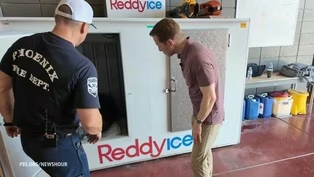
How bags of ice are helping save lives in Phoenix
Video has Closed Captions
In one of the nation's hottest cities, bags of ice are helping save lives (3m 36s)
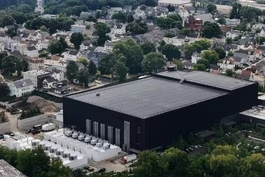
How data centers became a major issue in the midterms
Video has Closed Captions
How data centers became a major issue in the midterms (8m 2s)

Martina McBride shares her favorite Dolly Parton memories
Video has Closed Captions
Martina McBride shares her favorite Dolly Parton memories (5m 56s)

Maui residents face health struggles years after wildfires
Video has Closed Captions
Maui residents face health struggles 3 years after wildfires (8m 15s)

Meta case puts focus on youth mental health, Colo. AG says
Video has Closed Captions
$17B Meta settlement puts focus on youth mental health crisis, Colorado AG says (7m 14s)
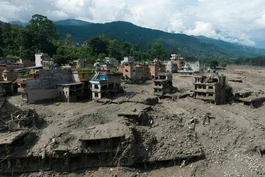
Wall of mud and debris floods communities in Nepal and Tibet
Video has Closed Captions
Wall of mud and debris floods communities in Nepal and Tibet (2m 35s)
Providing Support for PBS.org
Learn Moreabout PBS online sponsorship New Episode
- News and Public Affairs

Today's top journalists discuss Washington's current political events and public affairs.
 New Episode
- News and Public Affairs

FRONTLINE is investigative journalism that questions, explains and changes our world.
 New Episode

 New Episode


 New Episode
 New Episode

 New Episode
Support for PBS provided by:
Major corporate funding for the PBS News Hour is provided by BDO, BNSF, Consumer Cellular, American Cruise Lines, and Raymond James. Funding for the PBS NewsHour Weekend is provided by...