
July 24, 2026 - PBS News Hour full episode
7/24/2026 | 57m 46sVideo has Closed Captions
July 24, 2026 - PBS News Hour full episode
July 24, 2026 - PBS News Hour full episode
Problems playing video? | Closed Captioning Feedback
Problems playing video? | Closed Captioning Feedback
Major corporate funding for the PBS News Hour is provided by BDO, BNSF, Consumer Cellular, American Cruise Lines, and Raymond James. Funding for the PBS NewsHour Weekend is provided by...
July 24, 2026 - PBS News Hour full episode
7/24/2026 | 57m 46sVideo has Closed Captions
July 24, 2026 - PBS News Hour full episode
Problems playing video? | Closed Captioning Feedback
Where to Watch PBS News Hour
PBS News Hour is available to stream on pbs.org and the PBS app.
Providing Support for PBS.org
Learn Moreabout PBS online sponsorshipAMNA NAWAZ: Good evening.
I'm Amna Nawaz.
Geoff Bennett is away.
On the "NewsHour" tonight: The Trump administration once again levies tariffs on many of the United States' trading partners, this time claiming it's trying to combat forced labor.
CHRYSTIA FREELAND, Former Canadian Deputy Prime Minister: What is going on here is, frankly, a very obvious search for any pretext possible to impose tariffs on the world.
AMNA NAWAZ: One month after earthquakes hit Venezuela, a look at the shift from emergency response to long-term recovery.
And Ukraine reinvents the war supply chain by directly linking frontline soldiers with manufacturers, including volunteers making weapons with 3-D printers.
SIMON OSTROVSKY: A lot of these items look like toys, but they're actually very dangerous weapons.
They say necessity is the mother of invention.
And during this war with Russia, Ukraine has been incredibly inventive.
(BREAK) AMNA NAWAZ: Welcome to the "News Hour."
The latest set of tariffs from President Trump took effect today for more than 80 countries covering virtually all U.S.
imports.
The levies range from 10 to 12.5 percent, and they replace another set of temporary tariffs the president put in place after he lost a Supreme Court ruling earlier this year.
Today, in the Oval Office, he defended the move.
DONALD TRUMP, President of the United States: We put the tariffs on.
They're very standard tariffs.
The other way was easier.
I thought the decision by the Supreme Court was not a good one.
But we have many forms of tariffs.
AMNA NAWAZ: Liz Landers takes a look at this latest turn of events.
LIZ LANDERS: Amna, the administration says these new tariffs target countries that import goods using forced labor.
That characterization quickly drew objections from several allies and trading partners, who called it unjustified.
It all comes after the president announced new 50 percent tariffs on a slew of Canadian products set to go into effect in mid-August.
For more, we're joined by Chrystia Freeland.
She's the former deputy prime minister and finance minister of Canada, serving under Justin Trudeau and Mark Carney.
So we're going to get to the relationship between your country and the United States here in a second.
But I just want to get your initial reaction to this new round of tariffs and the administration's justification for them.
CHRYSTIA FREELAND, Former Canadian Deputy Prime Minister: This for me, Liz, I have to say, is a really sad moment.
It's a sad moment in history.
It's a sad moment in America's relationships with its closest allies, because what we are seeing is the United States beating up more fiercely on its allies, on its close friends, than it is on the countries to which it is antagonistic.
And it may feel good for some people in the short term, but I hope that Americans will recognize that your country is going to be weaker in the medium and long term if your country continues to treat countries that have been your allies over decades so terribly.
That's what I think is happening.
LIZ LANDERS: The U.S.
trade representative, Jamieson Greer, told Congress earlier this week of these tariffs -- quote -- "The specific authorities this administration is using have changed, but the trade strategy has not."
What has been the impact of this trade strategy?
And what do you expect will be the impact of these tariffs going forward?
CHRYSTIA FREELAND: So, economically, the trade strategy is making everybody poorer, because trade actually works.
It makes us richer.
That's why we do it.
It also is a tax on American consumers.
And it is one of the things that is driving inflation.
Inflation is still high in the United States, and these policies are keeping it there.
But I think the other thing that is really important to bear in mind when we're looking at these tariffs is, this is not what President Trump campaigned on.
It's not what he campaigned on in 2016.
It's not what he campaigned on in 2024.
What is going on here is, frankly, a very obvious search for any pretext possible to impose tariffs on the world and to impose tariffs with particular vigor, paradoxically, against America's allies.
I think that, if this administration wanted to be serious about saying, we're really worried about forced labor, we're really worried about the role that China is playing in the world and how China is treating its own people and the impact that is happening on the global economy, I think the U.S.
that wanted to lead a coalition doing that could be very successful.
But that's not what -- that is not what is happening right now.
LIZ LANDERS: As we were talking about, the president announced new 50 percent tariffs on a wide array of Canadian goods.
He said that they were in response to -- quote -- "Canada's discriminatory treatment of American products."
What is your response to the idea or to this allegation that Canada is engaging in unfair trade practices?
How significant is this standoff between these two allies?
CHRYSTIA FREELAND: The U.S.
action is significant.
It covers around $20 billion worth of trade.
It's a big breach.
It comes after a series of U.S.
actions since the reelection of President Trump that have been designed to hurt Canada.
Tariffs were imposed on Canadian steel, aluminum cars, and car parts last year.
Those are still in place.
This comes on top of those.
LIZ LANDERS: You were Canada's lead negotiator during Trump's first presidency when Canada, the United States, and Mexico were negotiating the USMCA, that trade deal between the countries.
What did you learn from that experience?
CHRYSTIA FREELAND: I learned that, at the end of the day, you can get a win-win outcome even with the Trump administration.
And the reason that was possible is the relationship, including the economic relationship between Canada and the United States, is a really good one.
It's mutually beneficial.
And at the end of the day, that recognition prevailed.
Two things really helped.
One was that we took the case outside the White House.
And we had huge numbers of Americans, whether they were congressmen and senators and governors to just regular people whose jobs and whose companies depended on trade with Canada speaking out and saying, why are we breaking up a good thing?
That was really important.
The other thing that was important was, I really think, with President Trump, the only thing he understands is strength.
And it's a really hard thing for a country to choose to retaliate with tariffs.
It's difficult.
It's painful.
In some ways, it's kind of a dumb thing to do, because it makes your own country poorer.
But I think the only way to get a good deal with President Trump is, if he hits you, your country has to be prepared to retaliate.
We have seen that China has managed to get a strong relationship with the president, and I think they have done that by being strong.
I think that's what America's allies need to do too.
LIZ LANDERS: What do you think is the future of free trade in North America?
CHRYSTIA FREELAND: Well, I hope that we continue to have a strong trade deal on our continent and a strong trade deal between Canada and the United States.
If the United States chooses not to have that kind of a relationship, Canada will survive, but it will make all of us poorer.
And regular Americans will face higher prices.
They will face inflation.
They will be a little bit less well off, and really for no reason, because, look, Canada is amazing.
We're a great country.
I don't think Americans see us as a national security threat.
And that's the justification for some of these tariffs.
LIZ LANDERS: Thank you for joining the "News Hour."
AMNA NAWAZ: And a note that we did invite the U.S.
trade representative, Jamieson Greer, to join us on the "News Hour" this week.
The administration declined.
We start the day's other headlines with two health updates from the CDC.
The agency says the U.S.
has now seen more cases of measles so far this year than in all of 2025.
More than 2,300 infections have been reported nationwide, making this the worst year for the disease since 1991.
Outbreaks in South Carolina, Utah, and Arizona have sickened hundreds of people, most of them unvaccinated.
The spike comes as Health Secretary Robert F. Kennedy Jr.
has downplayed the risk of measles and raised questions about the benefits of vaccines.
The CDC also says a massive cyclosporiasis outbreak linked to iceberg lettuce from Mexico has now expanded to four additional states, bringing the total to nine.
Officials say cases of the severe stomach illness are now in Illinois, Kansas, Oklahoma, and Pennsylvania.
That's an addition to Indiana, Kentucky, Michigan, Ohio, and West Virginia.
The CDC has now confirmed nearly 2,000 cases across those nine states and at least 98 hospitalizations, though the number of suspected cases nationwide is much higher.
Turning now to the war with Iran, President Trump provided few clues this afternoon on whether he would order a major escalation of attacks.
Speaking in the Oval Office this afternoon, Trump said there are a lot of possible exit strategies for the U.S.
and he refused to answer a question about whether any strikes on civilian infrastructure, which he has threatened, would be a war crime.
Instead, he insisted that talks are ongoing and that the U.S.
remains ready to carry on with its attacks.
DONALD TRUMP, President of the United States: We're locked and loaded and ready to go, but we're talking to them.
So I think, while we're talking, we will see what comes of it.
AMNA NAWAZ: Meanwhile, Iran struck U.S.
military targets in the region earlier today in response to the latest U.S.
strikes.
Iranian Foreign Minister Abbas Araghchi said that Tehran will not bow to U.S.
bullying and said the U.S.
must change its approach towards negotiations.
The Israeli military is deploying more troops to the occupied West Bank after one of the deadliest shootings there in months.
Palestinian health officials say the Israeli military shot and killed four Palestinians in the village of Tell in the Northern West Bank.
The bodies of those killed were taken to a nearby hospital.
Four others were wounded, some of them critically.
In the meantime, Israelis buried a 32-year-old reserve soldier who was killed in the shooting, one of at least two Israeli fatalities.
Both sides are offering different accounts of what led to the shooting.
In Ukraine, officials say at least 10 people were killed by a Russian ballistic missile strike today in the Kyiv region and nearly 100 others injured.
The attack happened near a defense industry event.
It comes a day after President Zelenskyy met with the American defense manufacturer Raytheon, which makes the Patriot air defense systems that Ukraine says it needs.
In the meantime, in St.
Petersburg, plumes of black smoke stretched into the sky after the latest Ukrainian drone attack on warehouses owned by Russia's largest online retailer, Wildberries.
Kyiv says the retailer supplies the Russian military, which the Kremlin denies.
In Western Europe, raging forest fires are forcing tens of thousands of people to flee.
In Southwestern France, fires have consumed around 50 square miles, not far from Bordeaux, since Wednesday.
Some homes were reduced to rubble.
Authorities in Spain have declared a national emergency as fires burn near Madrid.
Shelters are filled with evacuees.
One survivor described how quickly the flames consumed his home.
ENRIQUE MARTIN, Wildfire Survivor (through translator): I had to run from my house.
It was a ball of fire, and if I'd been five minutes later, it would have wiped us out.
My wife put her foot down, and that proved crucial.
AMNA NAWAZ: The fires come as Europe has suffered intense heat waves in recent weeks.
Both France and Spain are getting help from neighboring countries to combat the flames.
Member states of the International Criminal Court reportedly voted today to dismiss the tribunal's chief prosecutor over allegations of sexual misconduct.
British barrister Karim Khan was first accused of misconduct related to a female aide nearly two years ago.
He denies any wrongdoing.
It's the first time an ICC chief prosecutor has been removed from office.
And it comes as the Trump administration has launched renewed efforts to dismantle the body, saying the court is a threat to America's sovereignty.
In Georgia, a teenager pleaded guilty today to all 55 counts in a school shooting that killed four people and injured several others; 16-year-old Colt Gray, who was charged as an adult, entered the plea after previously pleading not guilty.
He was 14 at the time of the shooting at Apalachee High School in 2024, about 45 miles northeast of Atlanta.
Gray faces a minimum sentence of life in prison, though the judge can decide whether he should be eligible for parole.
In March, Gray's father was found guilty of second-degree murder, among other charges, for giving his son the gun that was used in the shooting.
On Wall Street today, stocks ended mixed, even as oil prices cooled for the first time in a week.
The Dow Jones industrial average added more than 230 points.
The Nasdaq slipped about 160 points, or more than half-a-percent.
The S&P 500 ended the day nearly flat.
And LeBron James is heading to the Philadelphia 76ers for his record 24th season.
The NBA's all-time leading scorer made the announcement on social media, writing -- quote -- "This is my last decision.
I'm not going for money.
I'm not going for family.
I still want to compete, to win and to have a chance at the feeling of winning another championship."
Terms have not been made public, but ESPN is reporting that he's set to sign a two-year $8 million deal.
Sixer fans are rejoicing, including Pennsylvania Governor Josh Shapiro, who proclaimed today LeBron James Day in the commonwealth.
Still to come on the "News Hour": David Brooks and Ruth Marcus weigh in on the week's political headlines; ocular prosthetics as art and a means of self-expression; and a look at the future of the national parks in Judy Woodruff's latest podcast.
Today marks one month since powerful earthquakes devastated parts of Venezuela, triggering a humanitarian crisis that is far from over.
Damage to schools, health facilities, and water systems has left communities without essential services, complicating an already difficult recovery.
Joining me now is Nate Mook, who leads the aid organization All Hands and Hearts.
He's just returned from Venezuela.
Thank you so much for being here.
NATE MOOK, CEO, All Hands and Hearts: Thanks for having me, Amna.
AMNA NAWAZ: You literally got back to the United States today after a week on the ground.
So just tell us, what does it feel like, what does it look like on the ground in Venezuela?
NATE MOOK: It's really hard to describe in words the scale of the devastation.
It's a little surreal because Caracas, the capital city, has mostly been spared by the earthquakes.
So it's sort of getting back to normal.
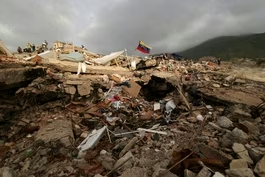
But as you drive north to the seaside, which is the community of La Guaira, which was hit by the two earthquakes back to back, it just looks almost like a war zone.
I have spent time in Gaza, and that's kind of the closest I can describe it, just buildings completely brought down to the ground.
And I think what's so tragic is now, a month later, Venezuelans are still there, standing on these buildings, digging down, trying to find their loved ones.
AMNA NAWAZ: Tell me about some of the people you met on the ground.
NATE MOOK: So, we met this amazing woman named Lara.
And Lara lost her brother-in-law and some other family members that were in one of the buildings that came down.
It happened so quickly.
Just the scale of these massive towers, building towers, brought down to the ground is just really hard to describe.
So Lara has been there from the start with friends and other people who lived in the building just digging.
She has shovels and buckets.
Ad people are doing what they can with sort of power tools that you would get at a Home Depot, for example.
They have some heavy equipment in Venezuela, but not to the scale that's needed.
So, for the most part, they're just on their hands and knees, kind of working and trying to get through.
They know generally in the building where their family members were, but accessing those areas and getting to those bodies now is what's difficult.
And Lara told us that she can't leave because she needs to -- they need to have closure.
They need to give their family member a burial.
AMNA NAWAZ: Nate, you have been in a lot of disaster zones.
You have seen a lot of responses.
What do you make and what can you tell us about the Venezuelan government response, knowing they were already facing economic and political crises before this, and also the U.S.
government response, knowing organizations like USAID are not what they once were?
NATE MOOK: Yes.
So it's really been incredible.
I think you have a few different pieces.
You have the U.S.
government, which surged in resources and support right away.
This has been one of the biggest responses from the State Department to a disaster in a very long time.
And you have Marines on the ground running the major airport there.
You have a lot of cargo flights bringing aid in.
You also have the Venezuelan government that has mobilized a lot of members of the military and police.
And you see them out, and they are assisting, and there's a lot of civil protection out there, kind of helping to -- even helping to dig in some cases and support families.
And then you have the international NGO community that has also surged in support, like All Hands and Hearts and our local partners on the ground.
We were active from day one, just trying to surge in what we can.
But the scale of kind of the damage and how it is so spread out, because the earthquake, it's not sort of in one spot.
It's really quite a wide area that's affected.
And so you will see a huge amount of assistance in certain areas, and then, in other areas, there really isn't much help at all.
We have a Venezuelan team on the ground.
We have Venezuelan partners.
And they are working 24 hours a day.
One of our partners, Claudia, runs the impact hub there.
This is sort of an entrepreneurial center.
Think of like a WeWork.
And yesterday she went and delivered tools to family members that are digging, and she literally is going to hardware stores.
And so there is something truly amazing to see of the Venezuelan people kind of surging in support.
I think the big question is, where do we go from here?
AMNA NAWAZ: Yes.
I mean, that is the big question.
You guys, your organization's been on the ground since the beginning of this.
As you mentioned, other organizations are there.
You have delivered food, clean water, shelter, tools, communications equipment.
But the U.N.
says nearly half-a-million people are still in need of humanitarian assistance.
Tens of thousands are in temporary camps.
What's the most urgent need right now?
NATE MOOK: Yes.
So what we're seeing now is this sort of shift from the rescue to kind of stabilization and eventual recovery.
I was just at a community camp that is called El Campito, and it's at a baseball field.
They literally turned to baseball field and started building little kind of shelters with tarps.
And so we brought in clean water and a Starlink, so they'd have some Internet connectivity.
We have kind of tried to find these pockets of support.
There are also people living on the streets.
So if their home was damaged or maybe wasn't fully demolished, people don't want to leave.
AMNA NAWAZ: Yes.
NATE MOOK: Their whole lives are there.
All of their stuff is still in their house.
And so they have sort of set up camps right outside.
And so I think what's difficult is, there is not a centralized, kind of single location to serve these thousands and thousands of families.
I talked to a gentleman who was at the campito, and he had sort of built up his little tent structure, and they'd even - - he was even building a little garden.
And I asked him, how long are you going to be here?
And he said he expects to be here at least a year, maybe longer.
They don't know where they can go from here.
How do we transition from this moment of displacement to try to get people into housing and what can be built?
But the scale of the debris removal and the cleanup that needs to happen, that really hasn't even begun yet, because family members, as I said, are still searching through the rubble.
AMNA NAWAZ: Certainly a very long recovery ahead.
Nate Mook, can't thank you enough for being here and making sure we don't let this fade from the headlines.
Thank you.
NATE MOOK: Thank you so much, Amna.
AMNA NAWAZ: Last week, Ukrainian President Volodymyr Zelenskyy dismissed his tech-savvy defense minister.
That sparked protests among supporters who credit him with helping to transform Ukraine's defense capabilities over the past six months.
Special correspondent Simon Ostrovsky and producer Katia Patin report on the revolutionary technologies and policies that helped drive that transformation.
And a warning: This report includes graphic descriptions of war.
SIMON OSTROVSKY: Victory gardens, war bonds, ration books, every war has its home front.
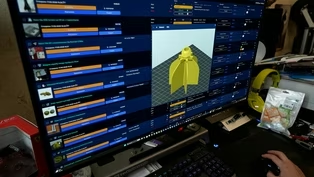
In Ukraine, a secret group of volunteers, including this woman who goes by the call sign Little Witch, are supporting their troops by making weapons using 3-D printers.
Like so many others in this country, she's transformed her small apartment into a high-tech printing armory.
"LITTLE WITCH," Volunteer Weapon Maker (through translator): It's hot as hell in here.
SIMON OSTROVSKY: An I.T.
specialist in Kyiv, Little Witch is one of more than 3,500 civilians volunteering for an organization called Drukarmija, Ukrainian for Print Army.
Their network of at-home 3-D printers is revolutionizing modern warfare.
People like her are able to connect directly to soldiers on the front line through an online marketplace where troops can browse products, place orders, and even leave reviews.
Everything is free, funded entirely through voluntary donations.
"LITTLE WITCH": Our guys sent me a video with what we printed at home and said, like, yesterday you sent it to us, and today your items killed Russian guys.
They said, like, perfect quality.
SIMON OSTROVSKY: She told us each printer costs around $1,000 and uses spools of plastic thread to make gear like gun magazines, casings for explosives or bodies for handheld drone detectors.
So this is the casing that they produce here right at home, and, obviously, this doesn't have all of the insides that it needs to fly, but it's a critical part of the interceptor drone.
Drones like these are used to shoot down Shaheds that Russia fires at Ukraine routinely.
So what made you get involved with this in the first place?
"LITTLE WITCH": Help our guys to survive.
We want Ukraine to be free, and we want that Russia leave us alone forever.
SIMON OSTROVSKY: Four years into a war against a country with an economy 10 times its size, Ukraine is fighting back with ingenuity, instead of scale.
On another platform called Brave1 Market, soldiers earn points for confirmed kills and can redeem them for weapons, a gamification of war designed to keep them motivated.
Andrii is one of the employees at Brave1, whose job it is to verify kills in order to correctly award those points.
Do you find that it is an effective motivation tool?
Why are soldiers so interested in collecting these points?
ANDRII, Brave1: First of all, you have some kind of cash back.
You have used two drones on a Russians, you have killed them.
Then you have got your two drones back from the marketplace.
Then you will use it again and again and again and again.
SIMON OSTROVSKY: Andrii told us he's able to confirm the accuracy and point value of every kill because, on the war's tech-dominated front line, nearly every mission is now recorded by drone or by a soldier's head-cam.
He says he watches hundreds of mission videos every day.
What's the most difficult video you have ever had to review?
ANDRII: Oh, yes, I remember this guy's face.
They hit him with Mark 19 grenade.
He was wounded.
Then the second one tear him open.
His belly, his guts went out, and then the third hit was with the M-67 grenade.
It just landed in his guts, like in the stomach.
And you can imagine the results.
SIMON OSTROVSKY: Remarkably, Brave1 and the Print Army's products both get delivered directly to soldiers on the front line, reaching positions at Amazon Prime speed.
"News Hour" followed one of the deliveries from the Print Army to a soldier serving in an undisclosed location in Ukraine.
ZHABA, Ukrainian Soldier (through translator): To make this work when it's dropped from a drone, we used an inertial firing pin.
SIMON OSTROVSKY: This Ukrainian soldier showed us how 3-D printed items are also used to adapt conventional weapons for modern drone warfare.
A lot of these items look like toys, but they're actually very dangerous weapons.
They say necessity is the mother of invention.
And during this war with Russia, Ukraine has been incredibly inventive.
The Army of volunteer 3-D printers is just one of the ways that Ukraine has adapted to fight a much larger enemy.
The Print Army says its volunteers shipped more than 527 tons of printed products like this last year alone.
Yuliia Myrna was preparing to enlist in the Ukrainian army before she joined the government-backed Brave1 platform, dedicating her digital marketing experience to reinventing the supply chain of war.
Is it fair to characterize the Brave1 marketplace as something like an Amazon for war?
YULIIA MYRNA, Brave1: It's much more than, I think, Amazon, because we not only offer them a big catalog.
If we speak about our companies, so we help them to see how effective their product on the front line and how they can improve it.
SIMON OSTROVSKY: While the Print Army brings manufacturing into the home, Brave1 brings the battlefield to the manufacturer.
Products purchased on Brave1 are tracked and analyzed, generating data gold for weapons makers, who are able to see which weapons are making the biggest difference in the war.
Brave1 isn't just a marketplace or an Amazon for soldiers to get the equipment that they want.
It's also a venture capital space, where technologies are put forward, and the promising ones attract funding from the government and private investors.
And it's thanks to the platform that many of the weapons in this room got developed in the first place.
Brave1 is reimagining the entire model for military procurement, offering each type of user a different service wherever they are on the battlefield.
And they're doing that by incentivizing soldiers to be as effective and lethal as they can possibly be, doling out the maximum points for eliminating targets that the Ukrainian government has identified as its top priorities.
Some of the highest point values are awarded for taking out a plane or helicopter, evacuating wounded soldiers, and destroying enemy air defense systems.
Capturing a Russian soldier is worth ten times the value of killing one.
While Andrii works from a desk in Kiev, the hundreds of videos he's verifying offer an up-close and gruesome view of life and death on the front line.
How does it feel?
I mean, how do you feel after having watched so many kill videos yourself?
ANDRII: Well, that's war.
We are fighting our own small war.
I have a sense of duty.
And I also want my father to get back home safe.
SIMON OSTROVSKY: Your father fights on the front lines?
Is it a tough job?
ANDRII: In a way, it is.
SIMON OSTROVSKY: What's tough about it?
ANDRII: The gruesomeness of this.
It's kind of like, if you watch one video, that's OK.
Two, three, four, OK.
But several hundred a month like this, yes, it kind of it... SIMON OSTROVSKY: It affects you psychologically?
ANDRII: Yes.
SIMON OSTROVSKY: Last week's removal of the chief architect of Ukraine's digital wartime transformation, Defense Minister Mykhailo Fedorov, is the biggest military leadership shakeup in the country since Russia invaded, leaving Ukrainians wondering whether his military reforms are here to stay.
For the "PBS News Hour," I'm Simon Ostrovsky in Kyiv.
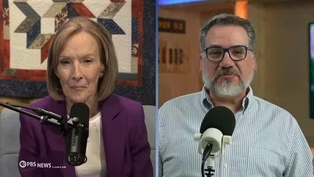
AMNA NAWAZ: Now, to discuss the economic and human toll of the Iran war, elections here at home, and more, we turn to Brooks and Marcus.
That is "The Atlantic"'s David Brooks and Ruth Marcus of "The New Yorker."
Jonathan Capehart is away.
Good to see you both.
RUTH MARCUS, "The New Yorker": Hi.
DAVID BROOKS: Hello.
AMNA NAWAZ: Let's start with the Iran war and how it's resonating here at home.
As you both know, gas prices now, according to AAA, are at $4.11 a gallon as the national average.
And while we have all seen Democratic opposition to the war, here's what a new Politico poll tells us, that some 37 percent of self-described MAGA voters think the war should continue even if prices go up.
That is down from 50 percent in May.
As you both well know, the human toll is also rising.
We saw four service members killed in just the last week.
That's on top of 14 others the Pentagon previously reported.
And right before he attended the dignified transfer of those four, the president shared this post, comparing the death toll of this war to others and writing: "These are the facts.
Report them."
So, David, at this point, what costs are Americans and supporters of the president willing to tolerate here?
DAVID BROOKS: Yes, I try not to make predictions because I'm not a total idiot, but I do think -- it would not surprise me if this war were still going on in January of 2029, when Trump leaves office.
AMNA NAWAZ: Really?
DAVID BROOKS: I just don't think he cares.
I don't think he cares about the midterms.
I don't think he cares about gas prices.
I think he cares about legacy.
And he wants to see himself as a man who remade the Middle East.
And he would not be the first U.S.
president who had that illusion.
And he talks about -- there's scuttlebutt today that the Cabinet is gathering to think maybe we should do a big massive expansion of the war.
I don't think we have the material to do that, like the missiles, all that kind of stuff.
So it would not surprise me if this dragged on with this, what we have been seeing the last couple months, the missile, missile, missile exchanges, small exchanges, this, that, talk, non-talk.
And that could go on forever.
And MAGA came into office saying we will have no more forever wars.
Well, here we are.
RUTH MARCUS: I have that written down right here.
RUTH MARCUS: He's gotten us into the kind of forever war that he's pledged that he was going to avoid.
And it's not even a forever war.
It's like a Groundhog Day war, because we're in this same cycle of threats and then retrenchment and threats and retrenchment, and we have an MOU and we don't have it.
I don't actually see how this could continue, even if he wanted it to, through January of 2029.
Is that what we have to get to?
DAVID BROOKS: That's my guess.
RUTH MARCUS: For this reason.
Exactly what you said, Amna.
People are fed up.
MAGA is fed up.
I filled up the other day at the pump, and it is painful.
And it's painful for a lot of people.
And I just don't think, even if he wants to, even if he doesn't care about the midterms, the midterms care about him.
And he -- even if he wants to persist, Congress at some point -- the first rule of politics is self-preservation.
They have not shown a willingness to stand up to him and defund the war yet.
But that -- if we are slinking, whatever, towards 2029, I think we will see that at some point, because this is intolerable for people.
It's intolerable for the global economy as well.
AMNA NAWAZ: You use the word painful.
We should underscore, most painful for the families who've lost someone in this war.
RUTH MARCUS: Yes.
AMNA NAWAZ: While we're talking about the region because it's already undeniably rippled across the region, this is the same week the Trump administration signed a nuclear deal with Saudi Arabia that lets U.S.
companies supply nuclear reactors and fuel for a nuclear energy program in the kingdom.
The president says that this deal bars them from uranium enrichment for weapons purposes.
He also said yesterday the deal hinges on Saudi Arabia essentially normalizing relations with Israel, which Saudi leaders have said they will not do unless there is a path for a Palestinian state.
David, we have talked about this before.
But the president announces a deal and then throws a wrench in it?
What what's going on here?
DAVID BROOKS: Well, he likes doing deals with the Saudis.
He thinks he can make money for American corporations.
And this little wrinkle is probably going to not make it not happen unless Trump drops the wrinkle.
The big picture here is that, as U.S.
nuclear umbrella withdraws from the world, as America begins to play a smaller role in the world, all sorts of countries around the world are thinking, holy cow, we need nuclear weapons.
The Saudis are thinking of that.
The Japanese are thinking about that, of all nations.
The Poles are thinking about that.
RUTH MARCUS: Well, they would know.
DAVID BROOKS: They would know, and they have suffered.
And they have -- so you have -- you could see a dozen, 15 countries not getting nuclear weapons, but considering it, because the U.S.
umbrella is no longer there.
So if you wonder what the effect of U.S.
power is, whether it's a force of stability or not, here's your sign.
It is a force of stability, and when you withdraw that force, the world gets a lot more dangerous right quick.
AMNA NAWAZ: I mean, that's a major reworking of the global security landscape, Ruth.
RUTH MARCUS: And that's precisely why this is a bad idea, this nuclear deal is a bad idea, because more proliferation is -- and the risk of proliferation is worse than nonproliferation.
And we are mired in this situation with Iran because we helped them get nuclear technology when the shah was in power.
How did that work out for us?
So Trump -- and it was a bad idea, by the way, when the Biden administration was talking about doing this, though it at least had the prospect of getting the benefit of Israeli recognition.
Here, Trump, he's so erratic.
He knows that Saudi Arabia can't at the last minute agree to the Israel recognition, and he throws it in anyway, like he's still negotiating leasing the top two floors of Trump Tower or something, and thinks he can wring something else out of people at the last minute.
It's not going to work, and I think we should probably be semi-thankful for that.
AMNA NAWAZ: Well, while I have you, I want to ask you about some political takeaways from election results we saw this week, because, back here at home, we saw the crucial swing state of Arizona hold their primary elections.
On the Republican side in particular, we saw three prominent election deniers win their races, these primary races, for governor, for secretary of state, and for attorney general.
David, when you look at these results, what stands out to you?
What does it say to you about the party or just about Arizona?
DAVID BROOKS: Yes, I once interviewed a guy who got the nomination of a major party, and they said, what did you learn when you get the nomination?
And he said, I learned we have no party.
We call it a party, but there's nothing in -- it's like a box with nothing in there.
Donald Trump has actually filled in the box.
Some of it is just the Trump persona.
But he actually has a structure.
He has an organization around the country.
They control the local activist community.
And, therefore, they win these primary elections at least, because they actually have a party.
On the Democratic side, it's not clear they have a party yet, because you look at the candidates that have been championed by the Washington Democrats, they have a pretty poor batting average.
They won one out of two in Arizona, let alone what happened in New York and other places.
And so the Democrats don't have a party.
And Trump has a party.
It just means it involves nominating a lot of election deniers, but they do have a structure.
And I wonder whether it will last after Trump, whether MAGA is a thing after Trump.
And I think it's not just the Trump personality.
I think they actually have cadres.
They have a structure.
They have believers.
So it works the way a party used to work, frankly.
RUTH MARCUS: So I think you're a lot more bullish on the future of the Republican Party than you should be.
And I don't think this is just wishful thinking, for this reason.
If you're looking at this election in Arizona through the lens of Donald Trump, who doesn't care about the midterms, but kind of cares about the midterms, you're going to feel pretty good about this.
He asserted his power.
He has, I agree with you, shaped the party and bent it to his will.
But here's the situation.
In Arizona, there are 313,000 more Republican voters than Democratic voters.
Yet there are two Democratic senators from Arizona and the top three statewide officials in Arizona, including the governor, are Democrats.
Why is that?
Because Republicans led by Trump are hiring, nominating precisely the wrong kind of people.
So, bully for them that they got their election deniers in the primaries.
That's not that hard.
How are they going -- you see the nominee, Andy Biggs, for governor trying to remake himself, but let's be serious.
He is the former head of the House Freedom Caucus and a leading election denier.
He can deny that now or try to soft-play that now.
But this is going to be a harder road for Republicans to regain power in the state than it would have been if they had taken a less Trumpy, more sensible approach.
AMNA NAWAZ: Just a quick minute left here, but I want to get both of you.
Just more than a week after the president delivered a prime-time address and blamed China for election interference in 2020, every time he is asked about it, there do not seem to be any repercussions for that alleged interference.
David, why not?
DAVID BROOKS: Because he's the present tense man.
Everything is happening at that moment, and what happened yesterday doesn't matter.
What happens tomorrow doesn't matter.
He's doing what's happening at this moment.
And in this case, I happen to be glad, because the China charges were bogus, and we need to have a relationship with China.
And so he's letting us have a relationship with China and not letting bogus charges get in the way.
So I'm glad he's -- he forgot what happened yesterday.
AMNA NAWAZ: Ruth.
RUTH MARCUS: This was never about calling China to account or punishing it or cracking down on it.
This was just about convincing the voters, if he is to lose in November, that they shouldn't trust that.
It's not about China.
It's about the United States and about diminishing confidence in our election system.
AMNA NAWAZ: And, meanwhile, President Xi will be visiting the White House in September.
Ruth Marcus, David Brooks, great to see you both.
Thank you so much.
RUTH MARCUS: Thank you.
AMNA NAWAZ: Well, prosthetics are typically designed to blend in as replacements for missing body parts, but, increasingly, they're becoming tools for creative expression, especially in the niche community of ocular prosthetics, or artificial eyes.
Our senior arts correspondent, Jeffrey Brown, meets a Portland eye maker whose designs are helping clients see themselves in a new light.
It's part of our ongoing coverage of the intersection of arts and health for our Canvas series.
RACHEL YEE, Prosthetic Eye Wearer: If I'm going to wear something like this.
JEFFREY BROWN: Many people accessorize with jewelry or purses.
RACHEL YEE: Getting more formal.
JEFFREY BROWN: Thirty-six-year-old Rachel Yee does it with eyes.
RACHEL YEE: I will do my first ever fun eye, which is this gold one, and have the two together.
JEFFREY BROWN: You accessorize.
That's how you think of the -- all the eyes you have now?
RACHEL YEE: Yes.
I'm lucky enough that I get to accessorize with something that is a medical necessity.
JEFFREY BROWN: Yee lost your left eye to cancer at 18 months old and spent years wearing a prosthetic designed to mirror her natural eye.
RACHEL YEE: I knew I was different.
I never felt like I was missing something.
It wasn't until I was older that I got a little more self-conscious about it.
I felt like a prosthetic in general wasn't to make me feel good about myself, but it was to make others feel comfortable looking at me.
JEFFREY BROWN: Everything changed in 2021 when she started wearing a new eye featuring a shimmering gold iris that was meant to grab attention, not deflect it.
RACHEL YEE: Standing out to me is more important, in fact, than just hiding who I am to make others around feel comfortable.
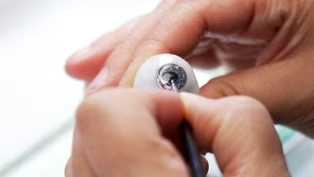
JEFFREY BROWN: In an office in nearby Portland, Oregon, where decorative eyes watch from nearly every corner, Christina Leitzel, board-certified as an ocularist, crafts the bull designs that have now become her trademark, so-called fun eyes.
CHRISTINA LEITZEL, Center for Ocular Prosthetics: I think there's something in me that I have always wanted to help people.
I originally wanted to make prosthetic limbs.
JEFFREY BROWN: As an art student in Philadelphia, she was drawn to artists like Sophie de Oliveira Barata, who turned prosthetics into powerful art pieces.
CHRISTINA LEITZEL: I just thought it was such a beautiful art form to blend both art and science and then give someone back something that they lost.
JEFFREY BROWN: Most eye prosthetics have two parts, a custom acrylic shell and a surgically implanted sphere that restores volume to the eye socket.
The implant is often made from a porous material that allows tissue to grow into it, helping the prosthetic move with the wearer's natural eye.
Half of Leitzel's work is still creating prosthetic eyes that seamlessly match the real thing.
But it's the fun eyes where her artistry comes alive, each one telling a story.
CHRISTINA LEITZEL: They could be anything from a cat eye, where it's a pet that had just passed.
MAN: I asked Christina to make me an eye so I can remember Noodles more, and just kind of have her with me all the time.
CHRISTINA LEITZEL: Or a portrait of a wife who died.
The message that I got was, can you paint the portrait of my wife?
Because I would like to have her see everything I'm seeing.
JEFFREY BROWN: Wow.
CHRISTINA LEITZEL: It's moving, and it's like, wow.
JEFFREY BROWN: On social media, her creations range from glittery glow-in-the-dark and color-shifting eyes to American flags, sparkling night skies, and soccer balls.
CHRISTINA LEITZEL: When you have an ocularist, most people, like, they confide, they share their stories.
JEFFREY BROWN: So this is a very close relationship.
CHRISTINA LEITZEL: Very, very personal.
And it's kind of scary to be so vulnerable and share that part of you.
So I think it's special in that way to be a part of someone's life and change them.
JEFFREY BROWN: Some come to Leitzel with the trauma of having recently lost an eye.
Bree was 27 when she lost her eye to ocular melanoma, a rare form of cancer.
BREE, Prosthetic Eye Wearer: I went under with perfect vision 20/20, no pain, and then I woke up with only one eye and no depth perception.
I couldn't grab anything in front of me.
It -- it broke me.
JEFFREY BROWN: Her first prosthetic was a close match to her remaining eye, but: BREE: When I first got it and looked in the mirror, it felt like somebody else was looking back at me.
It felt very uncanny.
I have always loved to stand out.
And I wanted an eye that reflected that.
JEFFREY BROWN: So the eye that's in now is -- it's a cat eye.
BREE: It is a replica of my current cat, who only has one eye as well.
He actually has the opposite eye of me.
So when he's up on my shoulder and we look at each other, we see eye to eye.
DAN ROCHE, Author, "Eyes by Hand: Prosthetics of Art and Healing": So many people who wear eyes talk about their close relationship with their ocularist and how just being able to talk through it with somebody who has seen this over and over is therapy.
JEFFREY BROWN: Dan Roche is a professor at Le Moyne College in Syracuse, New York, and author of the book "Eyes by Hand: Prosthetics of Art and Healing."
He also wears a prosthetic eye himself.
DAN ROCHE: This one.
JEFFREY BROWN: So it's your right eye.
DAN ROCHE: It's my right eye, yes.
And it's -- sometimes I look in the mirror and I can't tell which -- I forget which is which.
JEFFREY BROWN: His book traces the long history of prosthetic eyes, from the inlaid eyes placed in mummified bodies in ancient Egypt, to rudimentary eye coverings designed by a French surgeon in the 1500s, to eyes made by glass blowers in Venice in the 18th century and on.
DAN ROCHE: It's a very slow history, not a lot of major changes over the course of time.
JEFFREY BROWN: Today, there are fewer than 200 board-certified ocularists in the United States and Canada, who serve the roughly 20,000 people who lose an eye every year.
DAN ROCHE: Which is a smaller number than it used to be once OSHA regulations came in.
It used to be farm accidents and industrial accidents.
People would be losing eyes all the time, relatively.
JEFFREY BROWN: Most opt for a matching eye, like Roche, who spent his first 50 years with a cataract that clouded and blinded his right eye.
DAN ROCHE: I just dreamed for years and years about having two eyes that match, just sort of a normal gaze.
And when I looked in the mirror the first time and saw that, that thing that I'd been dreaming about for decades, it was -- I mean, it's trite, but kind of a dream come true in that regard, yes.
JEFFREY BROWN: Because ocularistry sits at the intersection of art, medicine, and psychology, insurance coverage is often inconsistent.
Some plans will cover the cost of a traditional prosthetic eye, which can range from $2,000 to $10,000.
But insurance will not cover a fun eye.
RACHEL YEE: Having access to someone that will create fun eyes was hard enough on its own, and paying for it on top of that is not doable for a lot of these families who have already gained so much medical debt.
JEFFREY BROWN: Twelve-year-old Gracie Corrigan lost her eye at 2 years old to retinoblastoma.
GRACIE CORRIGAN, Prosthetic Eye Wearer: See, there's my eye.
JEFFREY BROWN: The same rare and aggressive eye cancer that impacted Rachel Yee.
She also shared a frustration with traditional prosthetic eyes.
GRACIE CORRIGAN: People could tell, like this one wasn't matching this one or it wasn't moving the same.
Some kids have said something.
Like, some kids are rude about it.
JEFFREY BROWN: In 2022, Corrigan decided she was ready to get a fun eye of her own.
Rachel Yee decided to help.
RACHEL YEE: I am raising the money for Gracie to get a fun eye.
I went to social media and I said, is there any chance that you guys want to donate?
Within an hour, we had paid for Gracie's eye.
By the next morning, three more eyes had been paid for.
JEFFREY BROWN: The extra dollars became The Fun Eye Fund, a nonprofit that helps people afford custom prosthetic eyes.
GRACIE CORRIGAN: Having the fun eye is way better than a regular eye that would match this eye.
It's just fun.
It looks cool.
JEFFREY BROWN: Looking cool, looking like your own version of you, it's a new, perhaps unexpected mix of medical care and art.
For the "PBS News Hour," I'm Jeffrey Brown in Portland, Oregon.
AMNA NAWAZ: Finally, tonight, we have an excerpt from Judy Woodruff's podcast "In Pursuit of Happiness."
This week, Judy explores how America's national parks preserve not only the nation's most spectacular landscapes, but also some of its most important history.
Her guest is Jason Epperson, a podcaster and R.V.
traveler who spent years getting to know the parks with his family.
JUDY WOODRUFF: Do you have favorites that you like to share... JASON EPPERSON, Host, "PARKography": I do.
JUDY WOODRUFF: ... that you have been to over and over again?
JASON EPPERSON: Yes, Fort Sumter is really interesting because it's one of these cool coastal forts.
We have all these coastal forts all along the East Coast, where they were sort of built right after first the Revolutionary War and the War of 1812 to protect from, of course, battleships.
And during the Civil War, it was very clear that they were absolutely useless.
But Fort Sumter is where the first shots of the Civil War were fired.
And when you go there and you visit and you experience it.
You take a tour out there, you get on a boat, and ranger takes you through the place, and they invariably show you the bricks that the fort is built out of.
And these bricks were forged by enslaved people.
And when you go look closely at them, you see in the bricks fingerprints, and not just fingerprints of enslaved people, but enslaved children.
And you can look at sculptures of people all day.
It's -- a sculpture is a representation of somebody's idea of what somebody looked like.
When you see somebody's fingerprint in something, it's sort of this indelible idea that they were there.
JUDY WOODRUFF: Yes.
JASON EPPERSON: And it really brings home sort of this idea of what the Civil War was fought for at the place where it began.
I love that history.
I love White Sands National Monument.
White Sands in New Mexico is our children's favorite place in the National Park Service.
They feel like they're in an episode of Star Wars.
JUDY WOODRUFF: Really?
JASON EPPERSON: It's one of the few parks -- most of the parks, you have got to stay on a trail, right?
At White Sands, you can just kind of go anywhere you want to.
And it is these weird white gypsum dunes.
It's not actual sand.
It's gypsum, which is what drywall is made out of, in the middle of New Mexico that sort of contrasts completely with the landscape.
And at White Sands, they have found the oldest human footprints in existence.
White Sands -- just in the last couple years, they have found footprints in White Sands that make humans older than we thought they were in the United States.
JUDY WOODRUFF: Ah.
JASON EPPERSON: And so the human history goes way, way back, right?
It's beyond the Native Americans, and it goes very far back in the National Park Service.
But then this White Sands missile site, which is right next door, is also where the atomic bomb was tested.
And in White Sands National Park and in areas around it, you can still find slivers of green glass, which is which is... JUDY WOODRUFF: Oh, gosh.
JASON EPPERSON: Was instantly formed when the when the atomic bomb was first tested, so, again, beautiful natural area that is sort of this surprise out of the middle of nowhere, but has this wild human history to it.
AMNA NAWAZ: And you can watch that full episode of "In Pursuit of Happiness" on our YouTube page or wherever you get your podcasts.
Tonight, on "Washington Week," analysis of the increasing costs of the Iran war.
That is right here on PBS.
On "Horizons" this weekend, William Brangham and his guests discuss uterine fibroids, impacting up to 80 percent of women, but still widely misunderstood.
And on "Compass Points," Nick Schifrin and his panel examine the Trump administration's remote control of Venezuela.
You can watch both "Horizons" and "Compass Points" on our YouTube channel, wherever you get your podcasts, and on your local PBS station.
Check your local listings.
And that is the "News Hour" for tonight.
I'm Amna Nawaz.
On behalf of the entire "News Hour" team, thank you for joining us, and have a great weekend.
 New
NewAid worker describes crisis in Venezuela after earthquakes
Video has Closed Captions
Aid worker describes crisis in Venezuela, one month after devastating earthquakes (6m 46s)
 New
NewBrooks and Marcus on Iran becoming a 'forever war'
Video has Closed Captions
Brooks and Marcus on the Iran conflict becoming a 'forever war' (10m 13s)
 New
NewEye prosthetics become canvases for self-expression
Video has Closed Captions
Ocular artistry: Eye prosthetics become canvases for self-expression (8m 18s)
 New
NewHow volunteers with 3D printers make weapons for Ukraine
Video has Closed Captions
How volunteers with 3D printers make weapons for Ukraine (8m 33s)
 New
NewJason Epperson on the history found at national parks
Video has Closed Captions
Jason Epperson on the history found at national parks (3m 27s)
 New
NewNews Wrap: CDC reports more measles cases so far this year
Video has Closed Captions
News Wrap: CDC reports more measles cases so far this year than in all of 2025 (6m 48s)
 New
NewTrump sets new tariffs, covering nearly all U.S. imports
Video has Closed Captions
Trump sets new tariffs on trading partners, covering nearly all U.S. imports (7m 51s)
Providing Support for PBS.org
Learn Moreabout PBS online sponsorship New Episode
- News and Public Affairs

Today's top journalists discuss Washington's current political events and public affairs.

- News and Public Affairs

FRONTLINE is investigative journalism that questions, explains and changes our world.
 New Episode
 New Episode
 New Episode
 New Episode
 New Episode
 New Episode
 New Episode

 New Episode
 New Episode
Support for PBS provided by:
Major corporate funding for the PBS News Hour is provided by BDO, BNSF, Consumer Cellular, American Cruise Lines, and Raymond James. Funding for the PBS NewsHour Weekend is provided by...