
Forever Prison
Clip: Season 2017 Episode 6 | 15m 6sVideo has Closed Captions
FRONTLINE and Retro Report explore the untold history of the Guantanamo Bay prison.
FRONTLINE and Retro Report explore the little-known history of how Guantanamo Bay prison became a place where the government claimed it could hold people beyond the reach of U.S. law. It happened a decade before 9/11, in the wake of a bloody coup in nearby Haiti.
Problems playing video? | Closed Captioning Feedback
Problems playing video? | Closed Captioning Feedback
Funding for FRONTLINE is provided through the support of PBS viewers and by the Corporation for Public Broadcasting. Major funding for FRONTLINE is provided by the Ford Foundation. Additional funding...
Support provided by:

Forever Prison
Clip: Season 2017 Episode 6 | 15m 6sVideo has Closed Captions
FRONTLINE and Retro Report explore the little-known history of how Guantanamo Bay prison became a place where the government claimed it could hold people beyond the reach of U.S. law. It happened a decade before 9/11, in the wake of a bloody coup in nearby Haiti.
Problems playing video? | Closed Captioning Feedback
Where to Watch FRONTLINE
FRONTLINE is available to stream on pbs.org and the PBS app.
Buy Now
Inside the Scam
Follow scams as they unfold — and examine tactics used to manipulate victims. A collaboration between FRONTLINE and The Associated Press.Providing Support for PBS.org
Learn Moreabout PBS online sponsorship>> RATH: Over the years I've been reporting on Guantanamo, I've seen the prison camp evolve.
Once crammed full of suspected terrorists in orange jumpsuits, parts of the camp are now empty.
Just right here by the side of the road, this is where the detainees were kept in cages, essentially.
Gitmo is a symbol of the post-9/11 war on terror, but on my trips here, I began to hear a rarely told history of how it was first used to hold people outside the reach of U.S.
law.
It began a decade before 9/11, in the wake of a bloody coup in September of 1991, just across the water, in nearby Haiti.
>> A military coup is underway... >> ... when the Haitian military overthrew elected president Jean-Bertrand Aristide... >> ...reports that soldiers have killed up to 150 people this week.
>> I was 14, my dad was in hiding, so every time they come knocking on the door looking for my dad, it was like, we don't know where he's at.
I've seen people being burned alive, and people being beheaded just for your political belief.
>> Some army and police units are working as marauders.
>> My dad could have died at any given day.
So we had to flee.
>> RATH: Marie and her father were among the more than 70,000 Haitians who took to the sea in the aftermath of the coup... >> It is a refugee flood.
>> RATH: ...hoping to get political asylum in the U.S.
>> For many, leaving by boat was their only escape... >> The boat would be leaking water sometimes, so we had a bucket.
>> Officials worry that hundreds of Haitians may have died in the rough seas.
>> We ran out of food.
We ran out of water.
People was sick.
We were in a predicament, you couldn't go back.
>> The Coast Guard is now stopping Haitian sailboats around the clock.
>> RATH: U.S.
officials were inundated, intercepting hundreds of boats.
>> The State Department says the Haitians don't meet standard criteria for asylum.
>> RATH: After a quick review, they rejected most of the Haitians' asylum claims.
>> ...describing them as economic, not political, refugees.
>> RATH: And sent them back to Haiti.
>> The Coast Guard was picking people up and sending them back to Haiti without asylum processing, basically.
So without giving people a chance to establish that they were fleeing political persecution.
>> The Haitian exodus has tied American refugee policy into knots.
>> RATH: But the refugees kept coming.
>> One U.S.
official called it a national security crisis.
>> RATH: So they were brought to a place nearby, where normal U.S.
asylum rules would not apply.
>> Nearly 1,200 Haitians are being detained at the U.S.
naval base in Cuba.
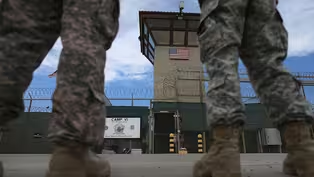
>> RATH: American soldiers quickly built a holding camp at the naval base on Guantanamo Bay, Cuba.
>> It was massive, a massive camp, and it was fenced with razor wire, and you have the tower with the guards, and then just during the day, you just roamed the yards.
We didn't have no rights because technically we're not in the U.S.
So it felt like you were in prison.
I mean, that's what it was to us, it was being in a prison.
>> RATH: Soon, more than 12,000 people would be held here while their asylum claims were being processed-- but without access to lawyers, like they would have had if they'd made it to the U.S.
>> This is essentially Guantanamo episode one.
We had foreign nationals held at Guantanamo precisely because the government believed, or took the position, that there were no legal constraints.
>> RATH: That issue caught the attention of a group of law students who were watching the story unfold.
>> I was in my last year at Yale Law School, where the students had been working on a variety of human rights litigation projects, and one of them was addressing what was happening with Haitian refugees.
And the question was whether anything more could be done.
>> What was happening on Guantanamo Bay was wrong, and we felt like we needed to do something, which was to file a lawsuit.
>> RATH: The law students brought their concerns to their professor, Harold Koh.
>> The students came to me and they said, "We'd like you to sue the U.S.
government."
The case started as a request for lawyers, and what happened with the Haitians were on Guantanamo, but they didn't have legal representation and they could be returned, potentially to their death.
So how could it be that you could be asked questions, have no right to consult a lawyer, and be returned to your death?
>> RATH: The government argued that the Haitians weren't entitled to lawyers because Guantanamo was beyond the jurisdiction of U.S.
law.
>> The position of the government really was twofold.
Number one, these detainees don't even have the right to walk into court to challenge their detention.
The government's second position was, even if they can walk into court and challenge their detention, there is nothing we're doing illegal here.
>> RATH: Bob Begleiter represented the government.
At the time, he says, he believed the Haitians at Gitmo were receiving due process.
>> Due process for them meant that their asylum applications were being considered in an, in an impartial way.
That was due process.
The government would say they got it, and, ultimately, I think they all did.
>> RATH: In the spring of 1992, the two sides met in federal court for a pretrial hearing.
The judge ruled that the team from Yale could go to Guantanamo.
>> They brought me to the outskirts of the camp, and there, there were all these Haitians, including many children, surrounded by barbed wire.
And they saw me get out of the car and a whole bunch of them came up to the barbed wire and just started grabbing the barbed wire so hard that blood was coming out of their hands.
And they're shouting, "Harold!
Harold!"
And I realized they're... I'm their lawyer, I've got to get them out.
>> RATH: As the case dragged on, the government rejected most of the refugees' asylum requests and sent them back to Haiti.
The few whose claims were seen as credible were allowed to go to the U.S.
to apply for asylum.
But some of those expecting to go found out they were being held back.
>> Everybody have a T number.
I think mine is T1246.
When your number is called, they put you in a chopper and... to bring you to the States.
Every day they come with a list, they call out numbers.
Your number never called until all the camps were closed.
That's when we find out, all the remaining people were H.I.V.-positive.
And unfortunately, my dad was one of those.
>> They have been cleared to enter the U.S., but are stuck here because of a U.S.
ban on H.I.V.-infected immigrants.
>> RATH: Because of that policy, more than 200 H.I.V.-positive refugees and their families were told they could be stuck at Gitmo indefinitely-- for ten or 20 years, or even until a cure for AIDS was found.
>> It's a death trap.
They're being held there, even though they have legitimate asylum claims, but because they're sick.
And what we tried to do was emphasize how crazy it was to do this.
You know, that our government would be holding people, all of a particular race and national origin, who are all sick in a particular way, instead of treating them like the refugees they were.
>> These Haitian refugees have reached a way station on what so far has been a journey to nowhere.
>> RATH: The government insisted the refugees were not being mistreated.
But another year would go by for the Haitians at Guantanamo.
>> People were getting aggressive because of the unknown.
You know, they would throw rocks at the MPs.
They would put you, what I would call solitary confinement.
And people were having hunger strikes.
It was us against them.
>> RATH: In court, the government's attorneys were painting a different picture.
>> I was told that it wasn't perfect but it was decent, that there was good sanitation, they were provided adequate sustenance and shelter.
>> RATH: Then the team from Yale discovered new evidence.
>> We got a series of videotapes.
And one of them showed this amazing scene where the U.S.
military came into the camp and suppressed an uprising among the Haitians by physically mauling them, dragging them around.
Remember, these are not criminals, these are refugees.
>> They have those white type of handcuff, where they would tighten them really tight.
A lot of people sometime would be on the floor with their hands and feet handcuffed and took away.
>> And suddenly it became clear that the benign picture that was being painted was just false.
The judge was watching this with, you know... stunned.
>> Oh, I thought it was horrible, you know.
These people had not even been charged with a crime, but they were treated worse than criminals.
>> RATH: Judge Sterling Johnson, Jr., presided over the trial.
>> How can you take a human being, take him into custody, tell a court that "I'm going to do whatever I want to do with you," and to the court, "There's nothing you can do about it."
Because it didn't happen in the territorial confines of the United States, it's in Cuba.
Our Constitution says that if you are in custody by American authorities, you have rights.
>> RATH: Judge Johnson ruled that the Haitians should be released from Gitmo, and that the laws of the United States did apply there.
Within days, all of the remaining Haitians left for the U.S.
>> All this time, we thought we were alone.
We were not alone.
We had people who wanted us here.
We had people who was fighting for us.
>> We won, and the Haitians came into New York under the court order.
My co-counsel, Michael Ratner, and I were standing at LaGuardia, and we're in the terminal.
And I said to him, "You know, the law made this happen."
>> RATH: The Haitians were free, but Judge Johnson's ruling was in jeopardy.
The government continued to argue that U.S.
laws should not apply at Guantanamo and threatened to appeal up to the Supreme Court, which had ruled against the Haitians in a related case, unless Koh agreed to a deal.
Getting these Haitians off of Guantanamo, it came with a price.
>> The ruling in our favor by the judge, the court order said, alien detainees on Guantanamo have constitutional rights.
And they said, "You're going to have to agree that that opinion should be taken off the books."
>> RATH: Koh felt he had no choice.
He took the deal with the government.
Judge Johnson's decision would not become legal precedent.
>> Given the situation they were presented with, they chose the wisest course.
Because better to have no precedent and live to fight another day, than to find that the court has decided against you at the highest level-- which is to say, you have almost nowhere to go.
>> RATH: Guantanamo would remain in legal limbo, leaving the door open for it to be used as a detention center outside the reach of U.S.
law.
>> ...are being flown from Afghanistan to the American naval base at Guantanamo Bay in Cuba.
>> NARRATOR: Next time on Frontline... >> They're pointing over there and they're saying that's the black flag of ISIS.
>> NARRATOR: Shia militias are helping push ISIS out of Iraq.
But at what cost?
>> Are you worried that Sunnis may turn to violence to fight back?
>> NARRATOR: On the ground, Frontline correspondent Ramita Navai investigates.
>> They're as scared of the militias as they are of ISIS.
>> NARRATOR: "Iraq Uncovered."
>> Go to pbs.org/frontline to learn more about detainees who were transferred out of Guantanamo during the Obama era.
Read extended interviews with Chuck Hagel... >> We want these people to get back into society.
>> ...and others.
>> See more of our reporting on Gitmo with our partners at NPR and WGBH News.
Connect to the Frontline community on Facebook and Twitter, then sign up for our newsletter at pbs.org/Frontline.
Captioned by Media Access Group at WGBH access.wgbh.org >> For more on this and other Frontline programs, visit our website at pbs.org/frontline.
>> Frontline's "Out of Gitmo" is available on DVD.
To order, visit shopPBS.org or call 1-800-PLAY-PBS.
Frontline is also available for download on iTunes.

Video has Closed Captions
Clip: S2017 Ep6 | 40m 51s | The dramatic story of a Gitmo detainee released from the controversial U.S. prison. (40m 51s)
Video has Closed Captions
Preview: S2017 Ep6 | 31s | With NPR, the dramatic story of a Gitmo detainee released after 14 years. (31s)
Providing Support for PBS.org
Learn Moreabout PBS online sponsorship New Episode
- News and Public Affairs

Top journalists deliver compelling original analysis of the hour's headlines.
 New Episode
- News and Public Affairs

Today's top journalists discuss Washington's current political events and public affairs.
 New Episode
 New Episode
 New Episode
 New Episode
 New Episode
 New Episode
 New Episode


Support for PBS provided by:
Funding for FRONTLINE is provided through the support of PBS viewers and by the Corporation for Public Broadcasting. Major funding for FRONTLINE is provided by the Ford Foundation. Additional funding...