
August 27, 2026 - PBS News Hour full episode
8/27/2026 | 57m 46sVideo has Closed Captions
August 27, 2026 - PBS News Hour full episode
August 27, 2026 - PBS News Hour full episode
Problems playing video? | Closed Captioning Feedback
Problems playing video? | Closed Captioning Feedback
Major corporate funding for the PBS News Hour is provided by BDO, BNSF, Consumer Cellular, American Cruise Lines, and Raymond James. Funding for the PBS NewsHour Weekend is provided by...
August 27, 2026 - PBS News Hour full episode
8/27/2026 | 57m 46sVideo has Closed Captions
August 27, 2026 - PBS News Hour full episode
Problems playing video? | Closed Captioning Feedback
Where to Watch PBS News Hour
PBS News Hour is available to stream on pbs.org and the PBS app.
Providing Support for PBS.org
Learn Moreabout PBS online sponsorshipGEOFF BENNETT: Good evening.
I'm Geoff Bennett.
AMNA NAWAZ: And I'm Amna Nawaz.
On the "NewsHour" tonight: Rescue teams in Nepal search for over a thousand missing people in the wake of devastating flash floods.
GEOFF BENNETT: Lindsay Clancy's murder trial nears its end, a case that has drawn national attention to postpartum mental health and the challenges surrounding its diagnosis and treatment.
AMNA NAWAZ: And how traumatized children in Gaza are trying to find glimmers of hope in their devastated homeland.
OMAR HALAWA, Child in Gaza (through translator): Because of the drones, they'll bomb the kites.
We've taken it down so a missile doesn't hit us.
We're not doing anything.
We're just playing.
(BREAK) AMNA NAWAZ: Welcome to the "News Hour."
The scale of the disaster in the Himalayas is becoming clearer tonight after catastrophic flooding tore through parts of Nepal and neighboring Tibet.
Scientists now believe the disaster was likely triggered by the collapse of a glacier high in the mountains, unleashing a torrent of water, mud, and debris that swept away bridges, roads, and entire communities.
GEOFF BENNETT: President Trump today called the devastation in Nepal brutal.
The death toll stands at least 390, with more than 1,400 others still missing.
That's as rescue crews race to reach survivors in some of the world's most difficult terrain.
In the valleys that carve through the highest peaks in the world, villages are now buried in mud.
This is Nepal's Nuwakot district.
Yesterday's floods left behind a layer of sludge so high, it reached rooftops and trapped trucks as if in quicksand.
Survivors recounted the terror as it all unfolded without warning.
JANAK BAHADUR, Flood Survivor (through translator): It came in suddenly and exploded like a bomb.
The river looked small from a distance, but it suddenly started overflowing and swept through this place.
GEOFF BENNETT: Geological experts believe a glacier collapse some 30 miles north of Kathmandu was likely what caused the disaster.
These satellite images show the glacier along those snowy peaks there at the bottom before the collapse.
And this is what it looks like now, the surrounding rivers swollen by the floodwaters and debris rushing downstream.
Cell phone video showed the torrent starting to barrel toward this hydroelectric dam.
Within seconds, it bursts through the other side and engulfs the entire site, this border crossing between Nepal and Tibet, the autonomous region in China, now completely destroyed by the ensuing landslides.
Nepalese officials say the floods have swept away dozens of bridges and damaged some 25 miles of roads.
That, combined with the already treacherous terrain of the Himalayas, have made rescue efforts especially difficult.
Nepal's army says it's airlifted more than 100 people to safety using helicopters.
On the ground, crews trudge through knee-deep mud with the aid of search dogs to locate the missing, hoisting them onto their backs, many survivors transported to hospitals in Kathmandu.
But as the search grinds on, many families have no choice but to wait for news they fear may never come.
SUBINA TAMANG, Wife of Missing Man (through translator): All I want is that my husband comes back to me safely in one piece.
I do not want anything else.
CHAMINDI SHRESHTHA, Mother of Missing Man (through translator): My son is stuck in the floods.
He is a truck driver.
And he said he was driving.
There is no news of him.
We are not able to find out anything.
GEOFF BENNETT: The scale of this catastrophe is being felt across the region.
Officials in China say they're searching for hundreds of people still missing in Tibet, where floodwaters stretched for miles across the vast plateau.
Authorities said a new lake was formed in the deluge.
A spokesperson for China's Foreign Ministry vowed to send aid to Nepal, which has significantly fewer emergency resources than its neighbor.
LIN JIAN, Chinese Foreign Ministry Spokesperson (through translator): The mudslide has caused massive casualties and left many missing in both China and Nepal.
The two sides are having close communication and coordinating efforts for search-and-rescue.
GEOFF BENNETT: Among the missing, some 500 foreign nationals.
The U.S.
State Department this morning confirmed three Americans had been rescued, but as many as 90 may have been affected by the floods.
SADHGURU JAGGI VASUDEV, Indian Spiritual Leader (through translator): I wish to bring to your notice that there has been a terrible... GEOFF BENNETT: In an emotional message today, the Indian spiritual leader known as Sadhguru said a group had been on a holy pilgrimage in the area and got caught in the floods.
He said 22 of them were U.S.
citizens.
And for more on what caused the devastating floods, we're joined now by Dan Shugar, who heads the waterSHED Lab at the University of Calgary.
Thanks for being with us.
DAN SHUGAR, waterSHED Lab Director, University of Calgary: Thank you.
GEOFF BENNETT: So scientists believe the deadly flood in Nepal may have started when a massive chunk of ice snapped off a glacier high in the Himalayas, unleashing this devastating cascade into the valley below.
Walk us through how that might have happened.
DAN SHUGAR: That was certainly our initial thought as to what happened based on the information that we had yesterday from some preliminary satellite information.
It's changed a little bit since then, but the general story is still the same.
At about just under 5,000 meters elevation is a glacier that in the satellite imagery that we saw yesterday essentially two days ago was there, yesterday was gone, and the flood resulted downstream.
Since then, we have found that glacier ice -- chunk of glacier ice that essentially disappeared downstream was part of a much larger mass of bedrock, so a gigantic chunk of the mountainside that collapsed, essentially exploding as it descended a vertical kilometer to the valley bottom, melting all that ice, and then flowing out and generating the floods that we saw in those horrific videos.
GEOFF BENNETT: What makes that part of the Himalayas so vulnerable?
DAN SHUGAR: That's a good question.
I suppose it would be a couple of things, one, incredibly steep topography and then huge relief, so massive differences between the low points and the high points, lots of glaciers, lots of glacial lakes, which weren't an issue in this particular disaster, but certainly in other ones.
A lot of seismic activity.
The Gorkha earthquake wasn't that long ago, and we saw very similar sort of disasters unfold, in fact, just on the other side of this mountain.
And the human part of that equation, I think, is important.
Unlike in Western North America, in much of the Himalaya, you have settlements in these incredibly high, narrow valleys that essentially are putting people and infrastructure and livelihoods at risk when these landslides or these floods come down.
GEOFF BENNETT: The other human element at play, it strikes me, is climate change.
What role does climate change play here?
What can scientists say with confidence about the connection between rising temperatures, retreating glaciers, and disasters like this one?
DAN SHUGAR: We can speak in generalities, because it's a little bit hard to speak about the specific event just yet because we haven't done any sort of attribution study.
As temperatures rise, glaciers will melt, will thin vertically, destabilizing the valley walls that they formerly were sort of help -- hoping -- or helping to hold up.
Additionally, as air temperatures rise, the permafrost is changing, and so permafrost is just ground that remains frozen year-round year after year.
But in some areas, both at high altitudes, but also in the north, permafrost is destabilizing because of warming temperatures.
And that can cause large landslides like this as well.
And then a third factor, I think would be changes in precipitation patterns, not only in terms of intensity, but in terms of when during the year they occurred.
Water can get underneath the glaciers, allowing them to slide a little bit more rapidly, any number of ways that that extra water can sort of enhance or increase the likelihood of one of these kinds of events.
GEOFF BENNETT: Dan, what lessons can be learned from this disaster?
DAN SHUGAR: I think that these landscapes, these steep mountain landscapes, are continually evolving due to climate change.
And the global community, not just the government of Nepal or China or India, need -- the global community, we need to be stepping up to help mitigate these risks and to enhance the resiliency of people living in these environments that are subject to these disasters that, when there's a climate change link, we in the rich West are largely responsible for.
GEOFF BENNETT: Dan Shugar with the waterSHED Lab at the University of Calgary, thanks for joining us this evening.
DAN SHUGAR: Thank you.
AMNA NAWAZ: In the day's other headlines: President Donald Trump signed an executive order today renaming Lake Ontario as Lake America.
It's part of his escalating trade war with Canada.
DONALD TRUMP, President of the United States: This is official, effective immediately.
AMNA NAWAZ: Trump made the name change official during a signing in the Oval Office this afternoon.
It requires federal entities to recognize the new designation, but it does not mean other countries have to do so.
Trump had threatened the change after talks broke down over his 50 percent tariffs on billions of dollars of Canadian goods, which took effect last weekend.
Canada then responded with levies of its own.
This afternoon, Prime Minister Mark Carney wrote on social media that Canadians know to call it Lake Ontario -- quote -- "now and always."
Federal aviation officials are reportedly moving to fire two air traffic controllers who allegedly left work early on the night of a deadly crash.
That's according to multiple media outlets citing sources.
Two pilots were killed and dozens injured when an Air Canada jet crashed into a fire truck in March.
Both employees are currently on leave.
Separately, federal investigators say that alerts from President Trump's helicopter to air traffic control went unheard before Marine One flew close to a passenger jet earlier this month.
They say ongoing construction at the White House may have been a factor.
But officials stress the president was never in danger.
An immigration officer facing charges related to a shooting in Minneapolis was released from a Texas jail today.
Christian Castro's release comes a day after a federal judge refused to order his return to Minnesota.
He's accused of firing his weapon through the front door of a Minneapolis home in January and wounding a Venezuelan immigrant.
Castro then falsely reported he had been attacked by the 24-year-old with a shovel.
The ICE officer was detained after a Minnesota judge issued a nationwide warrant for his arrest.
Minnesota officials fear he may flee to Mexico.
Russia says it launched what it called a massive attack against several Ukrainian cities overnight.
At least nine cities were targeted, including Kyiv, Zaporizhzhia, and the port of Odesa.
Ukrainian officials say at least two people were killed in the barrage and more than a dozen injured.
In the capital, jet-powered drones fell from the sky and black plumes of smoke rose from this warehouse just outside the city.
Also today, the Kremlin issued a new threat against the U.K.
in response to the country stepping up its support for Ukraine.
MARIA ZAKHAROVA, Spokeswoman, Russian Foreign Ministry (through translator): We have repeatedly warned that Ukrainian strikes on Russian territory using British weapons could prompt retaliatory attacks against any British military facilities and equipment in Ukraine and beyond.
AMNA NAWAZ: Meantime, authorities in Russia say a car bomb killed a military officer and injured his wife in a suburb of St.
Petersburg.
Local media identified him as a lieutenant colonel.
Officials have blamed Ukraine for a series of prior assassination attempts within Russia, some of which Ukraine has admitted to, while denying others.
The Bosnian Serb General Ratko Mladic, known as the Butcher of Bosnia, died in prison today.
Mladic led the Bosnian Serb army in the early 1990s.
Under his command, they pounded the besieged capital of Sarajevo as part of a broader conflict that left nearly 100,000 people dead and at least a million homeless.
He also oversaw the forces who carried out the 1995 massacre of at least 8,000 Muslim men and boys at Srebrenica.
It was Europe's worst atrocity since World War II.
One woman who lost two sons and a husband called Mladic one of the biggest war criminals.
MUNIRA SUBASIC, Relative of 1995 Massacre Victims (through translator): First of all, I am sorry that he died.
He should have suffered more.
He should have dreamt of our children's eyes; 31 years have passed, and us mothers are still carrying this pain in our souls.
AMNA NAWAZ: Mladic was already in poor health when he was arrested in 2011 after a yearslong manhunt.
During his trial, he remained defiant, even yelling at the judges when he was sentenced to life in prison in 2017.
U.N.
officials said today the 84-year-old Mladic died in a prison hospital in The Hague.
On Wall Street today, stocks ended higher after A.I.
giant Nvidia and others posted strong quarterly earnings.
The Dow Jones industrial average rose about 100 points on the day.
The Nasdaq jumped more than 1.5 percent.
The S&P 500 pulled closer to his record set earlier this month.
In China, the World Humanoid Robot Games are now over, but not before a robot sprinter broke yet another 100-meter record.
A Chinese humanoid beat Usain Bolt's world record for a third time yesterday, finishing almost a whole second faster than the Jamaican sprinter.
The ending, though, got a bit messy with sparks flying from one competitor.
Elsewhere, there were some stumbles in what are commonly called the Robot Olympics, but for the most part, more than 2,000 robots dazzled in dozens of disciplines like the long jump, tennis, martial arts, and boxing, among others.
And artist Yayoi Kusama has died.
She was one of Japan's most celebrated contemporary artists, known around the world for her signature polka dots and repetitive motifs.
Kusama first grabbed the art world's attention in the 1960s, showcasing her edgy sculptures and other works alongside the likes of Andy Warhol.
Those images laid the foundation for her mirrored Infinity Room installations in later years, which became social media sensations.
In 2017, she was featured on the "News Hour" speaking about her artistic attempt to reach the edges of our perception.
YAYOI KUSAMA, Artist (through translator): This effect of continual repetition calls out to the human senses and, in return, deep inside of our hearts, we yearn for true amazement.
AMNA NAWAZ: Kusama's legacy was tarnished later in life when her repeated racist comments against Black people came to light, including those made in her autobiography published in Japanese in 2002 and later in English.
She apologized for those statements.
Yayoi Kusama died earlier this month in her native Japan.
She was 97 years old.
Still to come on the "News Hour": what we know about the CIA director's clandestine visit to Moscow; why January 6 insurrectionists are still asking the Trump administration for restitution payments; and a leading hospital turns to improv comedy to help stave off dementia.
Members of the jury are now deliberating in the murder trial of Lindsay Clancy, the Massachusetts mother who strangled her three young children in 2023, before then attempting to kill herself.
Clancy's mental health has been the key issue in the five-week trial, which has drawn national attention and raised questions about gaps in maternal mental health care.
Clancy does not deny killing her children, but the former labor and delivery nurse has pleaded not guilty, arguing she can't be held criminally responsible for the murders because they occurred while she was suffering from postpartum psychosis.
Both the defense and prosecution gave their closing arguments this morning.
KEVIN REDDINGTON, Attorney for Lindsay Clancy: When the DA decides to charge someone with a crime, he has the burden of proof, his assistants have the burden of proof to prove that Lindsay at the time killed her children was not suffering from a mental disease or defect that caused her to have a lack of substantial capacity to appreciate, to know, to realize what was being done while she was in a psychosis.
JENNIFER SPRAGUE, Plymouth County, Massachusetts, District Attorney: All of the evidence that you have heard, even the experts that the commonwealth put before you say that she was suffering from mental illness and she tried to kill herself.
That's not the issue in this trial.
The issue is whether, at the time she killed Cora, Dawson and Callan she knew the difference between right and wrong, and whether she could conform her behavior to the requirements of the law.
AMNA NAWAZ: For more on the trial and the national conversation it sparked, we're joined now by Camilo Fonseca of The Boston Globe.
Camilo, welcome.
Thanks for joining us.
CAMILO FONSECA, The Boston Globe: Thanks for having me.
AMNA NAWAZ: So 21 days of testimony for more than 80 witnesses in this case, including family and first responders, Clancy's psychiatrists, her ex-husband.
What is the central issue that members of the jury will now be deliberating?
CAMILO FONSECA: So I think you heard it from the closing arguments there, is that what's at issue is not whether she killed her children, but whether she was criminally responsible, whether she was in a state where she was unable to control her actions.
And that's -- the defense's contention is that she wasn't.
She was in the throes of postpartum psychosis, that she heard voices, that she was not able to appreciate what she was doing rationally.
And the prosecution obviously is contesting that.
They're arguing that she was able to appreciate right and wrong, and regardless of whether she was struggling with her mental health at the time, that that is not enough, in the prosecution's eyes, to absolve her of criminal responsibility.
AMNA NAWAZ: This argument from the defense that she suffered from postpartum psychosis, as you mentioned, which is a very rare, but very severe mental health condition, what kind of evidence did they present to make that case?
CAMILO FONSECA: So they talked to a lot of doctors and psychiatrists that had been treating Lindsay Clancy in the months before the killings, in the months after she gave birth to Callan.
They were sort of picking apart what they saw as discrepancies in her treatment.
They talked to independent experts that were suggesting that she might have been overmedicated or that the -- her practitioners were not sharing information with each other.
It's going to be interesting to see whether the jury essentially buys that argument, because the prosecution has argued that her medical history is not at issue here.
It's what actually happened on the night of the killings.
So it's been the defense's point to make that actually all of this stems from the inability to spot the signs of postpartum psychosis, as you noted, very, very rare and very difficult to accurately diagnose.
But they argued there were signs and that she was actively seeking help up in the months before the killings.
AMNA NAWAZ: As we mentioned, this case has drawn significant national attention, everything from online conspiracy theories to crowds outside the courtroom, a number of women and mothers in particular that we have seen supporting Clancy sharing how they see their own postpartum struggles or mental health struggles reflected in this case.
I want to play for you just a little bit of sound from one of those women.
This is Mary Petitto.
Take a listen.
MARY PETITTO, Lindsay Clancy Supporter: Regardless of what happens in that house in January of 2023, we understand that Lindsay asked for help and it was not given.
And, as women, we understand that that was a failure.
And, regardless, she deserved better.
AMNA NAWAZ: Camilo, there is a confluence of factors in this case, both all these questions about postpartum and mental health care, but also questions of guilt and culpability, also just the very shocking nature of this crime.
How are members of the jury going to unravel all of this in their deliberations?
CAMILO FONSECA: It's going to be very complicated.
I mean, the questions of criminal responsibility versus mental -- her mental faculties at the time are not simple.
That's why we had almost three weeks of testimony from medical experts and people that treated her.
The finding that the jury is going to have to come to if they decide on a not guilty verdict will be not only that she was having mental health struggles, but also that she was unable to appreciate the rightness or wrongfulness of her actions or that she was unable to -- unable to obey the law.
So it's not simply a finding that she was dealing with mental health.
It's a finding that meets those specific criteria.
And that's been what the defenses have laid out.
AMNA NAWAZ: And if she is found guilty, what could Lindsay Clancy face here?
CAMILO FONSECA: She's facing up to -- if she is found guilty on first-degree murder, she will be committed to life without parole.
If she's found guilty of second-degree murder, which is to say not premeditated, she will be eligible for parole.
And then one big point of contention between the prosecution and the defense were instructions to the jury on a manslaughter charge, which Judge Sullivan ultimately gave.
And that would see a maximum of 20 years per count, so a maximum of 60 years, but there is no minimum.
So that would ultimately be up to the judge's discretion if they were to find her guilty of manslaughter and not of murder.
AMNA NAWAZ: All right, Camilo Fonseca of The Boston Globe, thank you so much for joining us tonight.
CAMILO FONSECA: Thanks again.
GEOFF BENNETT: For many countries in Europe that recall living under Soviet occupation, the specter of the Russia threat is never far from mind.
Many of those nations are now part of the alliance built to repel that threat, NATO.
AMNA NAWAZ: That includes Latvia, which borders Russia to the West.
Nick Schifrin spoke earlier today with its foreign minister after an active week of high-profile diplomacy.
NICK SCHIFRIN: This week, CIA Director John Ratcliffe flew to Moscow to meet with his Russian counterparts.
A person briefed on the meeting tells me that, at least in part, it was designed to deliver a warning against Russia's sabotage attacks inside of NATO.
U.S.
and European officials are increasingly worried about examples of sabotage across Europe that they blame on Russian actors, including multiple armed drones found in the Leipzig Airport in Germany and a near assassination of an American citizen in Poland.
Earlier this week, the president suggested the visit was also about Ukraine and today dismissed the possibility of any Russian attack on NATO.
DONALD TRUMP, President of the United States: I don't want to comment on that, but they're not going to attack.
NICK SCHIFRIN: The Baltics have long been the target of Russian cyber and sabotage attacks.
And I'm now joined by Latvian Foreign Minister Baiba Braze.
Minister Braze, thank you very much.
Welcome back to the "News Hour."
How widespread is this concern of Russian sabotage, Russian cyberattacks across Europe, including in Latvia?
BAIBA BRAZE, Latvian Minister of Foreign Affairs: Russian concept, warfare doctrine includes all types of means.
It's not just conventional warfare, as we are seeing that in Ukraine.
First, it includes cyber, as you rightly said, disinformation, hostile information operations, sabotage activities, killing of activists.
We have seen burning of the ammunition factories.
We have seen possible arson attacks on Prime Minister Starmer's properties or planning of those.
We have seen indeed, as you rightly mentioned, in Leipzig, the drone, the armed drone in the airport near big transport aircraft.
So there is no immediate military threat, but indeed the whole security situation in Europe, in Euro-Atlantic zone, is much more sort of active, much more in need of proper understanding and reaction if necessary.
NICK SCHIFRIN: Let me have you explain that last point especially.
The Latvian prime minister, Andris Kulbergs, put it this way: "There's currently no reason for concern.
Latvia's level of military threat has not changed.
The risk of direct military invasion threats to Latvia is currently low."
Explain that.
Does that mean that Latvia, your assessment is that Russia is deterred from a traditional military campaign against NATO, even as we talk about these other threats?
BAIBA BRAZE: Our military commanders altogether as NATO are planning and executing responses that are necessary.
So, when we say that there's no direct military threat, it's based on the whole set of analysis and understanding of the military picture.
It doesn't mean that there is no sort of other threats.
That is what we are trying to underline.
The rest of the picture is quite volatile because Russia is trying to challenge countries in various ways.
NICK SCHIFRIN: You use the word volatile security situation in Europe.
The U.S.
officials I talk to cite the Leipzig, Germany, drone incident as a particular source of worry and as a sign that Vladimir Putin is increasing his willingness to commit violence as part of these sabotage acts.
Are you concerned about these sabotage acts across Europe increasing in nature and in violence?
BAIBA BRAZE: I think all the services are indeed concerned, because these type of activities are much more difficult to assess in terms of -- as I said, the pure military conventional activity is quite well visible and understood.
In terms of these types of subconventional or asymmetric activities, TikTok much more difficult to sort of both understand, to see, to prevent.
And this is where challenge arises.
And that's why indeed we would characterize that as volatile in Europe itself.
NICK SCHIFRIN: I should say that Moscow denies any responsibility in these incidents.
European officials have cited either Russian intelligence actors or cutouts working on behalf of Moscow, pinpointing Moscow behind these attacks.
Do you believe that Vladimir Putin's intentions with these examples of sabotage are to test what he can get away with or to test NATO resilience, or perhaps both?
BAIBA BRAZE: Yes, I think all of that, and also indeed trying to undermine support for Ukraine.
Here in Latvia, there were -- there was a sabotage against a big warehouse from which supplies to Ukraine were provided.
There's the whole set of various troll factories, bots, and so on so forth constantly pushing various messages that, why are you supporting Ukraine, that support has to go to your own countries, and so on and so forth.
NICK SCHIFRIN: Inside of Russia, we have seen Putin under domestic pressure.
We have seen elites breaking with him over the war in Ukraine.
We have seen refining capacity drop below 50 percent in Russia because of Ukrainian attacks.
We have even seen social media posts criticizing the Kremlin because of long gas lines.
There are analysts who are concerned that Putin could respond to that domestic pressure by escalating the war, including beyond Ukraine's borders.
Is that a concern that you have?
BAIBA BRAZE: Our task is to take seriously the possibility of these variety of hybrid attacks.
Russia is bogged down and it doesn't have capabilities to challenge NATO.
And we have seen what happens if you start conventional war.
But below the level of conventional, it will continue.
And it might escalate.
It might be different.
But we all need to be ready.
We all need to be ready.
NICK SCHIFRIN: And while you're being ready, what can change Russian behavior?
Can, for example, a visit by the director of the CIA,who comes with warnings, get Russia to stop some of these hybrid attacks?
BAIBA BRAZE: I really can't comment on that, because that should be used to the American authorities.
Obviously, the -- what can change Russia's behaviors?
I think it's very clear message that they're not going to win the war, also more sanctions and continuing support to Ukraine.
NICK SCHIFRIN: Baiba Braze is the Latvian foreign minister.
Thank you very much.
BAIBA BRAZE: Thank you so much.
GEOFF BENNETT: Some January 6 rioters are pursuing a new path to seek millions of dollars from the Trump administration after the Justice Department abandoned plans for its controversial anti-weaponization fund.
They're now filing claims for damages against the federal government, claims that could ultimately end up in court.
Our White House correspondent, Liz Landers, is here to explain.
So, Liz, what are these January 6 defendants seeking from the government now?
LIZ LANDERS: Even before they were pardoned by President Trump, I heard from January 6 defendants who thought that they were owed money or some kind of restitution is what some of them said to me at the time.
And after President Trump pardoned them and been back -- President Trump has been back in office, I have spoken with some of them like Enrique Tarrio who have now filed claims.
This is through the Federal Tort Claims Act.
And I spoke with an attorney for one of the defendants, Peter Ticktin, and here is what he's alleging is the wrongdoing from the federal government.
PETER TICKTIN, Attorney For January 6 Defendants: These people should be compensated because their lives have been turned upside down.
They can't get on -- they couldn't -- for a while, they couldn't get onto an airplane without getting strip-searched.
Things were horrible for these people.
Their businesses are destroyed.
Their lives are ruined.
LIZ LANDERS: So this is an option now after the anti-weaponization fund has basically been put on ice by the attorney general.
We have heard him say that a number of times.
And Ticktin here is alleging wrongdoing against several groups like the Capitol Police, the Metropolitan Police, Department of Justice officials, and FBI personnel.
GEOFF BENNETT: And, as we have covered on this program, even though this so-called anti-weaponization fund is no more, these January 6 defendants can still get paid.
Remind us how that whole process works.
LIZ LANDERS: So this is an old process.
It was a law established in the '40s, the Federal Tort Claims Act, and it basically allows anyone in the U.S.
to sue the federal government for wrongdoing.
One example that experts gave us was, if a post service truck hits a person and they're injured, you can sue the federal government over that injury.
And there's a pretty standard process.
There's an SF-95 form, and it's two pages' long, and you explain in it the damages, the injury, or even the death that may occur.
And the government has six months to settle this claim.
If they don't settle the claim within six months, you then, as a plaintiff, as a defendant, can file a lawsuit in federal court seeking money.
But the interesting option here that the government has, the Department of Justice can decide to settle tort claims without even going to court.
So there does not necessarily have to be court involvement.
And Ticktin has started to file these lawsuits through the Federal Tort Claims Act.
And there was a recent filing that he filed just earlier this week.
In it, he's asking for up to a million dollars for each of the January 6 plaintiffs that he's representing.
And he told me that he may file up to 400 of these on behalf of 400 January 6 defendants.
He says he has reason to have faith in the attorney general, Blanche, who he says he thinks will be fair to his clients.
GEOFF BENNETT: So there's a statute of limitations here, as you mentioned.
Is that an issue for some of these claims?
LIZ LANDERS: Yes, it could be.
And, recently, a federal court in Florida actually had several January 6 defendants come to them and file a tort claim, and the case was dismissed.
The judge there said, this is way past the statute of limitations.
You're supposed to file for a federal tort claim filing within two years.
They were well past that because January 6, of course, was a number of years ago.
I asked Peter Ticktin about whether this is going to be an issue for him and his clients.
The Department of Justice says that these claims are outside the two-year statute of limitations and are therefore invalid.
How are you going to get around that?
PETER TICKTIN: We're suing for everything that's gone on since then and in regard to the continuing conspiracy.
We're in a continuing conspiracy that continued at least until September of this -- of 2025.
LIZ LANDERS: You're saying that the harm went through September of 2025?
PETER TICKTIN: At least -- the conspiracy continued at least that long.
LIZ LANDERS: Ticktin is claiming that there is this ongoing government conspiracy of lies about January 6 that continues to harm his clients.
That's why he says he thinks that they will not be subject to this two-year statute of limitations.
He also told us that this tort claim filing was not an attempt to get around the anti-weaponization fund and the collapse of that.
And he said, and I have heard this from other January 6 defendants themselves, that they were always planning to file in this tort claim court, even before the anti-weaponization fund was ever announced.
GEOFF BENNETT: And, of course, the idea that there's some sort of conspiracy is revisionist history.
LIZ LANDERS: Yes.
GEOFF BENNETT: Liz Landers, thanks as always.
PETER TICKTIN: Of course.
AMNA NAWAZ: This week in Gaza, the cease-fire between Israel and Hamas is again under strain.
Continued Israeli strikes drew criticism yesterday from the head of the U.S.-backed Board of Peace.
And, this week, even the simple joy of flying a kite sparked fear on both sides of the border.
Nick Schifrin is back with a look at ordinary life in Gaza under still extraordinary circumstances.
NICK SCHIFRIN: For a moment, it could be anywhere in the world, two young surfers beckoning the call of the waves.
In Gaza, where much of life is war, the Mediterranean offers a place to breathe and escape, where 19-year-old Ibrahim Olastof (ph) and 18-year-old Khalil Abu Jayyab can feel a lot.
KHALIL ABU JAYYAB, Gazan Surfer (through translator): There's nothing to give you hope here except the ocean.
If there was no sea in Gaza, there would be no life.
NICK SCHIFRIN: But life finds a way with the help of dreams.
They want to surf professionally, chase swells beyond these blockaded shores.
KHALIL ABU JAYYAB (through translator): We surf because it allows us to feel a sense of freedom and gives us time to forget all our struggles.
NICK SCHIFRIN: On the board, it's not all struggle.
There's a little bit of showing off.
The boards are older than they are.
Israel has banned Gaza from importing surfboards for nearly 20 years.
But in this moment, all that matters is the ride.
KHALIL ABU JAYYAB (through translator): There's a notion from people outside Gaza that we don't like joy or peace, but that's just not true.
NICK SCHIFRIN: Thirteen-year-old Omar Halawa's joy and peace comes when he combines a wooden frame, a little string, and colored paper into what he calls his stress relief.
The family says he lost his leg in an Israeli strike.
Ever since, he's turned to kites, a yellow hexagon with a tail in a blue sky over a tent city providing him and his sister a fleeting feeling of freedom.
OMAR HALAWA, Child in Gaza (through translator): Because of the drones, they'll bomb the kites.
We've taken it down so a missile doesn't hit us.
We're not doing anything.
We're just playing.
NICK SCHIFRIN: In Gaza, playing can be a rare commodity.
Kites have long been a source of fun, even wonder, especially today, flying over Gaza's canvas homes.
Yasmeen is Omar's mother.
YASMEEN HALAWA, Mother of Omar Halawa (through translator): After Omar was injured, he began flying kites.
He would make the kites, fly them and wish he was like a kite flying in the sky and going wherever he wants to go after losing his leg.
NICK SCHIFRIN: But kites have also been used in fiery protest.
Back in 2018, young Gazans launched incendiary kites into Israel, sometimes burning fields attached to Southern Israeli communities.
This week, those communities launched their own protests, demanding Israel dismantle Hamas and warning that ordinary kites that recently flew over the border were tests by Hamas' government.
Last year's cease-fire was designed to remove Hamas from power and rebuild the Strip.
So far, it has not.
And it was also supposed to stop the killings.
But the U.N.
says, since the cease-fire, more than 1,200 Palestinians in Gaza have been killed.
This spring, the U.N.
Independent International Commission of Inquiry repeated its accusation that Israel committed genocide in Gaza.
Israel rejects that and blames civilian casualties on Hamas operating from civilian infrastructure.
And Israel accuses Hamas of trying to rebuild its military capabilities and says recent targets include Hamas commanders who participated in the October 7 terrorist attack.
Gazans are still suffering the war launched by Israel after that day.
Last month, they held a mass funeral for 112 members of a single extended family, 40 of them children, whose bodies had been buried beneath the rubble for nearly three years, all witnessed by Gaza's children.
LAYAN ALQUQA, Child in Gaza (through translator): Here in Gaza, we are not just numbers that are written into news stories.
We are human beings with names, homes, dreams, and a family that loves you.
NICK SCHIFRIN: Layan Alquqa is 11, an age when the world should be full of wonder.
In Gaza, it's mostly full of wounds.
LAYAN ALQUQA (through translator): There are a lot of children who died because of fear.
Can you imagine children dying from how scared they are?
There are a lot of martyred children and a lot of orphaned children.
I was shocked to learn how these children will live without a mom and dad.
NICK SCHIFRIN: But, sometimes, even surrounded by grief, children get to be children again and share stories on Instagram.
She has no freezer, so she found a way to make watermelon ice cream.
And she says Gaza has no international support, so she found an advocate 2,000 miles to the West, Spanish Prime Minister Pedro Sanchez.
And a child's voice carried through the phone crossed borders.
PEDRO SANCHEZ, Spanish Prime Minister (through translator): To Layan, all the children of Gaza and your families, I want to tell you something very simple, and it's this.
All of Spain hears you, sees you, and cares for you, and doesn't forget about you.
NICK SCHIFRIN: For Gazans, forgetting is impossible.
Turning trauma into art can help heal scars.
Sarah is 15, whose work focuses on women carrying the weight of war, yearning for a home that now lives only in memory.
SARA FADEL SADA, Gazan Artist (through translator): I went to Beit Lahia a while ago and tried to get to my house, but it was completely gone.
I wasn't able to reach it.
I wasn't even able to sense home anymore.
There were no humans, no life.
There's no hope that it will ever go back to what it was.
NICK SCHIFRIN: Twenty-year-old Noura Al-Qassasa feels like she paints to survive.
Her work's been displayed in Britain, Turkey, and even the U.S.
NOURA AL-QASSASA, Gazan Artist (through translator): This one is between life and death.
I used red, black, and white because we didn't know if we were even living or not.
This is a pigeon with a target on it because we are all targets.
And it also shows our stolen freedom.
This one talks about the occupation and that we dream of living in peace.
NICK SCHIFRIN: Peace might be out of reach, but art can help the traumatized cope.
And stealing moments of joy can help the healing.
For the "PBS News Hour," I'm Nick Schifrin.
GEOFF BENNETT: The medical community is pursuing a range of treatments aimed at slowing the progression of Alzheimer's and other forms of dementia.
Now one leading institution is taking an unconventional approach, one designed to complement more traditional treatments.
Special correspondent Meghan Thompson takes a look for our ongoing series exploring arts and health, part of our Canvas coverage.
TANE DANGER, Mayo Clinic Artist in Residence: Don't catch it.
Don't catch it.
(CHEERING) MEGAN THOMPSON: At the world-renowned Mayo Clinic in Rochester, Minnesota, a room full of health professionals is cheering on colleagues throwing and dropping imaginary balls.
The game is called Loser Ball.
It all looks pretty silly, but the purpose is serious.
ANGELA LUNDE, Mayo Clinic Alzheimer's Disease Research Center: Dementia requires a new set of communication tools.
TANE DANGER: My very quick definition of improv... MEGAN THOMPSON: Tane Danger, a Minneapolis-based improv artist, is helping teach this workshop on dementia care.
Improvisational theater is often thought of as comedy.
But Danger -- and, yes, that is his real name -- says there's a lot more to it.
TANE DANGER: How to listen to people, how to think on your feet, all of those things are skills that aren't necessarily about being funny, but are about being a good listener and being a good communicator.
ANGELA LUNDE: One of the things about dementia is, it's extraordinarily unpredictable.
One of the things about improv is, it invites unpredictability.
MEGAN THOMPSON: Angela Lunde of Mayo's Alzheimer's Disease Research Center says it can be hard for caregivers, be they clinicians or family members, to know how to relate to a patient whose reality has shifted.
ANGELA LUNDE: Because of this disease and the changes that are going on in the brain, typical ways of interacting and communicating are no longer working.
Enter improv.
Improv helps people to just think differently.
TANE DANGER: You have to learn to be comfortable in things going differently than you thought they were going to go.
We spend our whole lives, somebody throws you a ball, you catch the ball.
That's the right way to do this.
And in this game, we have, like, upended that.
We flipped that and we said, no, the right thing to do in this case is to not catch the ball.
And that's weird.
MEGAN THOMPSON: Danger is known for using improv to take on complicated social, political, and even personal issues like voting... TANE DANGER: What would your ideal end of life be?
MEGAN THOMPSON: ... and end-of-life conversations.
He recently hosted a talk over beers between the mayor of Minneapolis and an adversary on the City Council.
JACOB FREY (D), Mayor of Minneapolis, Minnesota: Yes.
TANE DANGER: Yes?
MAN: Yes.
TANE DANGER: Great!
MEGAN THOMPSON: Here in Rochester, he is Mayo's first artist in residence through its Dolores Jean Lavins Center for Humanities in Medicine.
Since the 1980s, the center's mission has been to integrate the arts and humanities into patient care.
DR.
SCOTT BREITINGER, Medical Director: Individuals come from around the world to Mayo Clinic for the way in which we're able to bring cutting-edge clinical innovation.
But equally important is how we care for and rejuvenate the human spirit.
MEGAN THOMPSON: Dr.
Scott Breitinger is the medical director of the Humanities in Medicine program in Rochester.
He's also an accomplished artist himself, and says his drawing and painting go hand in hand with his practice of psychology.
They are both, after all, about interpreting and making meaning of the human experience.
DR.
SCOTT BREITINGER: We put tremendous work into curating the physical environment of Mayo Clinic.
MEGAN THOMPSON: Art is everywhere made by ancient artisans, Mayo's staff and famous artists like Dale Chihuly and Auguste Rodin.
DR.
SCOTT BREITINGER: The works of art are selected to create joy, create hope, create serenity and support.
WOMAN: Hi.
So good to see you.
MEGAN THOMPSON: Patients like heart transplant recipient Meghan Sly get to make art too through Mayo's Arts at the Bedside program.
MEGHAN SLY, Heart Transplant Recipient: Just brings me joy and a bright spot to my day, especially before the transplant, the unknown.
MEGAN THOMPSON: Music also plays an important role.
Mayo is the only medical center in North America with a carillon that chimes a recital every weekday.
And there are regular live concerts open to the public.
Today's performer is LaSonya Natividad, a Mayo nurse practitioner.
MOLLY BEECHER, Registered Nurse: The music is sometimes the best medicine.
It's therapeutic.
It's a good mental break from the stress of work.
JEREMIAH SIMMONS, Licensed Practical Nurse, Mayor Clinic: Like this song here.
(SINGING) JEREMIAH SIMMONS: Just -- it's just -- it feels - - it's a good feeling to have this, truly.
KATIE VAN BUREN, Director for Humanities in Medicine, Mayo Clinic: In a moment of darkness, arts and humanities can provide a light.
MEGAN THOMPSON: Katie Van Buren leads the Humanities in Medicine programs across Mayo's three main campuses in Minnesota, Arizona, and Florida.
She says the majority of this work is funded by private donors, and there's plenty of research on its benefits.
KATIE VAN BUREN: The literature demonstrates for patients, for example, that there are multiple positive impacts.
This includes for stress relief.
This includes for sensation of pain reduction.
It includes emotional support, connection to others.
TANE DANGER: It was fun.
MEGAN THOMPSON: Connection and communication, that's what Tane Danger and Angela Lunde are working on back at the improv workshop.
TANE DANGER: If I don't teach you this, then I lose my improv license.
(LAUGHTER) MEGAN THOMPSON: Explaining how a core tenet of improv, the phrase "Yes, and" could be used with a patient.
TANE DANGER: The first two words each of you will say are yes, and.
WOMAN: Yes, and.
ANGELA LUNDE: In a health care setting with somebody who has dementia, they may say, let me out of here, I don't know you.
And so the health care professional, I think, naturally might say, no, you can't leave.
So,essentially, there's an argument that's pursuing there.
So, yes, and, in this situation may sound something like, yes, Mr.
Richards, I can tell that you're really upset about being here, and know that I am going to do the best that I can to get you out of here as soon as possible.
DR.
JEEVA PALANISAMY, Mayo Clinic Internal Medicine Resident: The kind of biggest takeaway is that we can still find some point of common reality with our patients and validating kind of their feelings and their reality, while also adding to that.
TANE DANGER: You are building on each other's ideas in a very positive way.
The relationships and connections that people have in a health care space are obviously some of the most important, meaningful in somebody's entire life.
And so, if there are ways that the tools that I know about and can share, like, can help build that and can help people do that in an even better way, that is potentially some of the most meaningful work I will get to do in my career.
Oh, wow.
MEGAN THOMPSON: For the "PBS News Hour," I'm Megan Thompson in Rochester, Minnesota.
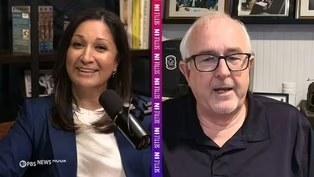
AMNA NAWAZ: Craig Fugate led the Federal Emergency Management Agency during the Obama administration through record-breaking disaster years.
I spoke to him for the latest episode of our PBS News podcast "Settle In" about how climate change has upended disaster response.
Here's a clip from that conversation.
How much of the conversation inside the agency was about climate change?
Did you feel like you had to push that a little bit inside?
CRAIG FUGATE, Former Administrator, Federal Emergency Management Agency: Most of the conversations were really about we needed to mitigate the effects of climate, which that also caused a problem, because when people use the word mitigate in emergency management, that means reducing the impacts of a disaster.
What they were talking about, and this was across the administration, was reducing greenhouse gases and addressing the effects of greenhouse gases and the transition away from carbon base to an electrical base, mitigating that.
But it wasn't dealing with the disasters.
And, really, I think within the agency -- and this was something that President Obama said.
I was traveling with him up to see Governor Christie in the aftermath of Superstorm Sandy.
And, again, I need to be clear.
A singular event is not an indication that the climate's changing.
We get these types of storms.
You get these types of events.
But the president said something I really took to heart, and that was, he said: "Craig, I think the debate about climate change is over.
We need to start talking about climate adaptation."
And that immediately caused a rift within the climate community for those who felt that, if we talk about adaptation, we're giving up.
And others, that was it was merely recognizing the climate had already changed.
I think that was the thing we kept hearing was, it was going to change.
And it was like, no, it's already changed.
We're already seeing these impacts.
And we need to adapt.
Really, we were able to go back.
FEMA says, look, just building back for the past 100 years' worth of data doesn't work anymore if we're dealing with record-setting events.
How do we change our guidance so that we're not just building it back where it was, the way it was, with maybe some upgraded building codes, but really focusing on, what are the future impacts and are we really mitigating for the future, versus only looking at the past?
AMNA NAWAZ: I mean, what did you think when President Obama said that to you?
Did you agree with that?
CRAIG FUGATE: I have sat through several times when President Obama would just off the cuff say stuff, and it was just like, why didn't I think of that?
(LAUGHTER) CRAIG FUGATE: And it framed it in such a way that it got rid of all the vagueness.
We were still -- at that time, everybody was arguing about what's causing climate change, is it real?
You still had that going on.
And his position was, the debate's over.
We're seeing the impacts.
We need to be talking about adaptation.
And, for FEMA, that meant that, because we spend a lot of your tax dollars rebuilding infrastructure, buildings and stuff, after disasters, particularly in these floods and other things, we needed to look at what we could do differently to address the future risks, not just the current risks.
AMNA NAWAZ: And you can watch our full conversation and all episodes of "Settle In" on our PBS News YouTube page or wherever you get your podcasts.
GEOFF BENNETT: And that's the "News Hour" for tonight.
I'm Geoff Bennett.
AMNA NAWAZ: And I'm Amna Nawaz.
On behalf of the entire "News Hour" team, thank you for joining us.
 New
NewCraig Fugate joins Amna Nawaz on 'Settle In'
Video has Closed Captions
Craig Fugate and Amna Nawaz discuss climate change and disaster response on 'Settle In' (3m 13s)
 New
NewGaza's youth search for hope in devastated homeland
Video has Closed Captions
Gaza's traumatized youth search for glimmers of hope in devastated homeland (6m 45s)
 New
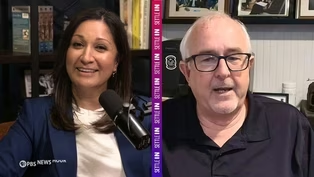
NewHow Mayo Clinic is using improv to engage dementia patients
Video has Closed Captions
How the Mayo Clinic is using improv to engage dementia patients (7m 13s)
 New
NewHow melting glaciers contributed to Himalayas flooding
Video has Closed Captions
How melting glaciers contributed to the flooding disaster in the Himalayas (8m 34s)
 New
NewJan. 6 rioters pursue new path for payments from Trump
Video has Closed Captions
Jan. 6 rioters pursue new path for payments from Trump administration (5m 4s)
 New
NewLatvia's foreign minister warns of Russian sabotage acts
Video has Closed Captions
Latvia's foreign minister warns of Russian sabotage acts in Europe (7m 24s)
 New
NewLindsay Clancy trial draws attention to postpartum care
Video has Closed Captions
Lindsay Clancy trial draws attention to postpartum mental health (7m 7s)
 New
NewNews Wrap: Trump signs order to rename Lake Ontario
Video has Closed Captions
News Wrap: Trump signs order to rename Lake Ontario as Lake America (7m 3s)
Providing Support for PBS.org
Learn Moreabout PBS online sponsorship
- News and Public Affairs

Today's top journalists discuss Washington's current political events and public affairs.

- News and Public Affairs

FRONTLINE is investigative journalism that questions, explains and changes our world.
 New Episode

 New Episode



 New Episode
 New Episode
 New Episode
Support for PBS provided by:
Major corporate funding for the PBS News Hour is provided by BDO, BNSF, Consumer Cellular, American Cruise Lines, and Raymond James. Funding for the PBS NewsHour Weekend is provided by...