
August 24, 2026 - PBS News Hour full episode
8/24/2026 | 57m 46sVideo has Closed Captions
August 24, 2026 - PBS News Hour full episode
August 24, 2026 - PBS News Hour full episode
Problems playing video? | Closed Captioning Feedback
Problems playing video? | Closed Captioning Feedback
Major corporate funding for the PBS News Hour is provided by BDO, BNSF, Consumer Cellular, American Cruise Lines, and Raymond James. Funding for the PBS NewsHour Weekend is provided by...
August 24, 2026 - PBS News Hour full episode
8/24/2026 | 57m 46sVideo has Closed Captions
August 24, 2026 - PBS News Hour full episode
Problems playing video? | Closed Captioning Feedback
Where to Watch PBS News Hour
PBS News Hour is available to stream on pbs.org and the PBS app.
Providing Support for PBS.org
Learn Moreabout PBS online sponsorshipGEOFF BENNETT: Good evening.
I'm Geoff Bennett.
Amna Nawaz is away.
On the "NewsHour" tonight: President Trump promises more tariffs on Canada after trade talks break down.
The U.S.
threatens new sanctions on countries doing business with Iran now that the military conflict is in a stalemate.
And new reporting details how President Trump directly intervened in the government's lawsuit against the entertainment giant Live Nation.
REBECCA BALLHAUS, The Wall Street Journal: There's still a feeling that there could have been a lot more that was gotten from the company than what the DOJ was able to get them to agree to.
(BREAK) GEOFF BENNETT: Welcome to the "News Hour."
The trade war between the U.S.
and Canada is intensifying after negotiations broke down over the weekend.
President Trump announced today that tariffs on Canadian-made cars, trucks, and auto parts will rise to 50 percent at the start of the new year, part of a broader round of 50 percent tariffs covering $28 billion in Canadian goods.
The president defended the move on social media, writing this: "Canada has been ripping off the United States of America for years.
Their ridiculously high tariffs on our farmers and farm products has made life impossible for these great American patriots."
Now, over the weekend, Canadian Prime Minister Mark Carney said his country had been preparing for a fundamental shift in its relationship with the U.S., which it no longer views as a reliable partner.
MARK CARNEY, Canadian Prime Minister: Our government understood before many that America would transform all of its commercial relationships, that it would put a series of tariffs on its closest allies and use economic integration as a weapon.
We recognize that sometimes its signature was written in pencil.
GEOFF BENNETT: The breakdown threatens to deepen the economic fallout on both sides of the border and raises new questions about the future of North American trade.
For a view from Canada now, we're joined by Peter Armstrong, senior business correspondent for the CBC.
Thank you for being with us.
PETER ARMSTRONG, CBC Senior Business Reporter: Thanks for having me, Geoff.
GEOFF BENNETT: And President Trump, as you well know, has long argued that Canada takes advantage of the U.S.
when it comes to trade.
What does the data actually show?
PETER ARMSTRONG: Yes, I mean, it it's an argument that really infuriates Canadians, because, for the most part, that trade deficit that the U.S.
runs is only because America decided to buy more safe, friendly, next-door-to-them oil from Canada.
Were it not for oil, there wouldn't be a trade deficit at all.
And, in fact, if you look at it and include services, so everything from consulting to software to digital streaming, that trade deficit shrinks to basically nothing.
I think it's $40 billion at that point.
So the argument that the trade deficit is what's behind all this, economists will tell you, I run a trade deficit with my dentist.
It doesn't make him a bad guy that's trying to rip me off.
It means I use the services he provides and he spends my money somewhere else in my community, and it all kind of works out well.
GEOFF BENNETT: When the president writes, "We don't need Canada, they need us," economically, how accurate is that?
Is Canada more vulnerable in this trade war than the U.S.?
PETER ARMSTRONG: I mean, yes, Canada is more vulnerable, but that doesn't mean this isn't being felt already by American producers, American businesses, American households, and consumers, right?
Like, just take the auto industry.
The automakers in North America have paid out something to the tune of $110 billion in the last 18 months alone in tariffs and costs due to the disruptions.
And we've seen a pretty significant drop-off in U.S.
made cars coming to Canada.
Canada is the number one export market for everything in the United States.
It's the number one export market for cars as well.
And a 27 percent drop-off has meant, like, I think it's a $7 billion loss for U.S.
automakers.
And you look at what else do they need, we provide an awful lot of the oil that gets turned into gasoline for American consumers, right, 25 percent of refinery throughput.
Put another way, the oil that goes into refinery to become gasoline, 25 percent of that comes from Canada.
And so it's been this really helpful, really reliable, really friendly relationship for 60, 70 years.
And the undoing of that, if that's in fact the goal is to undo the economic ties between these two countries, is not going to come without pain for people on both sides of the border.
GEOFF BENNETT: And that remarkable phrase from the prime minister that America's signature was written in pencil, given the depth of the U.S.-Canada relationship, what does it say when a Canadian prime minister is now publicly questioning whether the U.S.
can be relied upon?
PETER ARMSTRONG: Well, a couple of things.
You have to take into account the ferocious anger and sense of betrayal that I think a lot of Canadians are feeling right now.
And it's not just this round of tariffs.
It's not just the last round of tariffs, and it's not just the constant berating of, we're going to turn Canada into the 51st state, or that they refer to the prime minister as governor, and these other sort of just disrespectful ways of treating your closest trading partner.
But the cumulative effect of all of that really has weight.
And then you have to think about the fact that what we're undoing here is the USMCA agreement that was signed into effect during Trump's last term.
It's not like this was a deal that was made 40 years ago by some other -- a Democrat or somebody that he disagrees with.
This was made by Donald Trump, by Jamieson Greer, by American officials that are still part of this administration.
And they said at the time this is the greatest trade deal in history and it was going to benefit everybody on both sides of the border.
And then literally on day one of the administration, they came in and said, well, that deal's no good anymore.
We want to restart everything.
So you do have to wonder how much an agreement that we might have made would have been worth and whether at the last minute or in six months or in a year from now the terms of that agreement would have been torn up.
So I do feel some sympathy for the prime minister trying to carve a way through all of that uncertainty to find a deal that's good for both economies, but especially for Canada for his constituents.
GEOFF BENNETT: The ferocious anger that you speak of, when Carney describes what's happening in terms approaching an economic war, is that how Canadians broadly see this rupture with the U.S.?
PETER ARMSTRONG: They do, absolutely.
And to put it very plainly, again, it's not just the tariffs.
And it's not just the threats of economic annexation or this - - like, today, the vice president of the United States referred to Canada as a state.
This is not something that I think anybody in the United States would accept from any other country talking about your country.
Nobody here is accepting it as something that should be reasonable or taken reasonably here in this part of the country.
And they have taken lots of measures to push back, but the ones that seem to get under the skin of the administration the most are the two that have nothing to do with the federal government.
It's the provinces that have taken American alcohol off the shelves of liquor stores in eight of 10 provinces.
And it's been a really grassroots move by Canadian consumers and households to not travel to the United States while these tariffs are in place.
Both of those have come with enormous costs to tourism-heavy regions and to California wines and Kentucky bourbons.
And the more this goes on, I think the less likely it is that Canadians, even when those things go back on the shelves and even when tourism is back to Canadians say it's OK to travel there again, I'm not sure how many will actually take up a glass of American bourbon or travel to the United States, given how disrespected and how angry and how upset they are with the way this administration has treated Canadian trade, Canadian businesses, and I think Canadian citizens.
GEOFF BENNETT: Peter Armstrong, senior business correspondent for the CBC, thank you for being with us.
PETER ARMSTRONG: Oh, you bet.
GEOFF BENNETT: Today, the U.S.
launched what the Trump administration is calling an economic D-Day against Iran.
Operation Economic Outcast, as it's called, threatens tougher sanctions on countries that continue to trade with Tehran.
It's a new campaign of maximum economic pressure, as the administration tries to avoid returning to war, while struggling to break Iran's grip on the Strait of .
Nick Schifrin has more.
NICK SCHIFRIN: In the Strait of Hormuz, with vessels mostly at a standstill and diplomacy in a standoff, today, the Trump administration returned to economic pressure.
SCOTT BESSENT, U.S.
Treasury Secretary: Economic engagement of any kind with this murderous regime will expose those responsible to the full reach of American power.
NICK SCHIFRIN: Those engagements include direct flights and financial ties, but mostly Iran's revenue is from oil.
And 90 percent of Iran's crude exports are bought by China.
President Trump has emphasized U.S.-China strategic stability.
Today, Bessent neither ruled in nor ruled out new Chinese sanctions.
SCOTT BESSENT: No one is above the reach of U.S.
sanctions.
NICK SCHIFRIN: Today, Iran's currency dropped to a record low, and Iranians are struggling from massive inflation.
But Iranian leaders today threatened to block all the U.S.'
Gulf allies' oil exports, and they vowed military revenge.
MOHSEN REZAEI: We will retaliate in a seismic manner.
NICK SCHIFRIN: Meanwhile, today, there are some efforts to restart diplomacy.
Today, Pakistan's powerful army chief, General Asim Munir, visited Tehran.
He has played a key mediator role, as has Oman, whose foreign -- whose foreign minister will visit Iran tomorrow.
For perspective on all this, we turn to Miad Maleki.
He was born and raised in Iran, and, until last year, he was associate director for sanctions targeting in the U.S.
Treasury Department with a focus on Iran.
He's now a senior fellow at the Foundation for the Defense of Democracies.
Miad Maleki, thanks very much.
Welcome back to the "News Hour."
MIAD MALEKI, The Foundation for Defense of Democracies: Thanks for having me.
NICK SCHIFRIN: The U.S.
has had sanctions on Iran for years.
Why might today, why might this different version, new version of maximum pressure produce any different results?
MIAD MALEKI: That's a great question.
I mean, it's accurate to say that Iran's economy or Iran has been subject to the most comprehensive sanctions in the history of sanctions, since President Obama, when you had a secondary sanctions that was put in place, all the way until today, layers and layers of sanctions.
All sectors of Iran's economy are subject to sanctions.
What's different today, what I sensed today from Secretary Bessent's announcement is really focusing on the engagement aspects of enforcement of sanctions, meaning engagements with partisan allies and others on how we can bring these nations to enforce these existing sanctions more forcefully.
And that includes not just U.S.
economic sanctions, but you also have European Union sanctions against Iran.
You have U.K.
sanctions and many countries that have their own bilateral or unilateral sanctions against Iran.
NICK SCHIFRIN: Is what you're saying basically that the effectiveness of what was announced today dependent on diplomacy, dependent on the president diplomatically engaging with some of these countries, that still do business with Iran, whether from China, which we will get to in a second, or United Arab Emirates?
MIAD MALEKI: Absolutely.
I think sometimes a threat can be more impactful than a tool itself.
And I think what's been happening here is some engagement campaigns.
I can imagine, in the Treasury Department, their country programs or research that have been done for each country jurisdiction that still conduct trade and business with Iran.
And they have some engagement strategy, whether through direct engagements or, in some cases, rolling out sanctions actions and then engage those governments or jurisdictions to enforce sanctions better.
NICK SCHIFRIN: When it comes to the UAE, how important is it that that country, which has given Iran an economic lifeline for many years, follow through on not only the threats today, but what they promised last week, which was to cut off trade with Iran?
MIAD MALEKI: Well, that's the key on the announcement from UAE's Ministry of Foreign Affairs.
So if you look at where the naval blockade, the U.S.
naval blockade lines are, it's really outside as the Strait of Hormuz.
So what remained within the Persian Gulf was a trade and commerce between UAE and Iran.
It's really an economic lifeline for Iran to get gasoline, to get goods and services and access to the financial sector in UAE and, most importantly, the exchange houses that Iran really uses to get U.S.
dollars and also get access to the revenue from oil from China, some of which are moved to UAE.
So, now, with UAE'S decision, you can imagine how these naval blockades, a line of naval blockade are now extended within the Persian Gulf.
Now, the announcement by UAE's leadership alone can really lead to some derisking in UAE's exchange market.
Even if they're not -- there's no meaningful enforcement, that message itself can probably deter a significant level of exchange activities that Iran does in UAE.
NICK SCHIFRIN: When it comes to Iranian revenue, though, as I pointed out in the piece, it is China, right?
Ninety percent of Iranian oil exports go to China.
Explain how the sanctions announced today are supposed to help stop Beijing from that.
But, crucially, do we have any indication that President Trump is willing to sanction China?
MIAD MALEKI: Well, that's a big question.
i think, at the end of the press conference, that Secretary Bessent had a question, was, what are you doing as far as banks?
And he said, well, we will have one bank by the end of the week.
And he also said he doesn't want to blow up the financial economy or financial sector.
I take that as Treasury Department is not there yet to go after a major bank.
NICK SCHIFRIN: And especially a bank in China?
MIAD MALEKI: Absolutely.
I mean, Chinese banks are larger than U.S.
banks.
I mean, these are a major backbone of the trade between China and the U.S.
and global economy, and 80 percent of that trade goes through U.S.
dollars.
So, what happens here is, you have about 500,000 barrels of oil a day that the Chinese are purchasing from Iranians?
That's a major drop.
NICK SCHIFRIN: Despite sanctions.
MIAD MALEKI: Despite sanctions.
That's a major drop from 1.5 million barrels to 500,000 barrels a day.
So they're complying with sanctions.
So there's some level of fear of the sanctions already in China.
I think what Secretary Bessent is hinting at, engagement with these banks to make sure that the revenue from Iran's oil to China, they stay in China and they're not leaked out of these banks to the Iranian regime.
NICK SCHIFRIN: You and I have talking -- have been talking about maximum economic pressure on Iran for many years.
You were the author of some of the sanctions.
But, bottom line, there are experts who say this isn't going to change Iranian behavior, that Iran can take the pain of economic sanctions, even if China or the UAE cuts them off, and that will still not produce the results that the U.S.
wants.
MIAD MALEKI: Well, the Iranian regime will take the pain at the expense of the Iranian people.
That's what it do.
But the pressure is building up domestically.
Now, what I would say is, let's go back to the '80s.
I mean, I think historically you can see how the Iranian regime from the '80s on, they have only responded to pressure.
In the '80s, after eight years of Iran-Iraq War, in 1988, Ruhollah Khomeini then is the supreme leader.
After eight years of promising victory in that conflict, after facing major economic pressure, defeat on the ground or militarily, agreed to accept a cease-fire and gave up - - and the poison, the chalice of poison.
NICK SCHIFRIN: So, bottom line, you do think that this pressure will work and could get Iran to a cease-fire?
MIAD MALEKI: It depends on the level of enforcement, right?
If you see a meaningful enforcement, then we might get to a point that a regime is going to have to accept, as they have historically.
NICK SCHIFRIN: Miad Maleki, we will have to leave it there.
Thank you very much.
MIAD MALEKI: Thanks for having me.
GEOFF BENNETT: We start the day's other headlines with a wildfire emergency in the West, a blaze that's raging just outside of Reno.
That's Nevada's largest city outside the Las Vegas area.
Tens of thousands of people have been urged to evacuate, and firefighters are still trying to bring the fire under control.
Stephanie Sy reports.
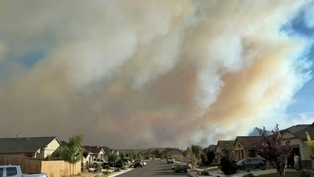
STEPHANIE SY: Tonight, above the glow of Reno's lights, a far more ominous glow, hillsides IN flames.
A massive and menacing wildfire is burning just miles outside the major city.
The fast-moving Hawk Fire ignited northwest of Reno on Saturday and has already scorched about 25 square miles.
MAN: The smoke is bad.
WOMAN: Oh.
MAN: Look at the visibility.
STEPHANIE SY: The fire was 27 percent contained as of today.
At least seven people have been injured in the fire, including three first responders.
DARIN BALAAM, Washoe County, Nevada, Sheriff: with This wind, listening to the fire, watching them as they have done this fire and many others, it just takes that little breeze and that one ember.
STEPHANIE SY: Firefighters are battling 90-degree heat, strong winds, and dry tinder brush as they try to get a handle on the fire from the ground and the air.
Nevada's governor has declared a state of emergency and deployed the National Guard to assist some 800 fire personnel.
WOMAN: Tons and tons of children.
STEPHANIE SY: Shelters have filled up, as tens of thousands of people have been forced from their homes.
Schools were closed to keep evacuation routes clear.
MAN: Yes, they're going all the way out.
STEPHANIE SY: Many were urged to stay away for several days because shifting winds are making the fire unpredictable.
TERESA LENSHYN, Reno Fire Evacuee: Oh, my gosh, I'm still scared to death.
It's like you don't know if the winds are going to shift and it's going to get worse.
So you're just kind of -- I got all my stuff in my car and in his car.
STEPHANIE SY: Fire officials say an investigation into the cause of the Hawk Fire is ongoing.
They say it is the third human-caused wildfire in the area in just the past two weeks.
Many residents say they're devastated and concerned that the fire could spread to more neighborhoods on the edge of the city.
JAYSON DAVIS, Reno Fire Evacuee: To a lot of people around here, this is their entire livelihood.
This is their entire life they built for years and years.
And we have never seen a fire like this.
STEPHANIE SY: Dozens of homes have been lost, but the full scale of the damage is not yet known.
For the "PBS News Hour," I'm Stephanie Sy.
GEOFF BENNETT: Meantime, roughly 45 million Americans are under extreme heat alerts today as parts of the South are facing a prolonged and dangerous heat wave.
The most intense conditions are expected across the Southwest and Southern Plains states.
Forecasters are expecting triple-digit temperatures with records likely to fall in the coming days, while, in Hawaii, the National Hurricane Center says Tropical Storm Moke is expected to bring heavy rain and strong winds as it passes to the south.
Hawaii is still recovering from Hurricane Lala, which battered the Big Island just over a week ago.
The U.S.
Supreme Court today cleared the way for President Trump to move ahead with his executive order restricting mail-in voting, though it's unclear how much of the plan can be put in place before the November midterms.
The order directs the administration to create lists of U.S.
citizens and requires the Postal Service to obtain lists of eligible voters from states to deliver mail-in ballots only to those people.
The ruling could still face additional legal challenges, and with some states set to begin sending out mail ballots within weeks, the administration has little time to put major changes in place.
President Trump has long criticized mail-in voting, repeatedly claiming it leads to widespread fraud, despite evidence to the contrary.
He has also voted by mail himself, including in this month's Florida Republican primary.
Turning now to the war in Ukraine, the U.K.
and France pledged increased support today as the country marked its 35th Independence Day.
In a video released for the occasion, Ukrainian authorities showcased the country's drone technology and other military hardware.
European leaders were also on hand.
On his first overseas trip since taking office, British Prime Minister Andy Burnham pledged to help Ukraine produce long-range missiles.
Ukrainian President Volodymyr Zelenskyy also delivered remarks, calling for continued support from abroad and unity at home.
VOLODYMYR ZELENSKYY, Ukrainian President (through translator): We are not asking you to fight for us.
Give Ukraine everything it needs to stop this war, to stop it faster than Putin can start the next one.
To prevent that, we must act together.
GEOFF BENNETT: Meantime, both Russia and Ukraine continued their attacks today.
Russian officials say three teenagers were killed when a Ukrainian drone hit this building in the Southern Russian city of Krasnodar.
And authorities in the Odesa region say a Russian attack on warehouse facilities there injured at least five people.
The Pentagon says it struck a boat in the Eastern Pacific, killing two people it accused of trafficking drugs.
The strike on what officials called a low-profile vessel operating along established narco-trafficking routes was the first to be announced in about two months.
And it comes as the Trump administration has said it wants to extend military operations to land targets in Latin America as well.
At least 210 people have died in dozens of such attacks since U.S.
forces started their offensive nearly a year ago.
Critics have questioned the legality of the strikes.
In Illinois, former Sheriff's Deputy Sean Grayson has died six months into a 20-year prison sentence for killing Sonya Massey, a Black woman who had called 911 for help.
His lawyer confirmed his death, but provided no additional details.
The 32-year-old had been diagnosed with colon cancer, and last month his application for an early medical release was denied.
It's not clear whether the cancer contributed to his death.
Body camera footage showed Grayson shooting Massey in her home in July of 2024.
Her killing sparked nationwide protests and led to changes in how Illinois law enforcement hires officers.
The Trump administration is moving to codify a new fee for H-1B worker visas that costs more than $103,000.
In a filing today, the Department of Homeland Security said some of the revenue would be used to help fund the nation's immigration courts and ICE.
Earlier this summer, a judge in Massachusetts struck down a similar temporary fee.
The H-1B program allows U.S.
companies to hire tens of thousands of foreign workers each year.
President Trump has argued it takes jobs away from Americans, but many companies say it's needed to recruit top talent, especially in tech and research.
Well, stocks on Wall Street started the week mixed.
The Dow Jones industrial average managed a gain of about 140 points, but the Nasdaq fell 200 points on the day.
The S&P 500 fell further back from its recent records.
And longtime television actor and singer Shelley Fabares has died.
She found fame as a teenager in the late 1950s playing Donna Reed's daughter on "The Donna Reed Show," seen here on the far left.
Fabares also appeared in three movies with Elvis Presley and had a music career of her own.
Her 1962 single "Johnny Angel" was her biggest hit, rising to number one on the Billboard charts.
Fabares found success later on the sitcom "Coach," where she earned two Emmy nominations.
In a statement, her family said she will be remembered as a source of love, strength, laughter, and comfort.
Shelley Fabares was 82 years old.
Still to come on the "News Hour": we speak with the editor of a military newspaper who was fired after reporting on the conditions aboard the USS Lincoln; Tamara Keith and Amy Walter on South Carolina's Senate run-off; and Richard Russo discusses his new novel about the places we leave behind.
The Wall Street Journal is reporting new details about President Trump's role in a major antitrust case against Live Nation, the concert giant that owns Ticketmaster.
Justice correspondent Ali Rogin has more.
ALI ROGIN: The Department of Justice spent more than a decade building a case accusing Live Nation of illegally dominating the live event industry by thwarting competition to keep ticket prices high and restricting artists' access to live venues.
But according to a new Wall Street Journal investigation, the president urged senior officials at the DOJ to settle the case just days before it was set to go to trial.
It came shortly after the president met with the company's CEO in the Oval Office.
Attorneys general from 33 states and D.C.
had joined the lawsuit, and, despite the settlement, most refused to sign on to it, saying the terms were too favorable.
In April, a jury in the state A.G.
's case found the company illegally monopolized the ticketing market.
For more, I'm joined by Wall Street Journal investigative reporter Rebecca Ballhaus.
Rebecca, thank you so much for joining us.
What did you and your colleagues' reporting reveal about President Trump's involvement in this case?
REBECCA BALLHAUS, The Wall Street Journal: Yes, so, as you said, this was an incredibly unusual case.
It's a case that was first brought by the Biden administration.
And when it's announced in 2024, then-Attorney General Merrick Garland says it's time to break up Live Nation and Ticketmaster.
And when Trump comes into office at his first spring in March 2025, it looks like he's poised to kind of keep up that pressure on the industry.
He announces this executive order that's aimed at cracking down on the concert industry, specifically targeting ticket scalping and exploitative pricing.
So it looks like the pressure's on and that he's not going to sort of reverse course on what the Biden administration has been doing.
And then we see the DOJ and Live Nation spend months and months exchanging settlements, negotiating.
Live Nation for months can't even get in the door with the DOJ.
They can't even get a meeting.
And then, finally, their CEO sits down with Trump in the Oval Office just days before the trial is set to start.
And our reporting shows that, after that, Trump makes the call to the DOJ and says, settle this case.
And by that -- the end of the day that Monday, the first day of the trial, Live Nation's lawyer tells the judge that they all but have a deal for a settlement, and that's hashed out in the next couple of days.
ALI ROGIN: Stunning 180-degree shift.
This is a playbook that other individuals and companies have followed when they are trying to appeal to President Trump directly when they're facing lawsuits.
So, what sort of tactics did you find that Live Nation employed to curry the president's favor and get him to intervene in this way?
REBECCA BALLHAUS: Well, so I should say here, the meeting with the president in the Oval Office with the Live Nation CEO, Trump had actually called that meeting to discuss the Kennedy Center, which at that point was a real fixation of his.
He wanted to improve bookings at the center and wanted Live Nation's help on how to do that.
And so he had asked the CEO to come and meet with him to discuss that, and then over the course of that meeting said something to the effect of, how's the case going?
Has it been resolved yet?
And we understand that the CEO told him, we have been having these talks with DOJ, but they failed, and the trial's starting Monday.
So that's one piece of it.
They certainly were able to get on the president's radar, but it's not our reporting that they arranged this meeting for this express purpose.
What we do know that they did is that they had months before the trial started hired a set of lawyers from Sullivan & Cromwell who were also representing the president in his two New York appeals.
And so, in December of 2025, they had hired that law firm to take over their settlement talks with DOJ.
And one of the reasons why we understand they hired Sullivan & Cromwell is because they had these connections with DOJ leadership.
ALI ROGIN: And when you went to the Department of Justice for a response, what did they say, given how unusual this type of intervention from the commander in chief is?
REBECCA BALLHAUS: So the Justice Department didn't acknowledge the reporting in our story regarding the president's intervention in this case and his call to the DOJ.
What they did say is that they were able to get more from the company earlier than if they'd gone through this trial process.
But what I did find really notable was Live Nation's response to our reporting.
And what they said is that, if you can't get a meeting with the Antitrust Division, which they spent several months trying to do, you have every right to go over their head to senior DOJ leadership, as we saw they did in this case.
And so I think it's a really interesting example of a company kind of owning using some of those levers.
While they're not acknowledging going to the president directly and saying that that was a part of it, they are saying that they appealed over the heads of the Antitrust Division, which is something that would have been very unusual in previous administrations.
ALI ROGIN: As we mentioned, many state attorneys general declined to sign on to this settlement because they thought Live Nation got off too easy.
They moved forward with their own case.
We know that a jury has decided against Live Nation.
But between that case moving forward and this settlement, where does that leave Live Nation today?
REBECCA BALLHAUS: Well, I think certainly more in limbo than it had hoped for when it reached this settlement with DOJ.
I think the hope was certainly that states would sign on and that this would kind of end trial and end the case.
That's not how it played out.
And instead now they're facing -- the judge is going to have to decide on the states' request to ask Live NATO ion to sell off Ticketmaster.
So the remedies in that case have yet to be decided.
ALI ROGIN: Rebecca Ballhaus with The Wall Street Journal, thank you so much for joining us.
REBECCA BALLHAUS: Thanks for having me.
GEOFF BENNETT: A Justice Department spokesperson told the "News Hour" today, in part: "'The Journal''s account of how this resolution came together is in material respects categorically false.
The department stands behind this settlement and the many lawyers who negotiated it."
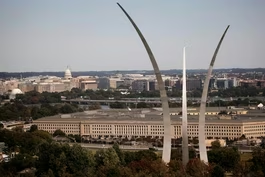
Now to the leadership upheaval at Stars and Stripes, the newspaper that has served American troops for generations.
Its publisher was fired, and its editor and one of its reporters were removed as well.
The turmoil has raised new questions about the future of a publication with an unusual mandate.
Stars and Stripes is funded in part by the Pentagon, but is protected from military censorship and editorial control.
Erik Slavin was its editor until last week, and he joins us now.
Thank you for being here.
ERIK SLAVIN, Former Editor in Chief, Stars and Stripes: Thank you for having me.
GEOFF BENNETT: So let's start with what happened.
On Friday, you received a separation notice from Stars and Stripes.
What reason were you given for your firing?
ERIK SLAVIN: It didn't actually come from Stars and Stripes.
It came directly from the Pentagon.
But I was told that I was being -- receiving a notice of proposed separation for insubordination, and it cited a CBS interview that I did where I said that hypothetical censorship would be a personal red line.
GEOFF BENNETT: So you were fired for saying that censorship is bad?
ERIK SLAVIN: Essentially, yes.
GEOFF BENNETT: This comes amid a broader shakeup.
The Pentagon fired the publisher after he announced his retirement.
You were let go, as was a Middle East reporter in April.
The Pentagon fired the ombudsman for the newspaper, whose job had been to safeguard editorial independence.
Do you see all of this is connected?
ERIK SLAVIN: Yes, I do.
Going back to January the 15th, that's when we first saw a tweet from the Pentagon's press office, which was coordinated with the rescission of the Code of Federal Regulations, which spelled out a lot of the freedoms that were guaranteed to Stars and Stripes.
At the same time, there was a leak to a friendly news organization to the administration that talked about getting rid of our overseas reporters and replacing them with military reporters.
So I think there were -- there were plans.
GEOFF BENNETT: And days before your separation, Stars and Stripes published significant reporting about the problems aboard the USS Lincoln.
Your firing notice doesn't mention that story, but do you have any evidence that that reporting played a role in your dismissal?
ERIK SLAVIN: You know, as you said, it wasn't in the statement.
I can tell you that, on August the 11th, Stars and Stripes was the first to break a lot of the details that came about aboard the USS Lincoln.
And I'm very proud of the reporting that we did.
It's a fundamental benefit for U.S.
service members to be able to have that kind of credible reporting.
Now, the administration didn't single out Stars and Stripes, but I know there were certain people within the administration who did voice displeasure with the reporting about it.
So, my separation came about 10 days later.
As I said, it doesn't cite that.
Those are just -- those are the facts.
GEOFF BENNETT: I want to pick up on something that you said about members of the military being able to rely on Stars and Stripes for credible reporting.
For viewers who might not know about this media organization, explain how it's different from any other news organization covering the military.
ERIK SLAVIN: So, Stars and Stripes exists at many different overseas bases, and Stars and Stripes will cover the kinds of stories that nobody else really has the interest or the bandwidth to cover, because nobody else is going to look into the cost of housing for service members at a small base in Poland or the barracks in Germany or a high school basketball game between two schools on military bases.
We cover these kinds of things because we know there's an audience for it, and we know that nobody else will.
GEOFF BENNETT: At the same time, you have the Pentagon providing roughly half of Stars and Stripes' funding.
There is this question some people might ask, why shouldn't Pentagon leadership have some say over the publication?
ERIK SLAVIN: Well, the Pentagon already has its own public affairs wing.
What Stars and Stripes brings is unique.
And, ultimately, I think it's great for the morale of service members when they can look at something and say, yes, this is credible.
This reflects my lived experience, and it's not something that's coming out of a public relations arm.
It's something real.
GEOFF BENNETT: We were just looking at this extraordinary montage of people reading your paper, your former paper, Stars and Stripes, over the generations.
As you see it, where is the legitimate line between oversight and interference with independent journalism?
ERIK SLAVIN: Well, Stars and Stripes has to remain independent from the military chain of command.
Its editorial content must remain that way for it to be credible.
And that's something that General Dwight Eisenhower said in World War II.
He said: "This is the soldiers' paper.
Do not interfere."
And that has been the tradition of Stars and Stripes, and I certainly hope that it can continue in some way.
GEOFF BENNETT: Erik Slavin, thank you for being here and for sharing your story.
ERIK SLAVIN: Thank you.
GEOFF BENNETT: Tomorrow, Republican voters in South Carolina will replace the late Senator Lindsey Graham on November's ballot in a runoff between his sister, Darline, and Congressman Ralph Norman.
Reporter Gavin Jackson of South Carolina ETV has the story.
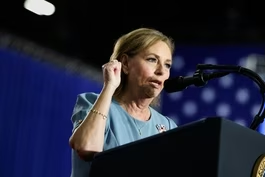
GAVIN JACKSON: Thousands turned out Friday in Myrtle Beach to hear from President Trump as he rallied for his handpicked successor to the late Senator Lindsey Graham, his sister, Darline, in the final days of a condensed campaign sprint that went from 10 candidates two weeks ago to Graham and Fifth District Congressman Ralph Norman.
She sees her outsider status as a positive, but it also comes with some negatives, like on the debate stage last week.
GRETA VAN SUSTEREN, Moderator: Senator, are Taiwan and the South China Sea national security issues for the United States?
And if so, why?
SEN.
DARLINE GRAHAM (R-SC): I'm just going to be honest here.
I'm not -- on national security, that -- I'm not that informed on national security, so -- but I do support the military.
GAVIN JACKSON: On Friday, Graham continued to downplay the comments.
SEN.
DARLINE GRAHAM: The critics say I shouldn't run for the Senate.
They say I'm not a politician.
You know what I say?
Guilty as charged.
(CHEERING) GAVIN JACKSON: Trump was asked about her performance before heading to South Carolina on Friday.
DONALD TRUMP, President of the United States: She is a terrific woman who answered that.
I watched that.
I thought it was a very honest answer, actually.
GAVIN JACKSON: Friday was also the last day of early in-person voting, and Graham supporters weren't too concerned over her debate response.
RUSSELL LEE, South Carolina GOP Voter: It's not something she's been involved with her whole life as far as foreign policy and stuff.
But we Have got a lot of people in Congress and the Senate that's probably a little dumber on things than what she is.
That's how I feel.
DOUG JAMES, South Carolina GOP Voter: Politicians don't know everything when they walk into office.
And I think that's a legitimate answer to know your limitations.
GAVIN JACKSON: Norman, Graham's opponent served in the State House for years, then in Congress since 2017.
Norman is a member of the far right House Freedom Caucus and garnered statewide name recognition after coming in third during the June gubernatorial primary.
And he classified Graham's response differently.
REP.
RALPH NORMAN (R-SC), Senatorial Candidate: You don't have to be an expert, but you have to explain your positions and your overall opinion.
And she just didn't do that.
GAVIN JACKSON: Whoever wins Tuesday will face off against Democrat Annie Andrews in November in this solidly Republican state.
For the "PBS News Hour," I'm Gavin Jackson in Myrtle Beach.
GEOFF BENNETT: We turn now to the political fallout from the stakes in South Carolina and the November elections to new reporting about a private meeting involving the president's son-in-law and the top House Democrat.
Let's welcome in our Politics Monday duo.
That's Amy Walter of the Cook Political Report with Amy Walter and Tamara Keith of NPR.
It's always great to see you both.
We are going to work our way to this South Carolina Senate race.
But I want to start with this Supreme Court ruling today, Amy, allowing President Trump to begin carrying out parts of his executive order restricting mail-in balloting.
There are, as we sit here, more questions than answers at the moment.
But based on what we know, what does this mean for voters heading into November?
AMY WALTER, The Cook Political Report: Yes, I mean I think it sows some confusion, because it is true there are other injunctions that still need to be worked through.
Now, I've talked with somebody who does a lot of work with election administration, who, at least up until this most recent ruling, had said, I just don't think that the federal government is going to be as engaged in the running of elections as it seems to be at this moment.
But if you are a voter and you hear all of this information coming back and forth for you, you may be concerned about whether or not your ballot is actually going to be counted.
And that is a major issue.
GEOFF BENNETT: Absolutely.
All right, so let's talk about the South Carolina Senate race.
President Trump's pick, Darlene Graham, she faces a real fight tomorrow.
Tam, you've been reporting on this.
What can you tell us?
TAMARA KEITH, National Public Radio: Well, I can tell you that President Trump's super PAC, MAGA Inc., just dropped more than $800,000 to help get out the vote for Darlene Graham.
This is notable.
MAGA Inc.
has something like $400 million cash on hand.
They have not spent it on pretty much anything all year long.
One of the big questions of this midterm is, will MAGA Inc.
ever spend any money?
And now we have an answer.
They're spending a large sum of money for Darlene Graham.
And that is just another indication that she needs the help and that the president had this rally on Friday night where he said, just pretend I'm on the ballot.
Just act like you're voting for me, which I think is basically his midterm message to Republican base voters.
But, in a way, he is on the ballot because his endorsement, his -- the power of his endorsement is on the line.
GEOFF BENNETT: Yes.
And what's so interesting about this race is that Ralph Norman, he's not running some anti-Trump campaign.
What he's saying is, hey, look, I'm MAGA too.
I'm with Donald Trump too, but you don't have to take Donald Trump's choice.
AMY WALTER: Well, he has two arguments.
That's fair.
If you are Trump, your argument against that would be, well, really?
How loyal are you to me, Mr.
Norman?
You endorsed a candidate, Nikki Haley, who was the former governor of South Carolina, over me.
GEOFF BENNETT: And they go way back, yes.
AMY WALTER: Yes, they go way back -- over me in 2024.
So, if you're looking for the loyalty piece of this, and that's -- let's be really clear.
When the president is giving an endorsement, it's more than just he wants to show how much sway he has over voters in these races.
What he's really suggesting is, I want somebody who's going to be loyal, not necessarily to the party, but to me, the person, and I know a lot -- that Darline Graham, even though it's not Lindsey Graham, would be personally loyal to me in a way that I can't guarantee that Congressman Ralph Norman would be, who is famous for, Norman during his time in Congress, being sort of a contrarian, voting against leadership, being part of the House Freedom Caucus.
So if that's what you are looking for, as the president, which he's always looking for somebody who's going to be loyal to the man, President Trump, then Darline Graham would be the easier and better choice for him.
GEOFF BENNETT: Well, in an unusual bit of midterm maneuvering, you have got the House Democratic leader, Hakeem Jeffries, meeting with Jared Kushner, Donald Trump's son-in-law, informal adviser.
They met privately in New York in recent weeks.
This was first reported by The New York Times.
And the meeting raises many questions.
The obvious one to me is, is the White House starting to hedge against a Democratic majority next year?
TAMARA KEITH: What I find so fascinating about this is late last week I spoke to a senior White House official and asked, what is your agenda?
What is your legislative agenda?
What do you want to be able to do if you if you, if Republicans maintain control of Congress?
And the answer was like, well, the SAVE America Act maybe.
This is the voting-related legislation.
There isn't this big, bold series of laws that the president is running on.
There isn't this big, bold series of actions that they want Congress to take.
This is a president who has done most of his governing through executive order and has done the bare minimum that he has to do with Congress.
So the idea that the president himself is trying to forge a path forward with Democrats is kind of hard to believe that he personally would really want that.
And there are those on the left, certainly people on social media who seem to be, for whatever reason, upset with Hakeem Jeffries for taking this meeting, in part because he spent months presenting Democrats as a check on Trump.
GEOFF BENNETT: Does privately meeting with Jared Kushner complicate that message?
AMY WALTER: Well, it could for some members of that coalition on the left, which says, if the argument that Democrats are running on this midterm is about corruption and the ways in which the Trump family has benefited from the presidency, Jared Kushner obviously falls into that category.
And there are many who believe on the left that what the Democrats should do if they take control of the House is spend most of their oversight power on President Trump and the deals that he and his family have cut.
So that sort of undercut that message by sitting down with Kushner versus, say, sitting down with somebody who actually works in the White House or in the legislative staff.
GEOFF BENNETT: And that's the thing.
Jared Kushner does not hold a formal government position, and yet he's the key guy the top House Democrat, potential House speaker is sent to meet with?
What does that say?
TAMARA KEITH: I think it says that they have a little tiny bit of a prior relationship... AMY WALTER: That's right.
That's right.
Yes.
TAMARA KEITH: ... and that President Trump has virtually no relationship with Hakeem Jeffries, which we saw when we had these government shutdowns and there were basically no negotiations, and then the White House spent weeks trolling Jeffries with memes.
GEOFF BENNETT: Let's talk about these Canada tariffs, shall we?
AMY WALTER: Shall we?
GEOFF BENNETT: The politics of it doesn't seem to make sense on the face of it.
What's your take?
AMY WALTER: Especially if you are, I don't know, a senator in a very tight race in a state that borders Canada, known as Maine.
Senator Susan Collins this weekend was campaigning - - out campaigning and saying I just don't think this is a great idea for the state of Maine, given the relationship that we have.
Michigan, also a very important state in the United States Senate race, also borders Canada.
A lot of auto parts go back and forth between those two states.
So the mixed messaging from the White House on tariffs has become really a problem for Republican candidates who want to make a -- who want to drive a message about affordability and we're going to bring prices down, we're cutting your taxes, while at the same time voters in these states are filling up their gas takes with gas that's more expensive, but also are seeing the impacts of tariffs.
Whether you're in Iowa and you're a farmer, whether you're in Michigan working in the auto industry, or whether you're in Maine and in lumber or blueberries or lobsters or anything else that is going back and forth over the border.
GEOFF BENNETT: And based on your reporting, why is the president picking this fight now?
TAMARA KEITH: It is not clear why exactly he is picking this fight now.
However, as the war with Iran has dragged on, he is looking for new and -- or old, new old ways to assert himself on the world stage.
And some of this is that some of the tariff stuff has ripened again after the Supreme Court case.
And so the White House and the Trump administration really do see this as a policy that is pro-worker, pro-America.
Almost everyone disagrees with them, including economists and many Republicans.
But this is -- this is something that is a firmly held belief for the president, and so they are forging ahead on all of this.
GEOFF BENNETT: Tamara Keith and Amy Walter, thanks, as always.
We appreciate it.
AMY WALTER: You're welcome.
TAMARA KEITH: You're welcome.
GEOFF BENNETT: Richard Russo has written ten novels, won the Pulitzer Prize for "Empire Falls," and collaborated on screen adaptations and TV series based on his work.
Now his latest book has just been published 40 years after his debut novel.
Senior arts correspondent Jeffrey Brown visited him recently for our arts and culture series, Canvas.
RICHARD RUSSO, Author, "Under the Falls": "Funny thing about the Adirondacks.
Head up the north way toward Montreal, and right away, you sense you're leaving the Rust Belt."
JEFFREY BROWN: The opening lines of the prologue to Richard Russo latest novel, "Under the Falls,' about a man who leaves behind a hometown fallen on hard times, but finds he can't quite escape it, like the author himself.
RICHARD RUSSO: If you look back to my earliest fiction, the lens through which I look at the world has really not changed.
It's place, it's character, and class, place, character, and class.
JEFFREY BROWN: For many years, Russo has lived and worked in Main along the coast in and near Portland.
But many of the books for which he's best known are set in the industrial factory towns of the Adirondack Mountains in Upstate New York, especially his hometown of Gloversville, once known as the glove-making capital of the world.
Of the Adirondack mountains in Upstate New York.
Especially his hometown of Gloversville, once known as the glove-making capital of the world, before most of the manufacturers and tanneries left the country.
Russo's mother, separated from his father, wanted out and wanted him to see a bigger and, in her mind, better world.
He did leave, but, he says: RICHARD RUSSO: I think it was particularly difficult for her to realize that -- after those first few novels, that the place that she was so determined to escape from, somewhere along the line, I learned who I was, who and what I loved.
That was the last piece of becoming a writer for me, because I learned how to do the technical things at the University of Arizona and the MA program there.
But I hadn't figured out who I was yet.
JEFFREY BROWN: That, he would figure out in his fictionalized versions of Gloversville, calling it Mohawk in his first novel, Thomaston in "Bridge of Sighs," North Bath in the Fools Trilogy.
His Pulitzer Prize-winning "Empire Falls," while set in a main mill town, also draws on his roots.
RICHARD RUSSO: "If, for instance, you were to head up Route 29, not just north but also west, into those same Adirondacks, what you would find is a place called Stone Mountain."
JEFFREY BROWN: And now comes "Under the Falls."
RICHARD RUSSO: Stone Mountain is yet another left-behind Richard Russo locale.
JEFFREY BROWN: What does that mean?
What is left behind?
RICHARD RUSSO: Well, left behind means people there don't have as many opportunities to make a decent living.
JEFFREY BROWN: A place, he told us, modeled on the real town of Caroga Lake, near Gloversville, with a once-thriving, now-shuttered amusement park, which figures into Russo's story, in which a man named Tyler Sinclair, now a famous Nashville musician, returns to Stone Mountain after fleeing years before without a word to his closest friends.
RICHARD RUSSO: He has done what he thinks is a pretty incredible thing.
He has left this town with really nothing but his guitar, nothing but his talent.
JEFFREY BROWN: Right.
Yes.
RICHARD RUSSO: And he's... JEFFREY BROWN: And made it.
RICHARD RUSSO: And made it.
He's gone to Nashville and become a major singer-songwriter.
And he's done the thing that -- I mean, every band he's ever been in has been called Stone Mountain.
JEFFREY BROWN: Right.
So he's left, but he but he also hasn't left.
RICHARD RUSSO: He's left, but he hasn't left.
Exactly.
JEFFREY BROWN: One thing new for Russo, this is a thriller, as Tyler gets caught up in violence, police corruption, the opioid epidemic that's ravaged so many parts of the country.
And his character is doing something like Russo himself, continuing to write of the place he left behind, telling its story whether people there like it or not.
Part of your novel is clearly about who gets to tell the story of a place.
RICHARD RUSSO: Yes.
Yes.
That's true for Tyler, I suppose, because it's been true for me.
JEFFREY BROWN: In his memoir, "Elsewhere," Russo, for the first time called Gloversville by its real name, warts and all.
Not everyone was happy.
RICHARD RUSSO: And what happened was that people in town who had loved my writing when I was calling it Mohawk or calling it Thomaston, when I called it Gloversville, what I was getting was an angry response that says, Russo, you have done pretty well for yourself, haven't you?
And the question that they were asking me is the same question that gets asked of Tyler.
JEFFREY BROWN: In the new novel, yes.
RICHARD RUSSO: In the new novel.
Where's our cut?
JEFFREY BROWN: Yes.
RICHARD RUSSO: And that's what Tyler is facing when he goes back to Stone Mountain.
PAUL NEWMAN, Actor: He's a sissy.
JEFFREY BROWN: Russo has also had success as a screenwriter, including for the television version of "Empire Falls with Ed Harris and Paul Newman.
And "Under the Falls," in fact, began as a TV script before being turned into a novel.
He showed me a similar work now in progress.
RICHARD RUSSO: I'm taking this old screenplay.
That's what a screenplay page looks like, lots of white space on that.
And eventually it's going to be a novel, and, of course, the pages, the pages are going to look more like that, more words.
JEFFREY BROWN: But that's actually happened with "Under the Falls."
RICHARD RUSSO: That's what happened with "Under the Falls."
JEFFREY BROWN: You started writing the... RICHARD RUSSO: It started out.
Yes.
You can't wait around for Hollywood to get its act together, because who knows?
JEFFREY BROWN: Meanwhile, the love of books and writing has been passed down.
One of Russo's daughters, Emily, co-owns a bookstore in Portland, Maine, that carries the works of another Russo daughter, Kate, herself a novelist and artist.
And at 77, Russo keeps going.
RICHARD RUSSO: To me, after doing it now for my fourth decade, it seems absolutely necessary.
And, strangely enough, I think the worst times we go through, and I think we're going through some pretty awful times right now, art is more important in bad times than in good times.
JEFFREY BROWN: From Portland, Maine, I'm Jeffrey Brown for the "PBS News Hour."
GEOFF BENNETT: And that's the "News Hour" for tonight.
I'm Geoff Bennett.
For all of us here at the "PBS News Hour," thanks for spending part of your evening with us.
 New
NewGraham, Norman make final push in S.C. GOP Senate runoff
Video has Closed Captions
Graham and Norman make final push in South Carolina GOP Senate runoff (2m 29s)
 New
NewHow Trump intervened in the DOJ case against Live Nation
Video has Closed Captions
How Trump intervened in the DOJ case against Live Nation (6m 25s)
 New
NewMilitary newspaper editor fired after challenging censorship
Video has Closed Captions
Military newspaper editor says he was fired for raising concerns about Pentagon censorship (5m 1s)
 New
NewNews Wrap: Wildfire forces evacuations near Reno
Video has Closed Captions
News Wrap: Wildfire forces evacuations near Reno (8m 7s)
 New
NewThe potential economic fallout of the U.S.-Canada trade war
Video has Closed Captions
The potential economic fallout of Trump's trade war with Canada (7m 14s)
 New
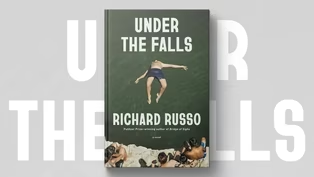
NewRichard Russo visits places left behind in 'Under the Falls'
Video has Closed Captions
In new novel 'Under the Falls,' Richard Russo explores places left behind (6m 5s)
 New
NewTamara Keith and Amy Walter on Trump's midterm strategy
Video has Closed Captions
Tamara Keith and Amy Walter on Trump's midterm strategy (8m 55s)
 New
NewU.S. reveals sanctions on Iran, threatens trading partners
Video has Closed Captions
A look at the new U.S. sanctions on Iran and threats against its trading partners (7m 49s)
Providing Support for PBS.org
Learn Moreabout PBS online sponsorship New Episode
- News and Public Affairs

Today's top journalists discuss Washington's current political events and public affairs.

- News and Public Affairs

FRONTLINE is investigative journalism that questions, explains and changes our world.
 New Episode
 New Episode
 New Episode
 New Episode
 New Episode
 New Episode
 New Episode
 New Episode
 New Episode
 New Episode
Support for PBS provided by:
Major corporate funding for the PBS News Hour is provided by BDO, BNSF, Consumer Cellular, American Cruise Lines, and Raymond James. Funding for the PBS NewsHour Weekend is provided by...