
August 11, 2026 - PBS News Hour full episode
8/11/2026 | 57m 46sVideo has Closed Captions
August 11, 2026 - PBS News Hour full episode
August 11, 2026 - PBS News Hour full episode
Problems playing video? | Closed Captioning Feedback
Problems playing video? | Closed Captioning Feedback
Major corporate funding for the PBS News Hour is provided by BDO, BNSF, Consumer Cellular, American Cruise Lines, and Raymond James. Funding for the PBS NewsHour Weekend is provided by...
August 11, 2026 - PBS News Hour full episode
8/11/2026 | 57m 46sVideo has Closed Captions
August 11, 2026 - PBS News Hour full episode
Problems playing video? | Closed Captioning Feedback
Where to Watch PBS News Hour
PBS News Hour is available to stream on pbs.org and the PBS app.
Providing Support for PBS.org
Learn Moreabout PBS online sponsorshipGEOFF BENNETT: Good evening.
I'm Geoff Bennett.
Amna Nawaz is away.
On the "News Hour" tonight: how President Donald Trump secretly switched airplanes before departing Turkey last month over a security threat from Iran.
The death toll rises and the search for survivors continues in the wake of a massive earthquake in Colombia.
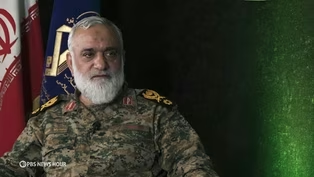
And in the midst of the Iran war, a rare and exclusive interview with a top adviser to the leader of Iran's Revolutionary Guard.
BRIG.
GEN.
MOHAMMAD REZA NAQDI (through translator): The longer this war lasts, the more experience we gain.
We had never seen a real war to gain real experience to learn how to fight with America.
(BREAK) GEOFF BENNETT: Welcome to the "News Hour."
We begin tonight with new details about the extraordinary secret security measures taken to protect President Trump.
The "News Hour" has confirmed reporting by The Washington Post that Mr.
Trump switched planes not once, but twice while leaving last month's NATO summit in Turkey.
The second transfer to a smaller aircraft by way of a catering truck had not been known until now.
Nick Schifrin has more.
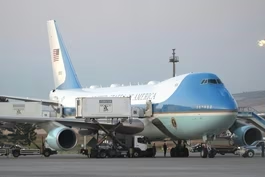
NICK SCHIFRIN: As he finished his trip to the Ankara NATO summit last month, President Trump swept aside a question about why he wasn't flying home on the plane on which he'd arrived, a Qatari-gifted 747.
QUESTION: Why aren't you flying on the new Air Force One?
DONALD TRUMP, President of the United States: It's flying to Europe to one of the big bases, two or three of the big bases, where we can show it to the people.
And we will be going home by normal methods.
NICK SCHIFRIN: His journey home only appeared normal.
At 8:24 p.m.
local that evening, President Trump boarded the legacy Air Force One.
He turned around, gave a wave to the cameras, broadcasting his departure live, and disappeared behind the closed door, which is when the camera zooms out, but doesn't focus on that catering truck.
It was parked on the other side of the plane near another catering truck at the level of the doors to let food in or sneak the president out.
And six minutes later, at 8:30 p.m.
local, the truck that usually caters to the president now secretly carrying him.
It backs up away from Air Force One toward another U.S.
government plane parked behind, unbeknownst to the press corps.
The other plane, an Air Force C-32A usually reserved for the secretary of defense or other senior officials, but not the president.
At 8:44 p.m.
local, the legacy plane takes off without the president, who was in fact still on the ground in the smaller plane, as the camera focuses on the plane that had become a decoy, flying to the United Kingdom's Mildenhall Royal Air Force Base.
When the legacy Air Force One landed there, it took the president 40 minutes to disembark, apparently the time it took him to land in the smaller plane and secretly move onto the legacy plane and walk down the steps as if nothing had happened.
He then walked to the new Qatari-gifted plane, where on board he told journalists there was nothing unusual going on.
QUESTION: So, you're saying there wasn't a security concern?
DONALD TRUMP: No, no.
QUESTION: Were you aware of any credible threat by Iran against Air Force One?
DONALD TRUMP: Well, I have a threat all the time.
I'm number one on their list before you.
But if I go, you go, right?
NICK SCHIFRIN: But we now know, in the four hours it took for the legacy Air Force One to fly from Turkey to the United Kingdom, the president was not on the plane.
Instead, it was full of staff and journalists, despite a threat from Iran deemed credible enough to convince the Secret Service, Geoff, to use the plane as a decoy.
GEOFF BENNETT: And, Nick, tell us more about this threat from Iran.
NICK SCHIFRIN: This threat existed well before this year and this war.
Iran has threatened to assassinate President Trump and other former senior officials ever since President Trump ordered the killing of Qasem Soleimani, the former powerful head of the Quds Force.
You see his assassination there in Baghdad in 2000.
He was responsible for militias and terrorism as part of the Islamic Revolutionary Guard Corps.
The threat was deemed credible enough against President Trump and these former senior officials that they received additional security details, not only in 2000, but through the Biden administration, in fact, until President Trump removed some of those details.
And Iran has followed through on other threats in the decades prior.
Now, as for the last -- the threat last month in Turkey, we don't know the specifics, but I talked to former officials today who said, for the Secret Service to take this step, it would have been serious, reliable, and well-sourced, part of a stream of ongoing intelligence or some kind of recent walk-in.
Take a listen to Mike Matranga.
He's a former Secret Service agent, now the head of M6 Global Defense.
MICHAEL MATRANGA, Former U.S.
Secret Service Agent: Obviously, there was credible intelligence that a threat was imminent, which is what caused the United States Secret Service and other entities, to include the United States military, to make this decision to pull off this ruse.
This is specifically coming from the administration of Iran saying, we want to assassinate the president of the United States, and so we have got to take this very serious.
And all of these measures that the men and women of the United States Secret Service and DOD are taking are absolutely appropriate.
NICK SCHIFRIN: As Matranga puts it, this has been a powder keg for decades for the Secret Service, given Iran's threats.
GEOFF BENNETT: Now, how unusual is it for the Secret Service to turn Air Force One and its passengers, to include White House staff, the traveling press, into a decoy?
NICK SCHIFRIN: As far as we know, the decoy fact of that question, it has only happened once before.
In 2000, President Bill Clinton landed in Islamabad, you see there, in an unmarked plane after Air Force One had landed and a body double who looked like Clinton got off of Air Force One.
Geoff, though, if you go beyond decoys, to include feints or secret trips like George W. Bush's to Iraq, see the Secret Service has taken steps like that before.
As for questions today of the vulnerability of those people who did fly on Air Force One without President Trump, Matranga said the bottom line is, the Secret Service had to make a trade-off.
MIKE MATRANGA: I don't think that anybody intentionally put the anchors or anyone else, the White House press corps, in harm's way, but that was a risk that had to be weighed.
And at the end of the day, we have to look at continuity of American government.
And, quite frankly, I don't know how to say this but just to say it, is that the president of the United States is more important than every single person on that plane.
NICK SCHIFRIN: More important than every other person.
Again, Geoff, all credit to The Washington Post, who broke this story.
GEOFF BENNETT: Indeed.
While I will have you, let's switch topics, because Russia released Marine veteran Robert Gilman today.
We reported on his story last night on this broadcast.
Bring us up to speed.
NICK SCHIFRIN: Russia released Gilman on humanitarian grounds.
The 32-year-old is a former Marine who went to Russia to teach English.
He was first arrested in 2022 for allegedly hitting a Russian police officer and was sentenced to 4.5 years, but his sentence was extended to a decade.
His family and advocates, including those you spoke to last night, said his health was badly deteriorating.
He was nonresponsive, unable to interact or eat, essentially catatonic.
Senator Ed Markey of Massachusetts even accused Russia of torturing him.
But, today, he was released after 1,666 days of detention.
You see him there on the left with his mother right next to him on an American plane.
Gilman's on his way now to a U.S.
military hospital in Texas, where he will be assessed and treated.
Global Reach says that he cannot talk -- cannot walk, rather, but was speaking,.
And the president actually, who spoke to him today, said he even asked for a cheeseburger on the phone.
The Trump administration says that there was no prisoner swap, nor -- quote -- "any other concessions" given to Russia.
But I did talk to U.S.
officials today about one other aspect.
They said that shortly before his release, he was declared wrongfully detained.
That is something, of course, that you heard from last night the family and advocates were complaining that that hadn't happened.
They had not made that public, for fear that it would imperil this release.
But U.S.
officials say, yes, he has been declared wrongfully detained, and that will open more treatment for him now that he's home and free.
GEOFF BENNETT: Certainly good to see him released.
Nick Schifrin, thanks so much for this reporting.
NICK SCHIFRIN: Thank you.
GEOFF BENNETT: In Colombia tonight, the desperate search for survivors is entering a critical phase after the powerful earthquake that devastated parts of that country.
More than 180 people have died, but, 24 hours after the quake struck, there are still remarkable moments of hope.
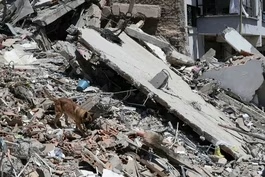
In Colombia today, neighbors and rescue workers gathered shoulder to shoulder, clearing away mountains of rubble in the search for survivors.
In Santiago de Cali, where dozens of homes and buildings have collapsed, at least 86 people have been pulled from the wreckage, among them this 6-month-old baby and the child's mother.
Rescuers say they heard the mother's cries beneath the rubble and then dug through the debris of their five-story apartment building to reach them.
More than 3,000 people remain missing after the 7.4-magnitude earthquake.
In Pereira, roughly 50 miles from the quake's epicenter, Jairo Vargas joined the search.
The architect says he traveled hours to reach his brother's apartment, convinced he's trapped inside.
JAIRO VARGAS, Searching For Brother (through translator): I'm absolutely certain he's here, absolutely certain.
His horse saddle and all his belongings are here.
He's not answering his phone.
The doorman didn't report him leaving, and his car is parked right there.
And he's not out.
He's got to be there trapped.
GEOFF BENNETT: Pereira is among the hardest-hit areas, where entire residential blocks have collapsed into piles of concrete and twisted steel.
But rescuers say there is still a critical window to find people alive.
JOSE FERNANDO USMA, Red Cross Rescuer (through translator): We still have a big window, about 24 more hours, of which there is hope of finding survivors.
Our biggest advantage is that there may be isolated air pockets or survivable spaces that can allow people to stay alive for a longer period of time.
GEOFF BENNETT: Colombia is mobilizing resources for a massive rescue and recovery effort.
Soldiers who just a day earlier were forced to stop training and brace themselves as the ground shook are now being deployed to help with rescue and cleanup operations.
But reaching the hardest-hit areas itself is a challenge.
Colombia's aviation authorities have closed six airports because of structural damage, potentially complicating the delivery of aid for weeks.
EDWARD DE BURGH, Senior Global Security Officer, Project HOPE: It was a very, very strong earthquake, much more than people had ever experienced before, and we live in an earthquake zone.
GEOFF BENNETT: Edward de Burgh is the senior officer of global security for Project HOPE, a humanitarian organization responding to disasters around the world.
He's based in Bogota.
And he says the quake has damaged the very infrastructure communities will rely on in the weeks and months ahead.
EDWARD DE BURGH: When a disaster of this magnitude happens, when it comes to things like primary health care, hospitals, clinics, which are housed in buildings, are affected like any other building.
Whether they're affected in a dramatic way or even just a way that makes safety an issue for entering them, they tend to close down, and then infrastructure or primary health infrastructure becomes challenged.
GEOFF BENNETT: Back in Santiago de Cali, another search unfolded in agonizing fits and starts.
At even the faintest hint of sound beneath the rubble, rescuers stopped everything and listened.
Overnight, that persistence paid off.
Nearly 24 hours after the quake first shook the country, firefighters found a 35-year-old man trapped under the rubble.
The city's mayor said the man suffered only minor injuries, one rescue offering hope to thousands of families still waiting for word.
Also in the day's headlines: Ousted Syrian President Bashar al-Assad has been sentenced to death in absentia for war crimes during the country's brutal civil war that left roughly half-a-million people dead.
The capital sentences read aloud on state TV were the first against Assad and his inner circle since a rebel uprising toppled his government nearly two years ago.
Assad and his younger brother, who was also sentenced to death, fled to Russia in 2024, where they were granted political asylum.
In Yemen, authorities say at least six people were killed when Iran-backed Houthi rebels fired ballistic missiles on a vessel in the Bab al-Mandab Strait.
The Houthis also claimed to have fired on a Saudi ship in the same waterway.
The strikes followed days of Houthi attacks on land and on ports that have killed dozens of Yemeni government forces and civilians.
They threaten to reignite a civil war that's been under a four-year tentative truce.
Meantime, U.S.
forces fired upon and disabled a Panamanian-flagged ship in the Gulf of Oman today.
U.S.
Central Command said the vessel tried to pass through the American blockade of Iranian ports.
Over 100 firefighters from Mexico have arrived in Canada to help battle a deadly blaze in British Colombia that's forced over 20,000 people to flee their homes.
Eyewitness video shows hillsides in Western Canada completely engulfed in flames.
The Bald Range Fire has consumed over 60 square miles.
At least one person has died.
Local authorities say firefighting crews have faced challenging steep terrain and windy conditions, and a criminal investigation has been opened into the cause of the fire.
Meantime, wildfire smoke is once again reducing air quality across much of the Western U.S.
The Democratic Republic of the Congo says the Ebola outbreak there has now killed more than 2,000 people.
More than 4,000 cases of the disease have been confirmed in the DRC.
And it's taken just three weeks for the death toll to double, making it the fastest growing outbreak on record.
Efforts to detect and contain the disease have been hampered by armed conflict, poor infrastructure, and distrust of health authorities.
There is no current treatment or vaccine for this strain of Ebola, but clinical trials have started in Eastern Congo to try and develop one.
On Wall Street today, stocks slipped even further from their recent all-time highs.
The Dow Jones industrial average lost 184 points.
The Nasdaq fell by more than half-a-percent.
The S&P 500 posted another modest drop.
And sky-gazers in many countries, including this one, are about to get a double dose of celestial events.
Both a solar eclipse and the Perseid meteor shower will be visible across the sky tomorrow.
From the Arctic Circle to Southern Europe, countries like Greenland, Russia, and Spain will see a total solar eclipse when the sun, moon, and Earth align perfectly in the sky; 26 states here in the U.S.
and Washington, D.C., will be treated to a partial eclipse seen from Alaska to North Carolina.
As for the Perseids, they will be best viewed after midnight across much of Northern -- the Northern Hemisphere.
NASA says as many as 50 to 100 meteors could be seen each hour under ideal conditions.
Well, still to come on the "News Hour": we speak with a top adviser to Iran's Revolutionary Guard Corps, as the war with the U.S.
continues; a look at the National Guard's controversial deployment to Washington, D.C., one year in; and credit card delinquencies rise in the U.S., as higher interest rates make it harder to pay off debt.
As the war with Iran continues its uneasy stalemate, we hear now from a top adviser to the overall commander of Iran's Islamic Revolutionary Guard Corps, the force largely responsible for border and internal security.
The U.S.
and many other nations have designated it a terrorist organization.
The IRGC, as it's known, rarely give interviews and almost never to Western media.
But Commander Mohammad Reza Naqdi sat down this morning in Tehran for an exclusive interview with special correspondent Reza Sayah.
REZA SAYAH: Commander Naqdi, thank you very much for sitting down with us.
It has been a long-running policy of Iran's Revolutionary Guard to never speak to American media.
What changed?
Why did you agree to sit with us?
BRIG.
GEN.
MOHAMMAD REZA NAQDI, Supreme Adviser to IRGC Commander in Chief (through translator): In the name of God, the most gracious, the most merciful, we never received a request to reject it.
We would like for our voice to reach the ears of people in Western countries.
It's Western media that don't like our voice to be heard.
There's nothing we do that's indefensible and outside the values of humanity that we would want to cover up or not discuss.
REZA SAYAH: Let's talk about this war.
Where do you see Iran in this juncture of the war?
Do you see yourself as winning?
Are you in control?
BRIG.
GEN.
MOHAMMAD REZA NAQDI (through translator): Certainly, victory is on our side, after the defeat of America's two main objectives, the toppling of the leadership and the breaking up of Iran.
We saw confusion and bewilderment in America.
It became a war without a strategy.
Every two or three days, they announced a new objective.
For several nights, they said they want to invade Kharg Island.
They said they want to open the Strait of Hormuz.
They mobilized their battleships.
Everything they tried, we can show how we were victorious.
REZA SAYAH: In your view, is it inevitable that Iran has won?
BRIG.
GEN.
MOHAMMAD REZA NAQDI (through translator): No, we have not yet reached our final objective.
This is clear.
Up until now, we are victorious.
In the future, we will continue to be victorious.
The longer this war lasts, the more experience we gain.
We had never seen a real war to gain real experience to learn how to fight with America.
In these five months, we have learned how.
We have also seen how the American military is weaker than what we perceived.
REZA SAYAH: Is it Iran's objective to drag out this war, to maybe wait until Mr.
Trump is out of office?
BRIG.
GEN.
MOHAMMAD REZA NAQDI (through translator): Look, we have to attain deterrence so that the enemy never dares to attack us, so we can live with security.
One way is to prolong this war until we get to the next term of the presidency and cause attrition, so that if anyone else wants to attack Iran, they will know there is a cost.
REZA SAYAH: This week, on at least two occasions, maybe more, Iranian forces attacked non=military ships that were trying to cross through the Strait of Hormuz.
What is Iran's objective in attacking civilian ships?
BRIG.
GEN.
MOHAMMAD REZA NAQDI (through translator): When we are at war, vessels need to pass through a region we can control.
When they leave an area that we control, it could be that they're transporting supplies for the enemy.
REZA SAYAH: Do you not see that as a violation of international law, attacking civilian ships?
BRIG.
GEN.
MOHAMMAD REZA NAQDI (through translator): When you're in a state of war, any thoroughfare deemed to be a threat, we can control it.
This is international law.
Anywhere in the world where there is war, this law exists.
REZA SAYAH: One of your most effective weapons in this war has been your missiles and your drones.
Reports said before the war you had about 3,000 to 4,000 missiles.
How many missiles do you have in your stockpile right now?
BRIG.
GEN.
MOHAMMAD REZA NAQDI (through translator): First of all, we are not reliant on missiles and drones.
If we are victorious, we relied on our faith to be victorious.
God is with us.
As for our missiles, the Americans and the Zionists always want to count our missiles.
First of all, the number of missiles we manufacture every day is more than the number we launch.
In a country this vast, we can make them wherever we want.
REZA SAYAH: Where are you making them?
Is it deep underground?
BRIG.
GEN.
MOHAMMAD REZA NAQDI (through translator): We do it in different ways.
We have various ways to manufacture them securely.
Rest assured, even if this war lasts for years, until the last day, Iran's rockets will be launched.
I will make this point, and this is more important than missiles.
If there comes a day when Iran has no more missiles left, that's when we will be even more dangerous for America.
REZA SAYAH: How would you be more dangerous?
BRIG.
GEN.
MOHAMMAD REZA NAQDI (through translator): Because America has thousands of economic interests throughout the world, and all of them can be easily destroyed.
REZA SAYAH: Military officers often put themselves in the place of their rivals and the enemy to maybe predict what they're going to do.
Put yourself in Pete Hegseth's place.
What is he thinking?
What is your prediction as to what he might do?
BRIG.
GEN.
MOHAMMAD REZA NAQDI (through translator): I will never put myself in his place.
He is a criminal who killed 168 innocent children.
Not only do these people not work for the benefit of humanity.
They don't even work for America.
They work for their own interests.
As soon as the stock market closes, they start hostilities.
When the stock market opens, they send positive messages to raise stock prices.
All the while, they are buying and selling the stocks themselves.
If I was in the place of the American Congress, I would call for an investigative committee to compare the assets of Mr.
Trump, his family, and his inner circle before the war to their assets after the war.
REZA SAYAH: Many observers say Iran has put up a strong fight, but that America has one weapon that Iran doesn't, and that's a nuclear bomb.
In your view, how likely is it for America to use a nuclear bomb?
BRIG.
GEN.
MOHAMMAD REZA NAQDI (through translator): Naturally, it can end up being a mistake for them.
The morning after they use a bomb, all of America's military bases around the world will be occupied.
Today, things are different than World War II.
The people of the world have awakened.
No one in the world will allow for such a crime to be committed, because the next time it could be themselves.
REZA SAYAH: Washington has long claimed that Iran is a threat to Israel.
Israel says Iran wants to build a bomb to destroy Israel.
Does Iran want to destroy Israel?
BRIG.
GEN.
MOHAMMAD REZA NAQDI (through translator): Iran has only one thing to say about occupied Palestine.
And this is something our martyred leader has also said.
The leadership there must be chosen based on a majority vote by the people who are connected to that land.
This will certainly not be done with a nuclear bomb.
But we certainly prefer if the Zionist regime did not exist.
Just like the previous South African regime, an apartheid and white supremacist regime that was discarded by the people, the same thing must happen in Palestine.
REZA SAYAH: Iranians are often seen shouting the slogan "Death to America."
And many American politicians point to that slogan and say Iran wants to destroy America.
BRIG.
GEN.
MOHAMMAD REZA NAQDI (through translator): Look, we have no enmity with the people of America.
REZA SAYAH: So what does that slogan mean?
BRIG.
GEN.
MOHAMMAD REZA NAQDI (through translator): The meaning of "Death to America" means death to America's leadership, a leadership that has invaded or violated more than 70 countries since becoming a superpower.
REZA SAYAH: Increasingly, many observers inside Iran and outside say that, if Iran had a nuclear weapon, America would not attack it, that it would be a deterrent.
Is the Revolutionary Guard, is Iran even discussing the possibility of pursuing a nuclear bomb?
BRIG.
GEN.
MOHAMMAD REZA NAQDI (through translator): I will say this clearly.
Our nuclear bomb is the hearts of the people of the world that we won fighting oppression.
Islamic values and the divine values of the Islamic Revolution are taking over the world.
There is no need for nuclear bombs.
There is no need for slaughter.
REZA SAYAH: After the death of the late supreme leader, his son Mojtaba Khamenei was appointed supreme leader.
But during this war, he has never been seen in public.
Can you tell us why?
BRIG.
GEN.
MOHAMMAD REZA NAQDI (through translator): The strategy belongs to him.
Our enemy is criminal and doesn't abide by any law.
REZA SAYAH: So is it because of security reasons?
BRIG.
GEN.
MOHAMMAD REZA NAQDI (through translator): Naturally, it is due to security.
Certainly, there is no other reason.
REZA SAYAH: Have you seen him?
BRIG.
GEN.
MOHAMMAD REZA NAQDI (through translator): Let's leave this matter alone.
REZA SAYAH: Commander Naqdi, thank you very much for your time.
BRIG.
GEN.
MOHAMMAD REZA NAQDI (through translator): You're welcome.
I too thank you.
GEOFF BENNETT: We asked the White House about the specific comments Naqdi made in that interview.
They responded with a statement that reads in part, "It would be wise for Iran to agree to a deal," adding, "Otherwise they know what will happen."
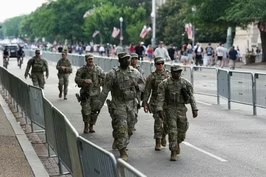
It has now been one year since President Trump declared a crime emergency in the nation's capital and deployed thousands of members of the National Guard to its streets.
As Lisa Desjardins reports, questions continue to mount over the mission's cost, its legality, and its effectiveness in fighting crime.
LISA DESJARDINS: From Metro stations to monuments, these days, soldiers in D.C.
are almost as common as sightseers.
Nearly 5,000 troops from more than 15 states currently patrol the capital, a controversial symbol of the president's authority in this overwhelmingly Democratic city.
DONALD TRUMP, President of the United States: I'm announcing a historic action to rescue our nation's capital from crime, bloodshed, bedlam, and squalor.
LISA DESJARDINS: When President Trump announced the deployment last August, combined with a surge of immigration enforcement, it immediately sparked protests and drew criticism from experts, who said the data showed violent crime in D.C.
was already at a 30-year low.
THOMAS ABT, Senior Fellow, Council on Criminal Justice: D.C., it's no secret, has had above-average levels of crime for many, many years.
But crime at the time of the announcement was falling quite rapidly.
So there really was no urgent situation that needed to be addressed.
LISA DESJARDINS: Total crime in Washington has continued to drop over the last year, down another 20 percent, according to the D.C.
Police Department.
The White House credits the Guard and the Make D.C.
Safe and Beautiful Task Force, which it says includes 20 federal and local law enforcement agencies and has made 16,000 arrests in the past year.
But there is debate over the root causes of the decline, particularly if the Guard impacts violent crime at all.
Yesterday, on TRUTH Social, the president threatened to sue the author of a study from the liberal Center for American Progress, calling the research a radical left scam.
In July, Secretary of Defense Pete Hegseth said critics of the operation were blinded by ideology.
PETE HEGSETH, U.S.
Defense Secretary: There's nothing political about this exercise.
Law and order is something all Americans deserve, black, white, rich, poor, man or woman from D.C.
or far-flung places in this country.
RODNEY MILLER, 50-Year D.C.
Resident: It's really unnecessary.
It's a kind of a horse-and-pony show.
LISA DESJARDINS: Polls have shown a majority of D.C.
residents oppose the deployment, and the Congressional Budget Office estimates the total cost of taxpayers so far has been at least $660 million.
In November, West Virginia National Guard specialist Sarah Beckstrom was killed and another Guardsman injured in an ambush-style attack not far from the White House.
An Afghan national is charged.
The president has also tried deploying troops to other Democratic cities in his second term, like Los Angeles, Chicago, and Portland.
Courts ultimately blocked those efforts, but Joseph Nunn at the Brennan Center says they are concerning and unprecedented.
JOSEPH NUNN, Brennan Center for Justice: No prior president has attempted to use the military for domestic law enforcement in such a wide variety of ways and on the scale that the Trump -- second Trump administration has attempted to use the military.
LISA DESJARDINS: Meanwhile, in D.C., where Trump has direct control of the National Guard, the Pentagon confirmed last month troops will remain on patrol through the end of the president's second term.
The Department of Defense estimated the cost over the next 2.5 years would be at least $1.4 billion.
For more on what the data say about the impact of the National Guard on crime in the nation's capital, we're joined now by Richard Hahn.
He is a senior manager for research in the Criminal Justice Department the Niskanen Center, a nonpartisan think tank based in Washington, D.C.
Richard, thank you for joining us.
This is not a simple discussion.
We will be getting into some of the complexities here, but I want to start with something clear.
Major crime is down in the nation's capital.
Let's look at some statistics.
This is just year over year from the D.C.
Police Department, homicides down 32 percent, robberies down 15 percent, car theft down 53 percent.
Again, that's today year to year since the National Guard arrived.
In your research, what kinds of crime do you think the National Guard actually affected or impacted?
RICHARD HAHN, Senior Manager for Research and Evidence, Niskanen Center: Well, the National Guard seems to have impacted mostly low-level opportunistic property crimes, things like petty thefts, people breaking into cars.
These are really vexing problems for residents in D.C.
As a D.C.
resident, I know that this is something that bothers me and plagues many of my neighbors.
However, it doesn't seem like the National Guard had much of an effect on violent crime, which was, of course, the banner issue that they were brought in to combat.
LISA DESJARDINS: That has been going down though.
So why do you think it's not due to the National Guard presence?
RICHARD HAHN: So the decline in all crimes in D.C.
has been going on for the last three years, really since we saw those peaks in 2023.
All types of crime had have been going down.
So what we did was try to distinguish between the effect the National Guard had and what was already going on in D.C.
And what we found is, the National Guard had a great impact on low-level property crimes.
They declined by about a quarter since the Guard deployed.
However, there was very little change in violent and other serious crimes after the Guard deployed.
And that's looking at the difference between what was already happening, what sort of the trend looked like before, and after the National Guard got here.
So, yes, year over year, all crime types are down, and that's a great thing.
That's a wonderful story for D.C.
But it doesn't seem like the Guard actually contributed much to that.
LISA DESJARDINS: And you're saying that they didn't have an effect over and above the trend that was already happening.
Now, the White House, and I reached out to them today, they argue that federal officers and part of the kind of program that they put in place in Washington, D.C., one thing that they did was take weapons off the streets.
Is it possible that that kind of effect could have impacted violence in the nation's capital?
RICHARD HAHN: I absolutely think it has impacted violence in the nation's capital.
I think the thing is that you got to look at you got to zoom back out and you have to look at what's been happening for the last three years.
And gun arrests have been going up for the past three years.
Arrests involving guns by Metropolitan Police have been going up for the past three years, and gun crimes have been going down for the past three years.
So this is really part of a larger trend that's been driven by our local police department that's not really been much affected by the National Guard's presence.
LISA DESJARDINS: I know that's one of your main points here is, you stress after looking at all this that something that may be overlooked here is the job the D.C.
Police Department has been doing.
And you also found and calculated that they have a smaller force now, but yet crime has been going down.
How?
RICHARD HAHN: That's correct.
So our theory behind this really great trend in D.C.
is that police have actually been better at being more proactive.
A greater share of their arrests over the past three years have come from stopping crimes that are actually occurring when they arrive, as opposed to waiting in their cruiser or on the corner for a call to come through dispatch for them to respond to.
So they're catching more crimes happening in the act.
And that's not something that the National Guard would really be good at.
The National Guard tend to be untrained as professional police officers.
Their duties entail a whole lot of other things besides policing, things like traffic safety, greening and cleaning.
And as it turns out, they have no arrest power.
They can simply detain someone.
So a National Guard troop should really not be judged by the same standards as of a police officer.
You get much more crime prevention out of a police officer than you do out of a National Guard soldier.
LISA DESJARDINS: And you sound like, in the police conversation, you're seeing less reactive policing, more proactive policing, make a difference in Washington.
RICHARD HAHN: That's correct.
LISA DESJARDINS: To finish this conversation about the National Guard, they did have a positive effect, as you say, on things like carjacking that are important to so many people, but it will cost.
Did you look at sort of the efficiencies here and how that worked?
RICHARD HAHN: Yes, we did.
The National Guard is very costly.
So, per person, the National Guard costs a little bit over $600 a day, and that's because not only do we have to pay their salaries, but we also have to feed them, clothe them, transport them.
And outside of that $600 figure, there's also a hidden cost to the economy in terms of people leaving their civilian jobs to do their tour with the Guard and also leaving their families, and that can't be captured in the figures that Congress released that on which we based the... LISA DESJARDINS: That's expensive.
RICHARD HAHN: It's a very expensive intervention, whereas a police officer in D.C., which is a relatively expensive place to police, is still under about $400 a day.
So that's a considerable difference in cost, and you get much more crime prevention out of a police officer than you do out of a soldier.
LISA DESJARDINS: Richard Hahn, thank you so much for looking at this, not a simple topic, but you're helping us understand it better.
RICHARD HAHN: My pleasure.
Thanks again.
GEOFF BENNETT: Americans owe more than a trillion dollars in credit card debt, up 60 percent from just five years ago.
Meantime, higher interest rates make debt even more difficult to pay off.
It's a downward spiral, causing credit card delinquencies to surge.
Our economics correspondent, Paul Solman, explains.
PAUL SOLMAN: For 35-year-old Helena Emenalo, it started innocently enough.
HELENA EMENALO, Owes Debt: My mother had to move in with us.
At the time, it was my husband and I. We had a little baby, and then we had another baby on the way.
The amount of people in our house almost tripled in a very short time span, and expenses tripled as well.
PAUL SOLMAN: To meet them, like so many other Americans these days, she turned to credit cards.
HELENA EMENALO: It's very easy to swipe, and this is an emergency, and everything can be an emergency right now.
PAUL SOLMAN: Before she knew it: HELENA EMENALO: I accumulated about $20,000 in debt.
PAUL SOLMAN: Compared to one estimate of average household debt nationwide, about $10,000.
But it's the most indebted, like Emenalo, who've driven credit card delinquencies to their highest rate in 15 years, bankruptcies up 12 percent in the last year alone.
HELENA EMENALO: Once you start adding all of that up, well, you realize you don't have enough money for day care, or you don't have enough money to pay your electorate bill.
And then all of a sudden, things just get unmanageable very, very quickly.
PAUL SOLMAN: People talk about a debt spiral.
That sound familiar?
HELENA EMENALO: It does.
Yes, it does.
I kind of found myself in, like, an endless cycle of just trying to pay something, even though it wasn't making a dent in the overall amount that I owed.
PAUL SOLMAN: And it's not just millennials and older generation members like Emenalo now caught up in the debt interest whirlpool.
BETH KOBLINER, Personal Finance Guru: It's a huge problem, and it's a specifically huge problem for young people.
PAUL SOLMAN: Personal finance guru Beth Kobliner first published "Get a Financial Life" for young people, now it is fifth edition, 30 years ago.
The early life debt dilemma since?
Worse than ever.
BETH KOBLINER: We have seen the rate of credit card debt for young people go up about 190 percent since 2020.
PAUL SOLMAN: And student debt now near $2 trillion.
BRIDGET CLINGER, Owes Debt: Last I checked, it was approximately $17,000.
PAUL SOLMAN: Twenty-five-year-old Bridget Clinger.
BRIDGET CLINGER: A lot of what I earn immediately goes to trying to pay off all this debt every month.
MAN: Gen Z has more debt than any other generation in history before it.
WOMAN: Let's talk about how much credit card debt I have, and spoiler alert, it is a lot.
MAN: Hey, is there any other 18-year-olds with like $6,000 in credit card debt?
PAUL SOLMAN: And there's a new debt trap for the young, says Kobliner.
BETH KOBLINER: Buy now, pay later is one more example of what we're calling frictionless finance, which may sound great, but it's actually quite pernicious in general, getting further and further away from knowing how much you're spending.
And, sometimes, we don't even realize when we're spending.
In the last decade, we literally have changed the way we have made purchases.
We no longer take out our wallet and use cash and count out the dollar bills.
Nobody does that anymore.
PAUL SOLMAN: Not Helena Emenalo.
HELENA EMENALO: I was doing a lot of buy now, pay later.
And when it came time to pay, I was like, oof, I don't have it.
PAUL SOLMAN: And when that happens: BETH KOBLINER: They say they won't charge you interest, but the problem is, if you're late, you're going to be hit with a big fee.
PAUL SOLMAN: Bottom line, as Kobliner has stressed for decades, if you borrow young, you dig yourself a hole.
MARJORIE SANPIETRO, Owes Debt: With my student debt, my husband's student data, our car loans, credit cards, it's probably like the amount of a mortgage, like, an amount of a current mortgage like $125,000, $150,000.
PAUL SOLMAN: So, folks like Marjorie Sanpietro use credit cards, their interest rates hitched to credit scores.
MARJORIE SANPIETRO: Where average credit card rate is about 30 percent, and that seems frustrating to me.
It's kind of predatory.
PAUL SOLMAN: Thirty percent, which implies a pretty low credit score, and says Emenalo: HELENA EMENALO: If you don't have a good credit score, like you can't buy a house, you can't buy a car.
PAUL SOLMAN: Loan defaults, bankruptcies, and yet another grim economic statistics setting records these days, low consumer sentiment.
Now, President Trump economic adviser Kevin Hassett dismisses its significance.
KEVIN HASSETT, Director, National Economic Council: I actually think that we should stop calling it consumer sentiment and start calling it political sentiment, because the variables really are -- it's really a political variable, not an economic variable.
PAUL SOLMAN: And, yes, says Joanne Hsu, who runs the consumer sentiment survey, the results have been a reflection of which party is in power, but recently: JOANNE HSU, University of Michigan: Republicans actually have been showing declining sentiment this year as well.
And the current reading from may shows both Republicans and independents at their lowest level since the beginning of 2025.
People across the political spectrum, they have been feeling less optimistic about the economy over the course of this year.
PAUL SOLMAN: And, come on, says economist Mark Zandi, the reason is obvious for so many Americans.
MARK ZANDI, Chief Economist, Moody's Analytics: If you look at real disposable income, that's after inflation, after taxes, it's lower today than it was a year ago.
And that's for the -- that's economy-wide, right?
So that means that it stands a reason about half the population is experiencing outright decline.
And so if you have been doing spending in a certain way for a long time and your income starts to erode, what do you -- how do you respond to that?
PAUL SOLMAN: Which brings us back to the subject of this story, consumer debt.
MARK ZANDI: Many people turn to leverage and credit, and the credit card being the best example of that, to help tide things over, but then you get nailed with higher interest rates.
Now you're paying 20 percent interest on whatever you borrowed, and that that's, like, very, very difficult to get out of.
PAUL SOLMAN: And deeper and deeper you may sink.
One final point.
In an increasingly K-shaped economy, who's doing the lending?
MARK ZANDI: The folks in the top part of the distribution, the well-to-do, they own lots of things.
They have the big deposits at banks.
They owned bonds and stocks.
And those deposits and those savings go to providing the credit that folks in the bottom part of the income distribution and the middle part of the distribution are using to finance their spending on autos and on a home and other things.
PAUL SOLMAN: There's an old saw in economics, it's not how much you borrow, but what you do with the money.
If you can afford to invest the money, great.
But if you can't, and have to borrow to survive, you may find yourself, like so many of our fellow Americans, sucked under.
For the "PBS News Hour," Paul Solman.
GEOFF BENNETT: And we will be back shortly with a look at new digital driver's licenses.
But, first, take a moment to hear from your local PBS station.
It's a chance to offer your support, which helps to keep programs like the "News Hour" on the air.
For those of you staying with us, we get an encore of sorts now from a musician who is bringing the organ to a new generation of listeners.
Senior arts correspondent Jeffrey Brown went to speak with her in Portland, Maine, as part of our arts and culture series, Canvas.
JEFFREY BROWN: A lone musician at the console of an instrument capable of enormous and enormously varying sounds, hands and feet flying across the keyboards.
ANNA LAPWOOD, Organist: Oh, my gosh, thank you so much for coming.
I am so excited about this.
JEFFREY BROWN: It's become a most unexpected phenomenon, playing out before packed audiences.
ANNA LAPWOOD: Hello.
I'm here at the Sydney Opera House.
JEFFREY BROWN: And gaining large followings on social media.
ANNA LAPWOOD: I will give this baby Trader Joe's bag and it's the perfect size for my organ shoes.
JEFFREY BROWN: And for the traditional pipe organ, something big is happening, and Anna Lapwood is helping lead the way.
ANNA LAPWOOD: It's a novelty that people haven't been given the opportunity to understand, because it's been impossible to get them close enough.
But now, with social media, we can bring a million people close enough just through a phone.
They come to the concerts.
They come and they want to hear what you're talking about and they want to understand.
And they have questions.
JEFFREY BROWN: They want to see it live and real.
ANNA LAPWOOD: And they want to feel it.
They want to feel the room shaking.
JEFFREY BROWN: We got a glimpse of the Lapwood effect recently in Portland, Maine, as she prepared for the final performance of a U.S.
tour playing the Kotzschmar Organ built for the city in 1912.
There's a lot going on here, right?
ANNA LAPWOOD: There's quite a lot going on, particularly an organ of this size, actually, because we have five keyboards, five manuals.
You have got the full pedal board.
You have all of the different stops -- these are called stops -- that control the sounds.
JEFFREY BROWN: Yes.
Ahead of the performance, she spent more than 18 hours registering the organ.
ANNA LAPWOOD: For every moment of the concert, you have to choose the sounds you want.
You have to basically audition the different sounds, for this program, about 350 different settings, all of which have to be programmed individually.
JEFFREY BROWN: Yes.
And this is a completely new organ for you, right?
ANNA LAPWOOD: It is.
JEFFREY BROWN: So, you are getting to know this instrument?
ANNA LAPWOOD: Every organ is totally different.
It's a bit like sort of speed dating.
You have to try and get to know the personality of the organ as quickly as possible and then figure out what that organ wants you to say with the music.
JEFFREY BROWN: Lapwood's classical music credentials, Bach and all, are impeccable.
Now the official organist at London's Royal Albert Hall, she was the first female organ scholar at Magdalen College in Oxford, later director of music at Pembroke College, Cambridge.
She tried many instruments in childhood.
Somehow, it was the organ, which she sometimes refers to as a machine, that offered a new kind of connection to audiences and more.
ANNA LAPWOOD: It is a way to connect with them, but I think, for me, it's been a way to connect with myself and figure out who I want to be on stage.
JEFFREY BROWN: What does that mean?
ANNA LAPWOOD: I feel the most free, natural version of myself.
I feel so much more free than I do in normal life, to be perfectly honest.
It is the freest version of myself on stage, because it's the music, which is just like a glove in my mind.
It is just me.
JEFFREY BROWN: The popularity she's gained has also led her into some unexpected places, performing with contemporary artists from other musical genres, including a collaboration with the electronic musician Bonobo.
MAN: Toccata and Fugue in D minor.
ANNA LAPWOOD: They heard me practicing at came on stage.
They were like: "This is so cool.
Wouldn't it be cool if we included the organ in our set tomorrow?"
So I ended up joining the show with no notice.
And it was so far outside my comfort zone.
I had no idea what I was getting myself in for.
JEFFREY BROWN: Yes.
ANNA LAPWOOD: And then there were these soaring strings, and I just started crying.
The wool had just been pulled from over my eyes, and I went, oh, my gosh, the musical world is about 70 million times larger than I'd ever imagined it could be.
No one knew I was going to be doing it, and the crowd just erupted.
JEFFREY BROWN: Clearly behind all this, Lapwood's personal effervescence, love of her instrument... ANNA LAPWOOD: "Lord of the Rings."
This is the biggest project I have ever done.
JEFFREY BROWN: ... and desire to communicate directly with her audience, including regular posts of behind-the-scenes of her life and work and middle-of-the-night rehearsals, often the only time she can access these special and unique instruments.
It's paying off with more than four million followers across platforms.
Is that a phenomenon that still surprises you?
ANNA LAPWOOD: All the time.
JEFFREY BROWN: All the time?
ANNA LAPWOOD: I still -- it's so strange.
I always say there's like Anna Lapwood and there's Anna, right?
JEFFREY BROWN: Who's here with me?
ANNA LAPWOOD: Somewhere in the middle, I think, probably a little mix.
JEFFREY BROWN: Yes.
ANNA LAPWOOD: I try to bring as much as I can over, and I think there's something that people like about that, because it feels like it gives them permission to be the most authentic version of themselves as well.
JEFFREY BROWN: The Portland concert had ticket holders come from 43 states and four foreign countries.
ANNA LAPWOOD: Hello.
WOMAN: Hi.
Can I give you a hug?
ANNA LAPWOOD: And she greeted many of them for more than two hours after the concert ended.
MAN: She just exudes this enthusiasm.
WOMAN: Hi.
ANNA LAPWOOD: Hi.
How are you?
WOMAN: I'm fine.
And you?
MAN: Her energy, it's just magnetic.
ANNA LAPWOOD: Well, come this way.
Come this way.
Come this way, yes, yes.
WOMAN: The way she lights up, she's so entertaining to watch.
JEFFREY BROWN: Lapwood's growing audiences online and in halls around the world are more than happy with what and how she's playing.
JEFFREY BROWN: For the "PBS News Hour," I'm Jeffrey Brown in Portland, Maine.
GEOFF BENNETT: Your old plastic driver's license could soon be getting a digital upgrade.
Digital reporter Tim McPhillips walks us through three things you should know, including some of the benefits and some of the concerns.
TIM MCPHILLIPS: One, what's a mobile driver's license?
IAN GROSSMAN, President and CEO: It's essentially what it sounds like, which is taking your driver's license and making it a digital credential that you can carry on your smartphone, your watch, your tablet.
TIM MCPHILLIPS: That's Ian Grossman, president and CEO of the American Association of Motor Vehicle Administrators.
They're a trade organization that provides DMVs with best practice guidance, as well as software and tech infrastructure.
Twenty states and Puerto Rico offer a form of a digital driver's license.
Some allow you to add it directly to your mobile wallet, like your credit card.
Others have a state-created mobile app that stores your I.D.
Two, what are the benefits?
Well, the idea is, when you need to show your I.D., you could essentially tap your phone on a reader, like at an airport or a doctor's office, or while getting a speeding ticket.
IAN GROSSMAN: You would never hand over your phone.
TIM MCPHILLIPS: And that could help to limit the information you share.
Take, for example, a liquor store.
IAN GROSSMAN: They don't need to know your name.
They don't need to know your address.
TIM MCPHILLIPS: And if, like me, you have lost your wallet and/or left it in a TSA bin, it's more difficult for someone to get into your phone than it is to just pick up your plastic I.D.
IAN GROSSMAN: What you have time to do is get to any browser anywhere, log into your online DMV account and say, I have lost that device, pull that credential off of that phone.
TIM MCPHILLIPS: But there are concerns around this new technology to prove who we are.
And that brings us to three, government data collection.
Here's American Civil Liberties Union senior policy analyst Jay Stanley.
JAY STANLEY, Senior Policy Analyst, American Civil Liberties Union: One problem is that the standard for digital I.D.
that a lot of the states, although not all of them, are adopting would actually let the government track you.
TIM MCPHILLIPS: So what does that mean?
Well, when you tap your mobile I.D.
on a reader, information about you is sent from point A to point B. That simple transaction involves major decisions.
Like, does verification happen locally on your phone or on a server?
And could a third entity like a state or federal government access data on where you used your I.D.?
Stanley and the ACLU have rallied against that last scenario called phone home or server retrieval over potential abuses.
For AAMVA's part, Grossman says states that might allow server retrieval would be blocked from using AAMVA's digital I.D.
systems.
IAN GROSSMAN: We have prohibited the ability to what we would say call back to the agency.
TIM MCPHILLIPS: All this is pressuring states not to build systems that phone home.
But because it is possible to do with the technology and laws in place today, the responsibility falls on our elected officials not to flip the switch.
But: JAY STANLEY: We have seen a couple states that have put in place some very good protections in their laws.
TIM MCPHILLIPS: In March, Utah put in place the nation's first digital identity bill of rights that bans phone home architecture.
Stanley agrees that states need to be proactive in codifying a phone home ban into law.
JAY STANLEY: The states are sleepwalking into building a version that's not privacy-protective, and we're going to get stuck with that as a standard for potentially generations.
TIM MCPHILLIPS: As of now, some state governments on both sides of the aisle have allowed mobile driver's licenses, but others have rejected them, like Texas and Minnesota.
But Grossman says widespread adoption is coming.
IAN GROSSMAN: But nobody is forcing anybody to do it.
TIM MCPHILLIPS: And Stanley argues that too should be codified in law.
JAY STANLEY: You should have a right to continue to use your plastic license.
TIM MCPHILLIPS: His fear?
JAY STANLEY: But it has a real potential that we're going to wake up one day, we're all going to be forced to get these things.
They're going to become like a virtual ankle bracelet.
TIM MCPHILLIPS: For PBS News, I'm Tim McPhillips.
GEOFF BENNETT: And you can find more on this online, including live election results from state primaries later this evening.
And that is the "News Hour" for tonight.
I'm Geoff Bennett.
For all of us here at the "PBS News Hour," thanks for spending part of your evening with us.
 New
NewCredit card debt rises as high rates make it hard to pay off
Video has Closed Captions
Credit card debt surges in U.S. as high interest rates make it harder to pay off (7m 9s)
 New
NewThe effectiveness of the National Guard deployment in D.C.
Video has Closed Captions
The effectiveness and cost of the National Guard deployment in D.C. (8m 50s)
 New
NewHow Trump secretly switched planes amid threat from Iran
Video has Closed Captions
How a catering truck helped Trump secretly switch planes amid threat from Iran (7m 46s)
 New
NewNews Wrap: Syria sentences al-Assad to death in absentia
Video has Closed Captions
News Wrap: Syria sentences Bashar al-Assad to death in absentia (3m 46s)
 New
NewSearch for quake survivors in Colombia enters critical phase
Video has Closed Captions
Search for earthquake survivors in Colombia enters critical phase (3m 47s)
 New
NewTop adviser to IRGC leader sits down for rare interview
Video has Closed Captions
Top adviser to Iran's Revolutionary Guard leader sits down for rare interview (9m 32s)
 New
NewWhat to know as your driver's license gets a digital upgrade
Video has Closed Captions
What to know as your driver's license gets a digital upgrade (3m 54s)
Providing Support for PBS.org
Learn Moreabout PBS online sponsorship New Episode
- News and Public Affairs

Today's top journalists discuss Washington's current political events and public affairs.

- News and Public Affairs

FRONTLINE is investigative journalism that questions, explains and changes our world.

 New Episode
 New Episode
 New Episode
 New Episode
 New Episode
 New Episode
 New Episode
 New Episode
Support for PBS provided by:
Major corporate funding for the PBS News Hour is provided by BDO, BNSF, Consumer Cellular, American Cruise Lines, and Raymond James. Funding for the PBS NewsHour Weekend is provided by...